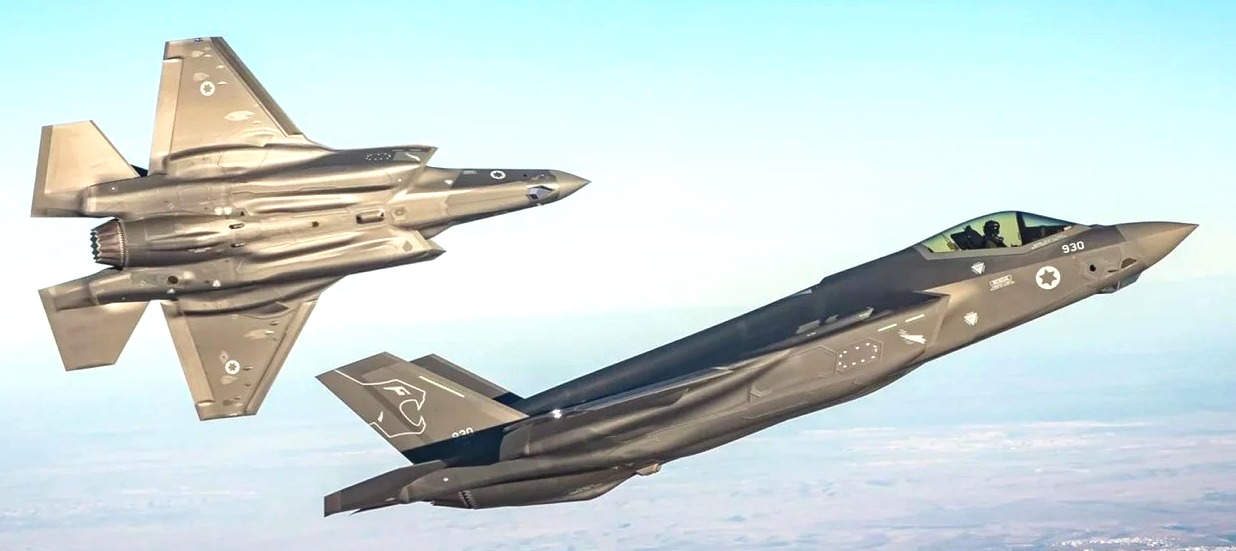
Israel Develops New External Fuel Tank Solution To Extend F-35I Adir Combat Reach In Contested Airspace.

Tel Aviv; May 2026: Israel is moving to extend the combat reach of its F-35I “Adir” stealth fighters through a new contract with Elbit Systems’ Cyclone subsidiary, a move that could reduce dependence on vulnerable aerial refuelling aircraft during deep-strike operations. The more than $34 million program is strategically significant because it aims to give Israel greater freedom to launch long-range precision missions while preserving the survivability and operational flexibility of its fifth-generation strike fleet.
The external fuel tanks are intended to increase the Adir’s combat radius without severely compromising the aircraft’s low-observable profile, allowing Israeli planners to build less predictable strike routes and sustain operations farther from home bases. The effort reflects a broader shift in modern air warfare toward extending stealth aircraft endurance and autonomy in contested environments where tanker aircraft, fixed bases, and support assets are increasingly exposed to advanced air defences and long-range missile threats.
The Israeli Ministry of Defence announced on May 14, 2026, a contract with Elbit Systems’ Cyclone subsidiary to develop and integrate external fuel tanks for the F-35I “Adir” fighter aircraft. The deal, valued at more than $34 million, or over NIS 100 million, is designed to extend operational range, reduce reliance on aerial refuelling, and increase mission flexibility during long-range operations. The announcement is significant because it addresses one of the most sensitive limits of fifth-generation aviation: how to project stealth airpower across extended distances without placing tanker aircraft, support assets, and predictable refuelling tracks under excessive risk.
The F-35I “Adir” is Israel’s national variant of the Lockheed Martin F-35A Lightning II, adapted to Israeli operational requirements and integrated into the Israeli Air Force as a low-observable multirole aircraft for penetration, precision strike, electronic warfare, intelligence collection, and networked targeting. Israel became the first country to select the F-35 through the US Foreign Military Sales process in 2010. The first Israeli F-35A Adir was rolled out at Lockheed Martin’s Fort Worth facility on June 22, 2016, while the first aircraft arrived in Israel in December 2016 before the fleet was declared operationally capable in December 2017. Since then, the Adir has become a central component of Israel’s long-range airpower architecture, combining reduced radar cross-section, fused sensors, secure data links, and precision weapons employment in a platform configured for missions where legacy fighters would face higher exposure.
The technical challenge is not simply adding fuel volume. External tanks on a fifth-generation fighter create a complex balance between range, radar cross-section, aerodynamic drag, infrared signature, centre-of-gravity limits, and stores certification. Conventional drop tanks used on F-16s or F-15s are primarily transit accessories, but an F-35I tank must be assessed against low-observable shaping, pylon-tank interface reflections, surface finish, electromagnetic behaviour, fuel-transfer sequencing, and flight-control software limits. Even a design derived from a Cyclone solution originally developed for the F-16 requires a new validation cycle for the Adir because the F-35’s aerodynamic configuration, digital flight-control laws, internal mission systems, and signature-management requirements are in a different category.
The operational gain should be understood in terms of combat radius rather than ferry range. Ferry range describes how far an aircraft can travel under a non-combat transit profile, while combat radius includes climb, ingress, routing, sensor operation, manouvering, weapons release, egress, reserve fuel, and potential diversion to another air base. Extra external fuel can allow F-35I formations to fly less direct routes, avoid known air-defence engagement zones, preserve fuel-state margins for high-altitude or low-level segments, and delay tanker contact until the aircraft are outside the most closely monitored threat areas. This gives Israeli mission planners more freedom to design hi-lo-hi, mixed-altitude, stand-in reconnaissance, suppression of enemy air defences, and precision-strike profiles across longer distances.
The most immediate military value is the reduction of tanker dependency during deep-strike operations. Aerial refuelling aircraft are essential force multipliers, but they are large, non-stealthy, high-value assets that require protected orbit areas, escort planning, emissions discipline, and carefully timed rendezvous points. Any long-range operation becomes more complex when fighter packages must connect repeatedly with tankers before or after target-area penetration. By increasing Adir fuel autonomy, Israel can reduce the number of refuelling brackets, lower the operational signature of a strike package, and free tankers for follow-on waves, combat air patrols, recovery operations, or simultaneous missions in other sectors.
From an engineering perspective, the integration process will likely require aerodynamic and structural qualification work around drag index, flutter margins, aeroelastic loads, pylon stress, buffet behaviour, fuel-transfer sequencing, emergency jettison behaviour, takeoff performance, acceleration, climb rate, and sustained turn performance. External tanks also change the aircraft’s centre-of-gravity envelope as fuel is consumed, which means the system must be compatible with the F-35I’s flight-control computers and mission-management architecture. For a low-observable aircraft, the fuel tank’s geometry and materials are as important as its capacity, since shaping, edge alignment, coatings, and attachment points can influence radar returns during ingress and egress. The official announcement does not disclose whether the tanks will be conformal, semi-conformal, jettisonable, or optimised for reduced radar signature.
However, the operational requirement clearly points to a balance between additional fuel capacity, aerodynamic performance, and the F-35I’s low-observable mission profile. This Israeli effort also fits a wider trend in fifth-generation airpower. A US F-22 Raptor had been observed with stealth-shaped external fuel tanks and sensor pods, a configuration intended to extend range and support passive sensing in contested airspace. The comparison is useful because both developments show that stealth aircraft are being adapted for longer missions without relying entirely on forward bases or tankers. The difference lies in operational purpose. The F-22 configuration is mainly tied to air-superiority persistence, long-range counter-air patrols, and passive detection, while the Israeli F-35I program is more directly linked to strike autonomy, regional deterrence, and the ability to reach distant target sets with fewer support-aircraft vulnerabilities.
Israel was associated with range-extending fuel tanks for the F-35I Adir, presented as a way to expand long-range strike reach while preserving low-observable characteristics.
The new Israeli Ministry of Defence contract gives this topic a more formal acquisition framework by identifying Cyclone, the Elbit Systems subsidiary, as the industrial actor responsible for development and integration. The official announcement does not disclose tank capacity, configuration, drag penalty, radar-signature data, or whether the tanks will be carried throughout the mission or discarded before entering a dense integrated air-defence environment. Even without those specifications, the operational logic is clear: more fuel gives the Adir a wider mission-planning envelope and reduces the pressure created by tanker availability, tanker vulnerability, and predictable refuelling corridors.
The external fuel tank program strengthens Israel’s ability to conduct long-range air operations beyond its immediate borders. In a regional environment shaped by Iranian missile forces, hardened infrastructure, layered air defences, drone and cruise missile threats, and proxy networks, Israel requires aircraft able to penetrate, sense, strike, and return with fewer external dependencies. The F-35I’s value is not limited to weapon delivery; it can act as a forward sensor, electronic-support platform, targeting node, and command-and-control relay inside a wider strike package. Longer endurance increases loiter time, supports more flexible ingress and egress routing, and gives commanders more options if air-defence activity, weather, or target movement forces real-time changes during a mission.
The external fuel tank deal gives the F-35I Adir a sharper role in Israel’s future air campaign planning. By extending mission radius, reducing tanker exposure, and increasing route flexibility, the upgrade can allow Israeli planners to build deeper, less predictable, and more autonomous strike packages. Its final operational value will depend on how well Elbit Systems and Cyclone balance fuel capacity, aerodynamic performance, low-observable shaping, flight certification, and mission-system integration. The direction is already visible: Israel wants its stealth fighter fleet to fly farther, operate with fewer support vulnerabilities, and preserve freedom of action during the opening phases of a high-intensity regional conflict.
Team Maverick.







Shivakumar Says Congress United, Assures Women Will Get Cabinet Berth
Bengaluru, Aug 2026 : Karnataka Chief Minister D.K. Shivakumar on Monday sought to dismiss…

Shivakumar Says Congress United, Assures Women Will Get Cabinet Berth
Bengaluru, Aug 2026 : Karnataka Chief Minister D.K. Shivakumar on Monday sought to dismiss …