
Forward-Looking Survey on Private Corporate Sector CAPEX Investment Intentions

(Survey period: October–December 2025)
Snapshot:
- NSO CAPEX Survey Indicates Strong Private Sector Investment Momentum
- ₹11.44 Lakh Crore CAPEX Estimated for 2025–26: NSO Survey
- High Realization of Investment Intentions Reflects Corporate Sector Resilience
- Forward-Looking CAPEX Estimates Signal Continued Investment Activity in 2026–27
- Internal Accruals Emerge as Primary Source of Corporate CAPEX Financing
- Private Corporate Sector Focuses on Core Asset Creation and Capacity Expansion
Key findings:
- The estimated CAPEX per enterprise for the last financial year (2024-25) was ₹180.2 crore and the actual CAPEX is estimated at ₹173.5 crore respectively, resulting in an overall realisation ratio of 96.3%. This high realisation ratio shows that that actual expenditure was broadly in line with the investment intentions of enterprises.
- The estimated aggregated provisional CAPEX for 2025-26 is ₹11,43,879 crore.
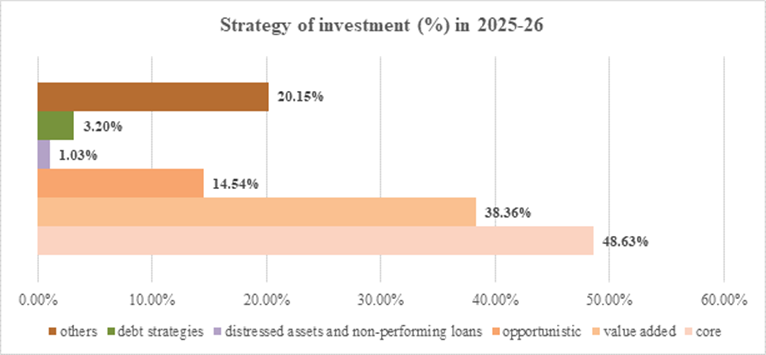
- The investment strategy of 48.63% of enterprises is focused on undertaking CAPEX on core assets during 2025–26, followed by 38.36% planning to invest in value addition to existing assets.
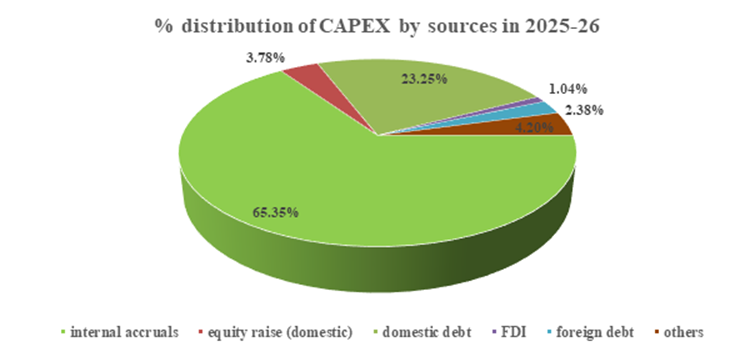
- Around 65.35% CAPEX in 2025-26 are sourced from internal accruals of the companies whereas 23.25% from domestic debt.
- The estimated aggregated CAPEX investment intention for 2026-27 is ₹9,55,281 crore. In spite of the generally conservative nature of reporting future investment intentions, the high reported values point to the likelihood of robust corporate CAPEX in 2026–27.
Survey Background:
National Statistics Office (NSO) conducted the first Forward-Looking Survey on Private Corporate Sector CAPEX Investment Intentions during November 2024 to January 2025 to collect information on the capital expenditure plans of enterprises in the private corporate sector. In continuation of this initiative, the present round of the CAPEX survey was conducted during October–December, 2025. A brief overview of key aspects, such as survey coverage, sampling methodology, and data collection process, is included in the endnote.
Key advantages of the Survey:
Comprehensive information on CAPEX is valuable for a wide range of stakeholders, including government agencies, private sector enterprises, industry bodies, researchers, and other relevant organizations. Such information helps in understanding emerging investment trends and supports evidence-based policymaking. At the same time, insights on CAPEX patterns and their magnitude can assist enterprises in making informed and strategic investment decisions based on the findings of the survey.
Key highlights from the CAPEX results:
Estimated Key Indicators for last years (2024-25), current (2025-26) and next (2026-27) financial year by Industry of Activity as per National Industry of Classification (Activity Categories) Last Financial Year (2024-25)1
The actual CAPEX incurred during 2024-25 was ₹173.5 crore per enterprise against an intended CAPEX of ₹180.2 crore (as reported in the CAPEX-2024 survey), resulting in an overall realisation ratio (RR) of 96.3%. This indicates that the actual expenditure was broadly in line with the investment intentions at the aggregate level for the panel of enterprises.
Current Financial Year (2025-26) and Next Financial Year (2026-27)
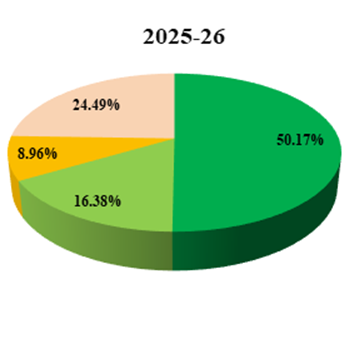
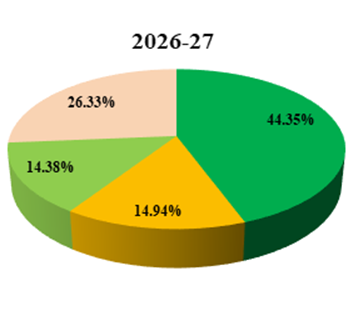
The provisional aggregated capital expenditure on acquisition of new assets in 2025–26 is estimated at ₹11,43,879 crore. For the next financial year, based on the responses received, the aggregated CAPEX intentions for 2026–27 are estimated at ₹9,55,281 crore. It may be noted that out of the 5,366 operational enterprises that responded to the survey, 4,203 (about 78.3%) reported their CAPEX investment plans for the next financial year (2026–27). Enterprises generally tend to adopt a conservative approach in reporting such estimates for a future year.
| Percentage distribution of provisional aggregate capital expenditure to buy new asset by main activity | |
 |  |
 | |
Strategy & Objective of CAPEX in 2025-26
As per the survey estimates, the strategy of investment for about 48.63% of enterprises during 2025–26 was focused on core assets, while 38.36% planned investments for value addition to existing assets. Around 14.54% undertook investments in opportunistic assets, less than 4% followed debt-related strategies, and about 1.0% pursued strategies involving distressed assets or non-performing loans. In addition, 20.15% of enterprises did not report any specific investment strategy from the listed options.
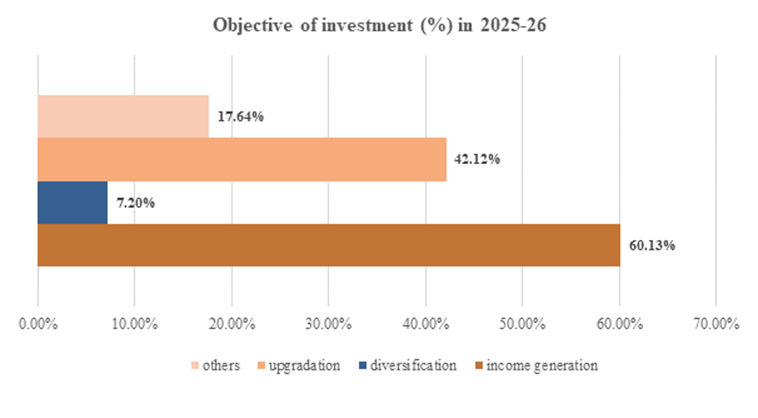
The survey estimates indicate that during 2025–26, about 60.13% of enterprises in the private corporate sector undertook capital expenditure primarily with the objective of income generation, while 42.12% reported CAPEX for upgradation of existing capacity. Around 7.2% of enterprises incurred CAPEX with the objective of diversification, and about 17.64% reported other reasons not specifically captured in the survey
 |
 |
Source of CAPEX in 2025-26
The survey results indicate that internal accruals constitute the primary source of CAPEX financing in the private corporate sector during 2025–26, accounting for 65.35% of the total investment. Domestic debt is the second-largest source, contributing 23.25%, followed by equity raised within the country at 3.78%. External sources play a relatively smaller role, with 1.04% of CAPEX financed through the FDI route and 2.38% through foreign debt.
 |
Percentage of enterprises investing in Green Energy & Robotics in 2025-26
| Type of energy | 2025-26 |
| Green energy (solar, wind, biomass) | 6.62% |
| Robotic equipment in manufacturing sector | 5.83% |
| Robotic equipment in all sectors | 2.83% |
Aggregated (Unweighted, i.e. without applying any multiplier) CAPEX during (2024-25 to 2026-27)
A total of 3,819 enterprises provided complete information for all three years of the reference period (2024-25, 2025-26 & 2026-27), thereby constituting a fixed panel. The aggregated (unweighted) CAPEX data from this panel offers a consistent basis for analysing capital expenditure trends over the three-year period. Despite the typically conservative nature of forward-looking estimates, the results indicate a moderate increase in aggregate CAPEX (unweighted) over this period for the panel of enterprises. It may be noted that enterprises generally adopt a cautious approach while reporting data on future investment intentions. Nevertheless, a modest growth rate of 1.9% was observed over the three-year period.
(in ₹ crore)
| Actual CAPEX 2024-25 | Intended CAPEX in 2025-26 | Intended CAPEX in 2026-27 |
| 6,00,123.1 | 6,11,160.7 | 6,11,411.7 |
The results of CAPEX survey are provided in the booklet which is available in the website of the Ministry (https://www.mospi.gov.in). To protect the confidentiality of CAPEX investment plans of individual enterprises, the Steering Committee of NSS Surveys recommended that unit-level data of CAPEX survey would not be disseminated.
Endnote: A brief about the coverage, sampling scheme, sample size and data collection mechanism in the Forward-Looking Survey on Private Corporate Sector CAPEX Investment Intentions
A. Coverage:
The survey covered large private corporate sector enterprises that play a significant role in their respective sectors. The sampling frame was made using data from active enterprises registered with the Ministry of Corporate Affairs (MCA), filtered based on annual turnover thresholds achieved in at least one of the last three financial years. The eligibility criteria were as follows:
- Manufacturing enterprises with an annual turnover of ₹400 crore or more
- Trade enterprises with an annual turnover of ₹300 crore or more
- Other enterprises with an annual turnover of ₹100 crore or more
Based on these criteria, the final survey frame consisted of 14,257 enterprises.
B. Sampling Scheme:
The sampling design for the second round of the Forward-looking Survey on Private Corporate Sector CAPEX Investment Intentions follows a stratified approach to ensure representation of enterprises across different industries. The sampling frame is stratified into 17 industry groups based on the Principal Business Activity reported in statutory filings. Strata with 100 or fewer enterprises are included entirely in the census sector. In addition, a fixed panel of 3,064 enterprises that responded in the previous CAPEX-2024 survey has been retained for complete enumeration to enable consistent analysis of CAPEX trends over time.
For the remaining strata with more than 100 enterprises, the census sector is identified using asset-based criteria derived from enterprise financial data, including Maximum Asset (highest asset value reported during the last three years) and Latest Asset Value. Enterprises accounting for 90% of these asset measures within each stratum (80% for Trade and Construction) are included in the census sector. The remaining enterprises form the sample sector, from which 20% are selected using Simple Random Sampling Without Replacement (SRSWOR), with allocation across strata based on their size and variability to ensure adequate representation.
C. Sample Size:
The sample size for the survey was of 7,486 enterprises: 5,795 enterprises in the Census Sector and 1,691 enterprises in sample sector.
D. Data Collection Mechanism:
The survey was conducted under the provisions of the Collection of Statistics Act, 2008 and The Jan Vishwas (Amendment of Provisions) Act, 2023, with prior notices sent to all selected enterprises outlining the survey’s objective and intended use of the data. Confidentiality of individual responses was strictly maintained, and no unit-level data would be disseminated. A secure, dedicated web portal was developed to enable selected enterprises to complete and submit the survey questionnaire online.
E. Important Caveat:
The results presented in this report pertain only to relatively large enterprises meeting the specified turnover thresholds used for constructing the survey frame and therefore should not be interpreted as representing the entire private corporate sector.
It may also be noted that certain enterprises, such as Special Purpose Vehicles (SPVs) engaged in infrastructure or construction projects, may undertake substantial capital investments but may not report significant turnover in the reference period, and therefore may fall outside the survey scope depending on the investment criteria used for constructing the frame. Conversely, some SPVs included in the frame may not report future investment intentions once their projects are completed.
In addition, certain changes have been introduced in the sampling design in the present round; including the inclusion of a fixed panel of enterprises surveyed in the previous round and an enhanced representation of the sample sector through a higher sampling fraction (20%) and improved response rate (73.7%). This aspect should be kept in mind while interpreting the findings.
F. Digital Tools for Self-Compilation and Reporting
In the CAPEX survey, enterprises submit their responses through a dedicated and secure web portal. This year, a bilingual instruction manual and a video guide covering portal navigation and providing a basic description of the different sections of the questionnaire have been added to the portal’s homepage to facilitate self-reporting by enterprises.
Booklet available in MoSPI website: https://www.mospi.gov.in/ Scan QR code to access MoSPI Publications/ Reports








More Than a Café: How MITTI Café is Brewing Hope, Dignity and Dreams at Rashtrapati Nilayam
Hyderabad, July 2026 : Tucked away inside the serene campus of Rashtrapati Nilayam in Boll…

More Than a Café: How MITTI Café is Brewing Hope, Dignity and Dreams at Rashtrapati Nilayam
Hyderabad, July 2026 : Tucked away inside the serene campus of Rashtrapati Nilayam in …