Donald Trump Swaying Away From Commenting On The Cause Of Repeated Aggression On Iran.

Washington DC; April 2026: When the US President spoke with reporters in the Oval Office on Monday afternoon (local time), he talked about several elements of the war on Iran, including claiming that regime change had not been one of the US’s original goals when it started the air strikes on February 28th. But President Trump have said several times that there has been regime change, and the people who are now running the country are people with whom the US can engage, even though the Iranians insist there are no negotiations under way to end the war.
Trump also said that, in the US’s view, Iran’s ability to try to build a nuclear weapons programme has been set back 15 to 20 years, although he did not present any concrete evidence to that point.
But what he did not talk about, was what would happen to Iran’s uranium stockpile of more than 600 kilograms (1,300 pounds) of processed enriched uranium. The material is reportedly buried in deep underground tunnels near Isfahan and other sites damaged in 2025, such as Fordow and Natanz. Who would take control of it? Would it be removed from Iranian territory, and what else is needed to secure that stockpile? Does that mean US ground troops are going in? That’s another point that Trump did not touch on.
Most importantly, Donald Trump’s Truth Social Post reveals that an ultraconservative learned Mark Levin has publicly called upon Trump to seize Iran’s stockpiles of enriched uranium by force. “We’ve got to get the uranium”, he said. “If it cannot be destroyed, if it cannot be altered, we gotta get it”.
According to the International Atomic Energy Agency (IAEA), Iran held roughly 440 kilograms of uranium enriched to 60% before the June 2025 US-Israeli strikes on Iran’s nuclear facilities. Tehran maintains that its nuclear programme is restricted to civilian use only.
“That’s a serious amount,” said Ludovica Castelli, a specialist in Middle Eastern nuclear policy at the Istituto Affari Internazionali think-tank. “If taken to weapons-grade it is 90%, which is enough for 10 nuclear weapons. What we don’t know is what happened to all of it”.
Despite President Trump’s claims last year that Iranian nuclear enrichment facilities had been “completely and totally obliterated”, it is unlikely that the United States managed to destroy the Islamic Republic’s already-enriched uranium.
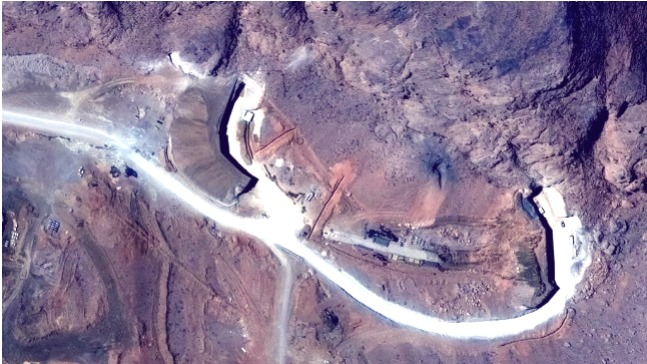
A satellite photo analysed by Maverick News 30 suggests that at least part of Iran’s highly enriched uranium stockpiles had been moved into underground tunnels near Isfahan in June last year, out of reach of the air strikes that came thundering down just days later.
To put it another way, that leaves enough to be “quite worrying for the international community, particularly the United States and Israel”, said Shahin Modarres, a specialist in Iran at the International Team for the Study of Security (ITSS) Verona.
Christian Emery, a specialist in international relations and Iran’s nuclear programme at University College London, said that the remaining uranium was no doubt a tempting target for an administration eager to create a concrete goal for a war that has so far failed to bring down the Iranian government.
“The reason Trump’s strategy has unravelled is that he clearly did not plan for the possibility that Iran would refuse to capitulate and accept terms he could dictate”, Emery said, while further adding, “Politically, therefore, the idea of a short ground operation to seize most, if not all, of Iran’s highly enriched uranium is extremely attractive to him. It would allow him to declare victory without having to reach any agreement with Iran”.
Clive Jones, the director of Durham University’s Institute for Middle Eastern and Islamic Studies, also suggested that such an operation could give Trump a quick way out of the war he started.
Such an operation would be a steep escalation in a war that has already spread across the Middle East, especially for a president who promised his base that he would not lead the country into new wars, let alone send American troops to fight and die overseas.
Christian Emery further stated, “At a minimum, it would be one of the most risky and difficult operations the US military has undertaken since the Second World War”. First, the US would have to be sure exactly where Iran has stashed its stockpiles.
While Clive Jones have pointed out: “It is likely the Iranians would have dispersed their enriched uranium, so locating it will be difficult. If that turns out to be the case, retrieving it would involve multiple ground offensives fighting their way through enemy territory on several fronts”.
Such a complex operation would almost certainly need to be coordinated with Israeli troops, Shahin Modarres said. Salisbury confirmed that Israel has units expressly trained to conduct special operations on Iranian soil.
Modarres further explained that such an operation would need several phases – first, an aerial bombardment to degrade Iran’s defences, followed by sending in special forces to take out enemy troops and secure the area.
These would be followed by military engineers tasked with locating the stockpiles, setting up a perimeter and bringing in the trucks, and diggers and cargo planes needed for the extraction. Finally, Emery said, these would give way to “experts trained in handling highly volatile nuclear material, who might also require tunnelling equipment or machinery such as excavators to clear debris”.
Experts say such an operation would take several days at least, and could drag on over several weeks. Salisbury said that on a scale of 01 to 10, the mission was as dangerous as you could get. “An absolute 10”, she said. “The operation is risky in itself, but the need to be handling uranium hexafluoride makes it hugely dangerous”.
Jones said that an operation of this scale would “likely incur large casualties on both sides”. And even if the mission was successful, the loss of 440 kilograms of enriched uranium would not stop Iran from potentially developing nuclear weapons in the future.
“Iran would still retain centrifuges, technical expertise and possibly other uranium stocks, including material enriched to 20% and below 05%, likely stored at multiple locations”, Ludovica Castelli said. “Iran’s programme is not just about one stockpile – it’s about accumulated knowledge, infrastructure and remaining materials. As long as those persist, the risk of a future militarisation of the programme remains”.
Suvro Sanyal – Team Maverick.





From a Charity Photo to the World Cup Final: Messi and Yamal Set for Extraordinary Reunion
New York, July 2026 : Football has produced countless remarkable stories over the years, b…

From a Charity Photo to the World Cup Final: Messi and Yamal Set for Extraordinary Reunion
New York, July 2026 : Football has produced countless remarkable stories over the years, …