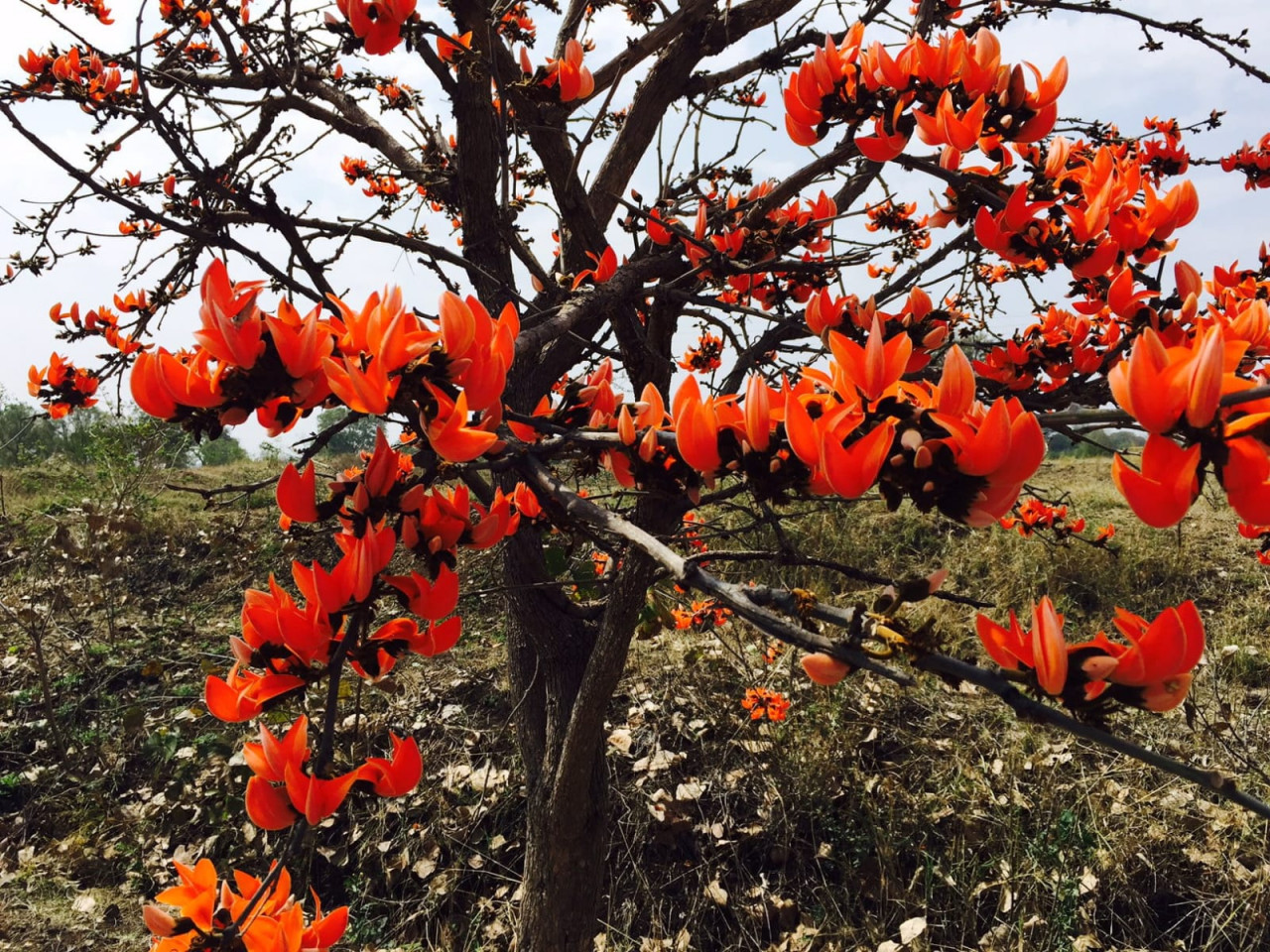
Palash Flower: Enhancing Livelihoods and Prosperity

Raipur, April 2026 : Palash (Tesu or Dhak) Flower
The Palash (Tesu or Dhak) flower is not only a symbol of natural beauty but also a valuable resource for rural economy, livelihoods, and health. Its bright orange-red blossoms are often called the “forest fire,” as they light up rural landscapes during the spring season and bring a sense of prosperity. Palash flowers, seeds, and gum (Kamarkas) are used in Ayurveda for treating skin diseases, intestinal worms, diabetes, and for improving sexual health. Rural communities also earn income by collecting and selling these medicinal products.
A Medicinal and Cultural Flower
The Palash flower (Butea monosperma), also known as Tesu, Dhak, or “Flame of the Forest,” is an important medicinal and cultural flower of India. Blooming in spring, its striking orange flowers not only enhance natural beauty but are also used in traditional medicine, natural Holi colors, and skincare products. In the Katghora forest division of Chhattisgarh, Palash trees are found in large numbers. Areas such as Pasa, Kendai, Jatga, Etamanagar, Katghora, Chautma, and Pali have abundant availability of this tree.
For tribal and forest-dependent families in these regions, minor forest produce collection is a key source of livelihood. Palash flowers are mainly collected during March and April. The Chhattisgarh State Minor Forest Produce Federation, Raipur, fixed the procurement rate at ₹11.50 per kilogram in 2025, ensuring fair value for collectors’ efforts.
Rising Collection in Katghora Forest Division
Palash flower collection in the Katghora forest division has been steadily increasing:
- 2022–23: 402 quintals collected from 116 collectors
- 2023–24: 58 quintals from 40 collectors
- 2024–25: 147 quintals from 107 collectors
- 2025–26: 76 quintals from 20 collectors
Along with increased collection, prices have also risen. In 2022–23, the rate was ₹900 per quintal, which increased to ₹1,150 per quintal in 2024–25. Later, the federation sold it at ₹1,600 per quintal, providing better returns to collectors.
₹87,400 Paid to 20 Collectors
Through Van Dhan Vikas Kendras in Pasa, Morga, Donganala, Gursia, and Manikpur, collection activities have been organized systematically. These centers have provided training, collection support, and marketing assistance to local people.
In 2025–26, a total of ₹87,400 was paid to 20 Palash flower collectors, improving their economic condition and living standards. This initiative stands as a successful example of government schemes creating employment and income opportunities through minor forest produce.
A Major Source of Rural Employment
Palash flowers are considered highly auspicious and are associated with Goddess Lakshmi. They are used in religious rituals, and it is believed that keeping them in a safe or treasury brings wealth and prosperity. Leaves of the Palash tree are also used to make eco-friendly plates and bowls, which are widely used in weddings and social functions, generating rural employment.
In the upcoming season, efforts will be made to widely promote Palash flower collection across all committees in the Katghora forest division to involve more people. This will not only increase livelihood opportunities but also ensure sustainable use of forest resources.
Palash is not just a flower—it represents self-reliance, livelihood, and a new wave of prosperity.
Natural and Herbal Colors from Palash Flowers
One of the most significant commercial uses of Palash flowers is the production of natural and herbal Holi colors. Tribal and rural women are preparing eco-friendly colors through the “Palash brand,” thereby enhancing their livelihoods and promoting sustainable income generation.





Union Forest Minister Bhupender Yadav Visits Sariska Tiger Reserve; Prays at Venkatesh Balaji Temple for Prosperity of Nation and State
Jaipur, April 2026 : Union Forest Minister Bhupender Yadav visited the Sariska Tiger Reser…

Union Forest Minister Bhupender Yadav Visits Sariska Tiger Reserve; Prays at Venkatesh Balaji Temple for Prosperity of Nation and State
Jaipur, April 2026 : Union Forest Minister Bhupender Yadav visited the Sariska Tiger Reserve …