
India, Japan Launch Major Clean Energy and Investment Push with CBG Initiative, Green Ammonia Project and 129 Business Agreements

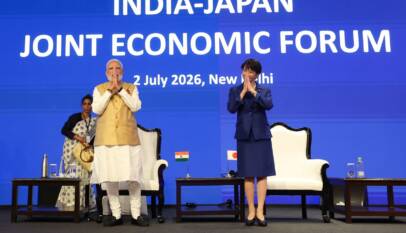
New Delhi, July 2026 : India and Japan took a significant step towards strengthening their strategic and economic partnership on Thursday as Japanese Prime Minister Sanae Takaichi announced a series of landmark initiatives aimed at boosting clean energy, rural development, industrial investment and regional cooperation. Addressing the India-Japan Joint Economic Forum during her three-day official visit to India, Takaichi unveiled the Japan-India Compressed Biogas (CBG) Initiative, a large-scale clean energy programme that seeks to transform agricultural waste into sustainable fuel through cooperative institutions.
The initiative, announced following bilateral talks with Prime Minister Narendra Modi, aims to harness India’s vast but underutilised rural biomass resources—including cattle dung, rice straw, sugarcane residue and other agricultural waste—to produce compressed biogas. The project reflects the shared commitment of both nations to promoting renewable energy, strengthening rural economies and deepening cooperation in sustainable development.
Takaichi said India possesses enormous biomass resources that remain largely untapped and described the initiative as an opportunity to convert agricultural waste into a valuable source of clean energy. She noted that Prime Minister Modi has long advocated using cooperative institutions to empower rural communities and convert local resources into economic opportunities.
Calling the project a continuation of that vision, the Japanese Prime Minister said both leaders had agreed to jointly launch the Japan-India CBG Initiative, under which cooperatives will play a central role in producing compressed biogas from cattle dung and other biomass resources across rural India.
Under the ambitious programme, India and Japan aim to establish 1,000 biogas plants across the country by 2030, significantly contributing to India’s clean energy targets while creating new income opportunities for farmers and rural communities. The initiative is also expected to reduce dependence on fossil fuels, improve waste management and support India’s transition towards a greener energy ecosystem.
Takaichi further announced that both governments had signed a Letter of Intent (LoI) to develop a large domestic market for vehicles powered by compressed biogas. The agreement envisages supporting nearly 2.5 million CNG-powered vehicles that will run on CBG produced under the initiative, creating a comprehensive value chain from biomass collection to fuel production and transportation.
She said the programme would simultaneously promote environmental sustainability, strengthen India’s energy security and generate rural employment by encouraging the productive use of agricultural residues that are often burned or discarded.
Beyond the clean energy partnership, Takaichi announced another major milestone in bilateral cooperation with the launch of a joint green ammonia production project having an annual capacity of approximately 400,000 tonnes. Developed by Japanese and Indian companies, the project is expected to become a new pillar of energy security cooperation between the two countries.
Describing green ammonia as an important clean fuel for the future, she said the project symbolises a new chapter in India-Japan collaboration on sustainable energy and decarbonisation.
The Japanese Prime Minister also highlighted the growing momentum in private-sector cooperation, announcing 129 agreements between Indian and Japanese companies involving investments exceeding 2 trillion Japanese yen. The agreements span multiple sectors, including energy, manufacturing, technology, infrastructure, startups and small and medium enterprises.
According to Takaichi, the India-Japan partnership has expanded far beyond traditional areas of cooperation and now includes a diverse network of businesses and innovators working together to develop advanced technologies and sustainable industrial solutions.
She emphasised that energy security remains one of the most important pillars of bilateral ties. Referring to discussions held during the recent G7 Summit, Takaichi said Japan has advocated strengthening global energy security through transparent energy trade, strategic petroleum reserves and closer cooperation between energy-producing and energy-consuming nations.
Under Japan’s Power Asia Initiative, she said both countries would expand cooperation into new areas, including enhanced petroleum stockpiling and regional energy resilience. These efforts are intended to reinforce energy security across the Indo-Pacific while ensuring stable and diversified energy supplies.
The Japanese Prime Minister also highlighted India’s growing role as a strategic gateway for Japanese companies expanding into emerging markets. She noted that an increasing number of Japanese businesses are using India as a base for operations in Africa, reflecting India’s rising importance in global supply chains and investment networks.
Under the vision of a Free and Open Indo-Pacific (FOIP), Japan and India plan to extend their successful development model to countries across Africa, Asia and Latin America, strengthening partnerships throughout the Global South. Takaichi said the two nations would continue working together to promote sustainable growth, infrastructure development and economic prosperity in developing regions.
Prime Minister Narendra Modi and Prime Minister Takaichi jointly visited an exhibition at the India-Japan Joint Economic Forum showcasing bilateral achievements in technology, manufacturing, digital innovation and industrial cooperation. The forum brought together government leaders, industry representatives and investors from both countries to explore new business opportunities.
Takaichi is visiting India from July 1 to July 3 at the invitation of Prime Minister Modi. During her visit, the two leaders participated in the 16th India-Japan Annual Summit, where they reviewed the full spectrum of bilateral relations and exchanged views on regional and global issues of mutual interest.
India and Japan share a longstanding relationship rooted in centuries of cultural and civilisational exchanges, democratic values, respect for the rule of law and an enduring commitment to peace, stability and sustainable development. The announcements made during the visit underscore both countries’ determination to further elevate their Special Strategic and Global Partnership through closer cooperation in clean energy, investment, technology and regional development.




Team Special Olympics Bharat Accorded Grand Send-Off Ahead of Special Olympics Unified Football World Cup 2026
Faridabad July 2026 : Team Special Olympics Bharat was accorded a warm send-off at Manav R…

Team Special Olympics Bharat Accorded Grand Send-Off Ahead of Special Olympics Unified Football World Cup 2026
Faridabad July 2026 : Team Special Olympics Bharat was accorded a warm send-off at …