Uttar Pradesh plants over 2.47 million trees across 926,082 square meters in municipal corporations using Miyawaki technique

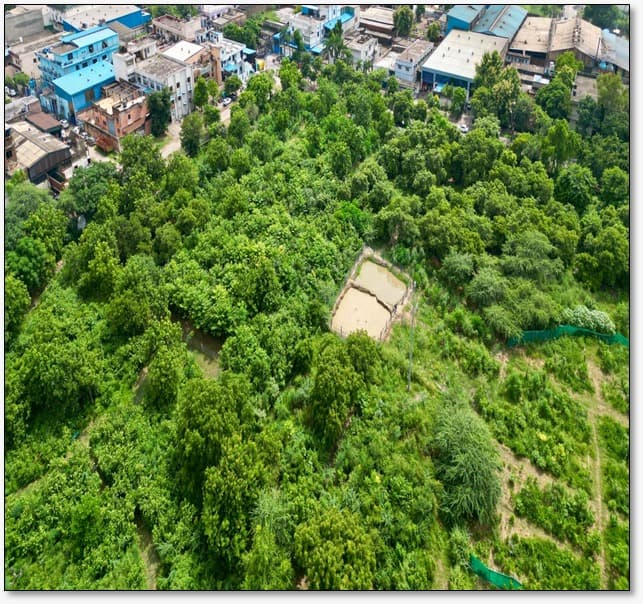
Lucknow : Uttar Pradesh is setting a new standard for urban afforestation in India, planting over 2.47 million trees across 926,082 square meters in its Municipal Corporations using the innovative Miyawaki technique. This ambitious initiative, led by the state’s Urban Development Department, is transforming urban landscapes into vibrant green spaces across 762 Urban Local Bodies (ULBs), including 17 Municipal Corporations, 200 Municipal Councils, and 545 Nagar Panchayats.
Major Achievements Across Municipal Corporations
Leading the plantation drive, Kanpur Municipal Corporation has achieved the highest number with 676,600 plantations covering an impressive 213,997.77 square meters, setting a remarkable example for urban forest development. Ghaziabad Municipal Corporation follows with 343,461 plantations across 154,832.73 square meters, while Moradabad Municipal Corporation has contributed 285,000 plantations spanning 59,691.132 square meters.
Prayagraj Municipal Corporation stands out with 256,262 plantations covering the largest area of 71,427.016 square meters, demonstrating efficient space utilization for maximum green coverage.
Other significant contributors include:
Varanasi Municipal Corporation: 176,246 plantations across 23,552.7 square meters
Lucknow Municipal Corporation: 157,600 plantations covering 45,324.79 square meters
Saharanpur Municipal Corporation: 109,149 plantations across 49,695.397 square meters
Gorakhpur Municipal Corporation: 105,000 plantations spanning 30,351.4 square meters
The initiative extends beyond major cities, with smaller municipal corporations also making substantial contributions:
Jhansi Municipal Corporation: 78,850 plantations (18,372.73 sq meters)
Bareilly Municipal Corporation: 66,437 plantations (18,858.35 sq meters)
Agra Municipal Corporation: 52,500 plantations (13,233.22 sq meters)
Firozabad Municipal Corporation: 33,793 plantations (9,671.987 sq meters)
Meerut Municipal Corporation: 25,000 plantations (182,109 sq meters)
Even smaller urban centers have participated actively, with Mathura contributing 18,000 plantations across 4,775.291 square meters, Ayodhaya contributing 8300 plantations across 2257.74 sq meters. Aligarh and Shahjahanpur contributed 6550 and 4300 plantations across 1821.085 and 4419.16 sq meters respectively.
Nagar Palika Raebareli: A Model for Small Urban Centers
Nagar Palika Raebareli exemplifies how smaller urban local bodies can make meaningful contributions to environmental conservation through strategic implementation of the Miyawaki technique. With 7,000 plantations spread across 19,991.47 square meters, Raibareilly demonstrates remarkable efficiency in space utilization, achieving an average of 2.86 square meters per plantation. This compact yet effective approach showcases how municipal councils can create dense urban forests even with limited resources. The success of Raibareilly’s initiative serves as an inspiring model for other Nagar Palikas across Uttar Pradesh, proving that environmental impact is not solely dependent on scale but on strategic planning and community commitment. The town’s achievement reinforces the state government’s vision of inclusive urban greening, where every urban center, regardless of size, contributes to the collective goal of creating sustainable, climate-resilient cities.
Addressing Urban Environmental Challenges
The initiative comes as a strategic response to Uttar Pradesh’s rapid urbanization. With the state’s urban population projected to reach 67.3 million by 2036 according to Ministry of Health and Family Welfare estimates, the government has recognized the critical need for expanding urban greenery to combat climate change impacts.
“Blessed with fertile soil, abundant water resources, and a predominately plain topography, along with the wealth of native plant species, Uttar Pradesh holds immense potential to enhance its urban green spaces,” stated a senior official from the Urban Development Department.
The Miyawaki Advantage
The Miyawaki technique, known for creating dense, native forests that grow 10 times faster than conventional plantations, has been particularly effective in urban settings. This method creates self-sustaining ecosystems that require minimal maintenance after the initial three-year establishment period.
The plantations utilize native species, contributing to the state’s rich biodiversity. Uttar Pradesh, which harbors 4,250 species of angiosperms – nearly one-fourth of India’s total floral diversity – is leveraging this natural wealth to create sustainable urban forests.
Expanding Horizons: UPVAN Scheme
Building on the success of municipal corporation initiatives, the state government has launched the UPVAN Scheme, targeting an additional 32 acres of Miyawaki urban parks. This expansion will extend beyond Municipal Corporations to include selected Municipal Councils and Town Panchayats, ensuring comprehensive urban forest coverage across the state.
National and Global Impact
With India accounting for 7.3% of the world’s total land area through its 2,40,928 square kilometers, Uttar Pradesh’s initiative represents a significant contribution to global environmental conservation efforts. The state’s approach aligns with the Urban Development Plans Formulation and Implementation (UDPFI) guidelines, setting a model for other states to follow.
Looking Forward
The success of Uttar Pradesh’s Miyawaki plantation initiative demonstrates the state’s commitment to sustainable urban development. The program’s comprehensive coverage – from major metropolitan areas like Kanpur and Ghaziabad to smaller urban centers like Shahjanpur and Aligarh – showcases a holistic approach to urban greening.
As urbanization continues to accelerate, these green lungs will play a crucial role in maintaining ecological balance, improving air quality, and enhancing the quality of life for the state’s growing urban population. The program’s expansion under the UPVAN Scheme signals the government’s dedication to creating a greener, more sustainable urban future for Uttar Pradesh’s 44.5 million urban residents and the millions more expected to join them in the coming decade.






Ukraine Inches Closer To European Union Membership.
Kyiv/Brussels; June 2026: Prime Minister of Ukraine, Yulia Svyrydenko, has posted on her ‘…

Ukraine Inches Closer To European Union Membership.
Kyiv/Brussels; June 2026: Prime Minister of Ukraine, Yulia Svyrydenko, has posted on her ‘X’ …