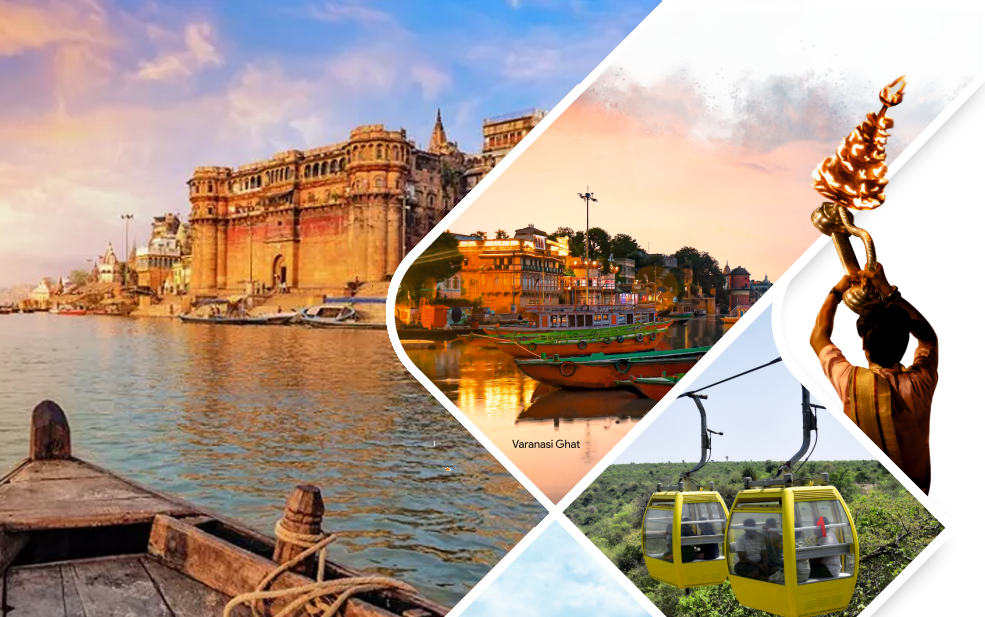
UP’s tourism sector soars under Yogi govt’s vision

Lucknow : Tourism in Uttar Pradesh is poised for significant growth, thanks to the concerted efforts of the Yogi government. The latest projections by the World Travel and Tourism Council (WTTC) regarding India’s tourism landscape provide strong indicators of this potential. The state government is strategically and proactively working to convert these promising signals into tangible outcomes. As the influx of domestic and international tourists continues to rise, it will not only boost the local economy through spending on travel, accommodation, food, and souvenirs but also contribute to the growth of local businesses. Still, it will also generate employment across related sectors, including transportation, hospitality, homestays, and tour guiding.
According to the WTTC report, India’s tourism figures for 2024 have already surpassed the pre-pandemic benchmarks of 2019. The Council’s forecasts for 2030 are equally encouraging. Uttar Pradesh holds a unique and unmatched position in the national tourism landscape—being home to sacred destinations like Ayodhya, the birthplace of Lord Shri Ram; Brijbhoomi, associated with the life and teachings of Radha and Krishna; Tirthraj Prayagraj; Kashi, the eternal city of Lord Shiva; and key Buddhist sites such as Kushinagar, Sarnath, and Kapilvastu. As national tourism grows, Uttar Pradesh naturally benefits from this momentum, a trend reflected in official data as well.
The Yogi government is fully committed to developing world-class infrastructure focused on tourist safety and convenience, especially at sites with high tourism potential. This development is being carried out in a phased and mission-mode approach. The central government is also playing a pivotal role in this transformation through various flagship schemes.
WTTC estimates that 2025 could be a record-breaking year for India’s tourism sector, with the potential to contribute ₹22 lakh crore to the national economy and generate employment for over 48 million individuals. By 2030, this contribution is expected to rise to ₹42 lakh crore, with employment exceeding 64 million.
These statistics also highlight the significant potential of Uttar Pradesh’s tourism sector, particularly in the realm of religious tourism. The state government fully recognises this and has prioritised the development of spiritual and cultural attractions.
As Chief Minister Yogi Adityanath aptly stated, “Efforts to promote religious tourism not only reinforce the spirit of devotion but also catalyze economic growth.” He added, “Government initiatives, such as Swadesh Darshan, PRASAD, and the development of the Ramayana, Krishna, and Buddhist Circuits, have significantly accelerated tourism development in the state. The double-engine government has implemented concrete measures to improve roads, transport, accommodation, and security in key tourism zones.”
Due to increasing interest in tourism and the practical implementation of government policies, there has been a remarkable surge in both direct and indirect employment. Local youth are gaining job opportunities in their regions, while traditional handicrafts and regional specialities are receiving renewed recognition and market access. The expansion of tourism is also paving the way for startups and young entrepreneurs to explore new avenues.
Undoubtedly, Uttar Pradesh is emerging as a new hub of tourism, distinguished by its rich historical and cultural heritage, as well as its visionary leadership committed to preserving and promoting it.
The Yogi government is implementing a comprehensive tourism development plan with a strong focus on religious and cultural destinations. As part of this, 272 routes connecting key pilgrimage sites are being developed at a cost of ₹4,560 crore. Major spiritual destinations are being upgraded to offer world-class amenities to both domestic and international tourists.
Heliport services have already been launched in Lucknow, Prayagraj, and Kapilvastu, with plans to extend this facility to other prominent tourist destinations soon. In Ayodhya, the Ayodhya Research Institute is being modernized, while a new International Ramayana and Vedic Research Institute is under development. Major projects, such as the Buddha Theme Park in Kushinagar, the Veda Science Study Centre in Sitapur’s Naimisharanya, and the revitalisation of Naimishar Tirtha and Shukra Tirtha, are also underway.
Heritage conservation efforts include the development of the birthplace of Paramahansa Yogananda in Gorakhpur, and Shringverpur in Prayagraj, the site of Lord Ram’s historic meeting with Nishadraj Guhya during his exile. The government is also actively developing all major locations in Uttar Pradesh’s Vanagaman route, the path Lord Ram traveled with Sita and Lakshman. Notably, native saplings mentioned in Tulsidas’ Ramcharitmanas and other scriptures will be planted along this route, adding authenticity and ecological value.
To further attract tourists, ropeway projects under the Public-Private Partnership (PPP) model have been launched in Chitrakoot, Barsana, and Ashtabhuja-Kalikhoh, with plans for similar projects in Prayagraj and Kashi.
Beyond individual sites, the government is also developing religious and cultural tourism clusters through corridors, development councils, and dedicated tourism circuits. This includes high-profile projects like the Shri Kashi Vishwanath Dham Corridor, the Vindhya Dham Corridor (Mirzapur), and the Nath Corridor (Bareilly). While work at several sites has been completed, others are progressing rapidly. To ensure focused development, the government has established dedicated Tirtha Vikas Parishads, such as, Shri Ayodhyaji Tirtha Vikas Parishad, Shri Devipatan Tirtha Vikas Parishad, Uttar Pradesh Braj Tirtha Vikas Parishad, Shri Vindhya Dham Tirtha Vikas Parishad, Shri Chitrakoot Dham Tirtha Vikas Parishad, Naimisharanya Dham Tirtha Vikas Parishad, and Shri Shukra Tirtha Vikas Parishad.
The government has also demarcated several thematic circuits for targeted development, including Religious Circuits (Ramayana, Mahabharata, Krishna-Braj, Shaktipeeth, Jain, Buddhist, and Sufi-Kabir), Spiritual Circuits, Bundelkhand, and Wildlife-Eco Tourism Circuits, as well as a Craft Circuit, to promote the state’s rich artisanal heritage.
To preserve and promote traditional local festivals, the Yogi government has provincialized key regional fairs, ensuring their continued cultural and economic impact. These include, Makar Sankranti and Basant Panchami in Ayodhya, Kartik Purnima in Anupshahr (Bulandshahr), and Ganga Snan Mela and Lakkhi Mela of Shri Dauji Maharaj in Hathras.
The Deepotsav in Ayodhya, launched under the Yogi government, has become a globally recognised event that significantly enhances Ayodhya’s cultural identity and branding. The Chief Minister’s participation in Krishna Janmashtami in Mathura and Holi in Barsana has further enhanced the global visibility of these festivals, driving increased tourist interest and foot traffic.
Government data show a remarkable surge in tourist numbers, with Ayodhya increasing from 5.76 crore visitors in 2023 to 16.44 crore in 2024, Kashi from 10.18 crore to 11 crore, Mathura from 7.79 crore to 9 crore, and Prayagraj from 5.06 crore to 5.12 crore.
Mahakumbh in Prayagraj in 2025 set new tourism records. It served as a major magnet, not just for devotees, but also for cultural and spiritual tourists visiting Ayodhya, Kashi, and Braj. Mahakumbh had attracted 66.30 crore visitors, contributing over ₹3 lakh crore to the state’s economy.

Drones Revolutionising Modern Warfare, Reshaping Global Defence Strategies
New Delhi, July 2026 : Drones have emerged as one of the most transformative technologies …

Drones Revolutionising Modern Warfare, Reshaping Global Defence Strategies
New Delhi, July 2026 : Drones have emerged as one of the most transformative …