Germany shifting its stance on Israel, citing the principle of Staatsrason.

Germany, Israel’s second-largest weapons exporter, has so far tried to engage with Israel in the hope that it would reverse course. A Foreign Office official briefed the media that Germany was examining the European Commission’s proposal and “would participate constructively in the discussions in Brussels”. The country has recently signalled an important policy shift by keeping all options on the Gaza issue, instead of opposing sanctions against Israel, as per the media brief.
According to the former German Ambassador Martin Kobler, “We are seeing a growing change in language. This is due, of course, to the aggravating situation which is just unbearable and unjustified”.
Germany’s approach has traditionally been shaped by the principle of Staatsrason, which translates as reason of state, the idea that unwavering support for Israel is a core German interest, rooted in the historical responsibility of the Holocaust. But recent developments suggest this stance is being reassessed in light of the humanitarian crisis in Gaza. “The government is keeping options open”, Mr. Kobler said. A former ambassador to Egypt (2003-2006); Iraq (2006-2007); Pakistan (2017-2019), he is part of a group of retired senior diplomats that has published op-eds urging Germany to support proposals such as those recently put forward by the European Commission to partially suspend Israel from the Horizon Europe research programme.
In the past, politicians from the centre-right Christian Democratic alliance (CDU/CSU), led by Chancellor Friedrich Merz, and the Social Democrats (SPD) have come out in support of measures such as a partial weapons embargo, or suspending Israel from the flagship EU-funded research programme, Horizon Europe. In May, Germany’s anti-Semitism coordinator Felix Klein said Staatsrason did not “justify everything”.
Mr. Kobler has further reiterated, “We are for the security of Israel due to our history in Germany, but what is happening today contravenes international law. That is also true of Hamas’ actions”. Possessing a deep knowledge of the Palestinian War by the virtue of his representations in the Palestinian territories in Jericho (1994-1997) as Germany’s representative, highlighted the need for a balanced approach that upholds human rights while maintaining dialogue with Israel. He echoed the humanitarian groups’ criticism of air drops to deliver aid, which are inefficient compared to trucks. “This is about being pro-human rights, pro-human dignity, pro-rules based international order – not pro-Israel or pro-Palestine. Israel is on the way to a pariah state with what it’s doing. This is not good for the security of Israel“.
The argument, protecting Palestinian rights is good for Israel’s security was also put forward by French President Emmanuel Macron when he recently made the case for recognising a Palestinian state. He has since been joined by the UK and Canada. It is a position, however, that is rejected by Israeli leaders, who are now considering a military occupation in Gaza.
Germany’s diplomatic stand has been closely scrutinised because it could significantly shift discussions at European Union level to sanction Israel. In June, an internal review by the European External Action Service found that Israel had breached a human rights clause enshrined in the EU-Israel Association Agreement, which governs relations between the two parties. As a result, a flurry of national decisions has been taken. On Wednesday, Slovenia became the second EU state that said it would ban all imports from Palestinian occupied territories, a measure requested by the International Court of Justice last year. Alongside Slovenia, the Netherlands has banned two extremist Israeli cabinet members from its territory.
Germany has resisted France’s calls to recognise Palestine together in September, in an effort to relaunch the peace process. Berlin’s long-standing position has been that recognition must come at the end of a negotiated solution. “It’s high time to change Germany’s position”. Mr. Kobler said, arguing that dialogue with Israel has failed. “Did it prevent one settlement? Did it prevent settler violence? Did it prevent the way that the government is going towards annexation in Gaza?”
If adopted, the Commission’s proposal would represent the first retaliatory sanction against Israel taken at EU level. Many countries, including the Netherlands, have been less ambiguous than Germany and said they would back it. France, too, would support it, if Israel does not satisfy demands expressed by Paris in the past months. They include Israel suspending the work of the controversial Gaza Humanitarian Foundation, resuming tax transfers to the Palestinian Authority, and stopping the E1 settlement project in the West Bank.
Polls show that Germans have an increasingly negative perception of Israel. Speaking this week, CDU foreign policy expert Norbert Rottgen said: “If Israel’s policy doesn’t change very quickly, Germany would also be forced to take concrete measures together with our partners”.
Siemtje Moeller, the SPD’s deputy leader, after returning from her trip to Israel with Mr. Wadephul to Israel saying she was “unconvinced” by Israeli claims that starvation in the strip was Hamas’ fault.
In a letter to SPD lawmakers sent on Monday, Ms. Moeller wrote that the Israeli government would not budge without pressure. “If such concrete improvements fail to materialise in the near future, there must be consequences”, she warned.
Team Maverick

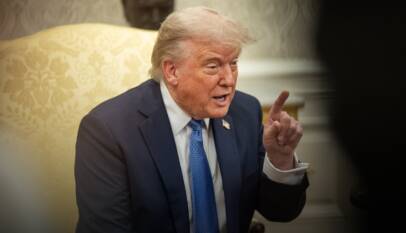





Trump Says US, Israel Agree to Hold Off Iran Strikes Pending Rapid Deal
Washington, Aug 2026 : US President Donald Trump said Saturday that the United States and …

Trump Says US, Israel Agree to Hold Off Iran Strikes Pending Rapid Deal
Washington, Aug 2026 : US President Donald Trump said Saturday that the United States …