Kamikaze call that never came in the last 80 years.

In August 1945, 80 years ago Emperor Hirohito announced Japan’s surrender, bringing World War II to an end. But while others heard the emperor’s broadcast in the early afternoon sun of August 15th., it was Corporal Tatsukuma Ueno 17 years old, army pilot at Tachiarai Airfield in southwestern Japan’s Fukuoka Prefecture, was apprised later on.
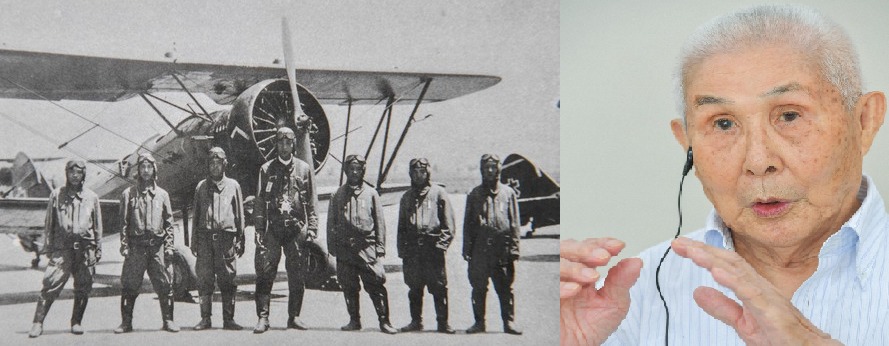
Tatsukuma Ueno who is now a late nonagenarian (97 years), has narrated the spine chilling tales of his traits as a Japanese Fighter during the World War II. “My mind was completely blank“, as he said in Niiza, Saitama Prefecture, near his home. “I had intended to die, and suddenly, instead, I was going to live, I didn’t even think to consider if it had been better to be alive or dead, I was just stunned“.
Born in Japan in 1928, Ueno lived in occupied China from age 7 to 15, where he lost his father in an accident on the railways. Ueno spent a month at his uncle’s home in Yamaguchi Prefecture in western Japan in a despondent stupor of fishing, eating and sleeping. Eventually, he was pushed to go back to school along with other boys who were coming to terms with futures they had previously given up. Eager to reduce his family’s financial burden, he passed the entrance exam for the Otsu army air force school for cadets in southwestern Japan in late 1943. As a young teen, Ueno was enamored with the idea of being a pilot. He had then rushed back to Japan for his studies, where he found poverty and signs of a faltering war effort. With personnel shortages on the frontlines, what should have been two years of basic training at the Tachiarai school was condensed into about six months.
He took further training in Seoul in Japanese controlled Korea, learning in Yokosuka-K5Y training planes known as “Red Dragonfly” due to their burned orange colouring. As Ueno learned to navigate the skies, Japan’s position in the war grew increasingly desperate. By 1944, military leadership was debating using “kamikaze – divine wind” suicide attacks in which young men plunged planes, midget submarines and other craft laden with explosives into enemy targets.
Ueno recalled how he and his fellow pilots delved into military leadership and youthful zeal – which motivated them in exploring missions with chances of no return. Pilots were trained to crash their aircraft, loaded with their explosive payload, into battleships and vulnerable parts of aircraft carriers. In practice, many aimed for smaller targets that accompanied the carriers.
The first kamikaze attacks were executed in October 1944, during the Battle of Leyte Gulf in the Philippines. For Japan, it was a key engagement aimed at stopping U.S. forces from cutting off crucial shipping lanes. In early 1945, as the prospect of a land battle on Okinawa loomed, Ueno was in training to perform steep dive maneuvers, in which he practiced plunging at around 500 kilometers per hour and dropping a bouncing bomb toward a vessel below. They had flown Mitsubishi Ki-51 planes for the exercises, the same aircraft that kamikaze pilots were using at the front. “There was an understanding that this training was getting us ready to conduct kamikaze attacks“, Ueno said.
Soon after, in February 1945, Ueno and the others were handed slips of paper. On them, they were asked to answer whether they would be willing to join special attack units for kamikaze, with three options: ardent desire, willing or refuse. As far as Ueno knows, no one refused. “I was already resolved to die. At that point, we had done the training. I was 17, so I didn’t think too deeply about things, except wondering what it might be like to die”. Ueno was there, he awaited the go-ahead for an attack he was unlikely to survive, after being passed over for “kamikaze” suicide missions
Fortunately, he was not among those called up to join a special attack unit, though nine of his fellow trainees were. Ueno was rejected due to a lack of trained pilots and instead was made an assistant instructor. Usually, orders came by letter, but with the reeling Japanese forces sliding toward defeat, the instructions came by telephone. His duties included transporting planes for kamikaze use. During that time, he says, he came close to dying at a plane’s controls.
In March 1945, he was flying in a 12-plane transport formation to an area in what is now North Korea. The flight path went over central Japan’s Suzuka mountain range, an area of treacherous topography where Ueno’s former superior had died in a crash. While gliding over the peaks, Ueno’s plane was caught in a downdraft which sent it hurtling earthward, coming as close as 100 meters from impact before he recovered control. “I saw the faces of my mother and sister. I thought, this is what death would feel like”.
As Japan’s position in the war deteriorated, it’s 66th air combat group was transferred back to the Tachiarai Airfield. He thought his turn had come. On the morning of Aug. 14, he was told to get ready to fly out, but with no further orders by the evening, he remained on standby. The next morning, on August 15th., they learned the emperor was due to address the nation at midday.
After the war, Ueno finished his studies and turned his hand to the construction trade under his uncle’s guidance. The industry helped rebuild a defeated and demolished country; After the war, the practice of sending young men to their deaths was criticised by former pilots as a form of collective coercion that unjustifiably ended many young lives. Some said that young men felt pressured into the suicide attacks and could not back out.
An association for commemorating and honoring fallen kamikaze says over 6,000 men died in suicide attacks staged by the Japanese Imperial Army and Navy, with under 4,000 dying in aircraft-based operations.
In later years, Ueno took to carving Kannon Buddha statues for bereaved families, and around a decade ago he began telling his war stories. He said his effort to remember the young men he knew comes not from a sense of duty. “I do it from my heart. We spent time together, eat together as comrades. They were resolved to die, but it doesn’t mean they wanted to“.
Eight decades on, few are left who saw the war from a Japanese aircraft cockpit. Every April, Ueno attends the annual remembrance event for kamikaze pilots at the Bansei Tokko Peace Museum in southwestern Japan. “Now whenever I go, everyone is someone’s child, their nephew, niece or grandchild. The men I knew are all gone“, he said. “It’s like war was another world away, not just in the past”.
Team Maverick




Washington Sundar Ruled Out of ODI Series Decider Against England Due to Hamstring Injury
New Delhi, July 2026 : India have suffered a major setback ahead of the series-deciding th…

Washington Sundar Ruled Out of ODI Series Decider Against England Due to Hamstring Injury
New Delhi, July 2026 : India have suffered a major setback ahead of the …