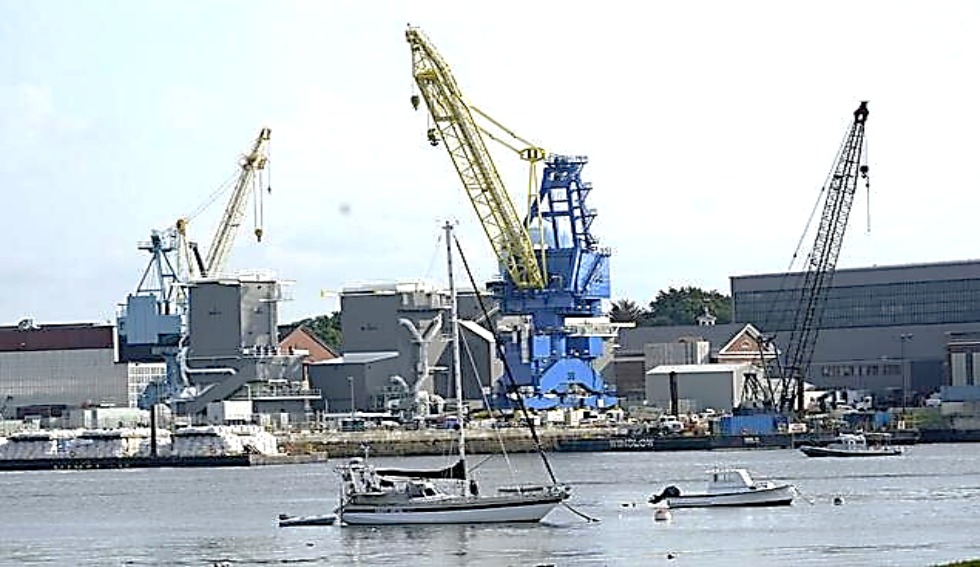
Japan alongside South Korea is rendering ship building traits to the United States.

President Donald Trump demands a plan to revive U.S. shipyards and engage foreign partners. The Pentagon is seeking $47 billion for shipbuilding in its annual budget. The urgency stems from the fact that Washington severely lags behind China in building naval ships, a situation raising alarms among policymakers who worry the maritime balance of power could shift to China, now the world’s No. 1 shipbuilder. The U.S. commercial shipbuilding accounted for 0.1% of global capacity in 2024, while China produced 53%, followed by South Korea and Japan, according to a report by the Center for Strategic and International Studies. A Navy review from April 2024 found that many of its major shipbuilding programs were one year to three years behind schedule.
In this context it is of omnipotent importance that South Korea and the U.S. are already making a joint progress on shipbuilding. In March, Hanwha Ocean completed maintenance work for a 41,000-ton U.S. Navy dry cargo and ammunition ship in South Korea. The overhaul of USNS Wally Schirra was the Korean company’s first project after it secured a repair agreement with the U.S. Navy in July 2024.
Last year, Hanwha Group has acquired Philly Shipyard in Philadelphia, which builds large merchant mariners, part of the reserve auxiliary fleet.
Earlier this month, South Korea have proposed to invest $150 billion in the U.S. shipbuilding industry to support Trump’s “Make American Shipbuilding Great Again” initiative as part of its tariffs talk with the White House. China formed the world’s biggest shipbuilding company by merging two state-owned shipbuilders. It is widely considered to be a tactical initiative, as the combined entity of China State Shipbuilding Corporation (CSSC) produces Chinese navy’s combat vessels from aircraft carriers to nuclear submarines, with a commanding 21.5% of global shipbuilding market.
American lawmakers are setting forth a trip to South Korea and Japan to explore how the United States can tap those allies’ shipbuilding expertise and capacity to help boost its own capabilities, which are dwarfed by those of China. It is Senator Tammy Duckworth, D-Ill., along with Senator Andy Kim, D-N.J., who are scheduled to land in Seoul on Sunday before traveling to Japan, with a plan to meet top shipbuilders from the world’s second, and third-largest shipbuilding countries. The senators want to examine the possibilities of forming joint ventures to construct and repair noncombatant vessels for the U.S. Navy in the Indo-Pacific and bring investments to American shipyards. “We already have fewer capacity now than we did during Operation Iraqi Freedom in 2003”, Duckworth reiterated. “We have to rebuild the capacity. At the same time, what capacity we have is aging and breaking down and taking longer and more expensive to fix”.
Duckworth, who serves on the Senate Armed Services Committee, said she hopes the trip could lead to joint ventures among the U.S. military, American companies and foreign partners to build auxiliary vessels for the Navy and small boats for the Army.
Another possibility is repairing U.S. ships in the Indo-Pacific region. “If we have to bring ships all the way back to the United States … to wait two years to be fixed, that doesn’t help the situation”, Duckworth said. The discussions, she said, will focus on auxiliary vessels, which are noncombatant ships such as fueling and cargo vessels that support naval and military operations, while asserting that the Navy’s auxiliary fleet is aging and insufficient in numbers. She has further stated, that she had earlier conversations with Hyundai Heavy Industries “about them actually buying into U.S. shipyards on U.S. soil”.
Team Maverick





PM Modi Arrives in Sweden for Bilateral Talks, Business Engagements and European Industry Summit
Gothenburg (Sweden), May 2026 : Prime Minister Narendra Modi on Sunday arrived in Sweden o…
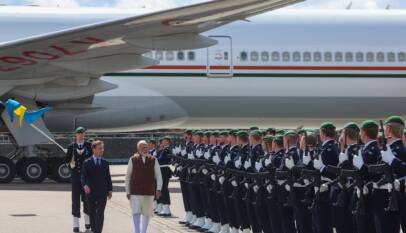
PM Modi Arrives in Sweden for Bilateral Talks, Business Engagements and European Industry Summit
Gothenburg (Sweden), May 2026 : Prime Minister Narendra Modi on Sunday arrived in Sweden …