The World’s First and Largest Floating Farm.

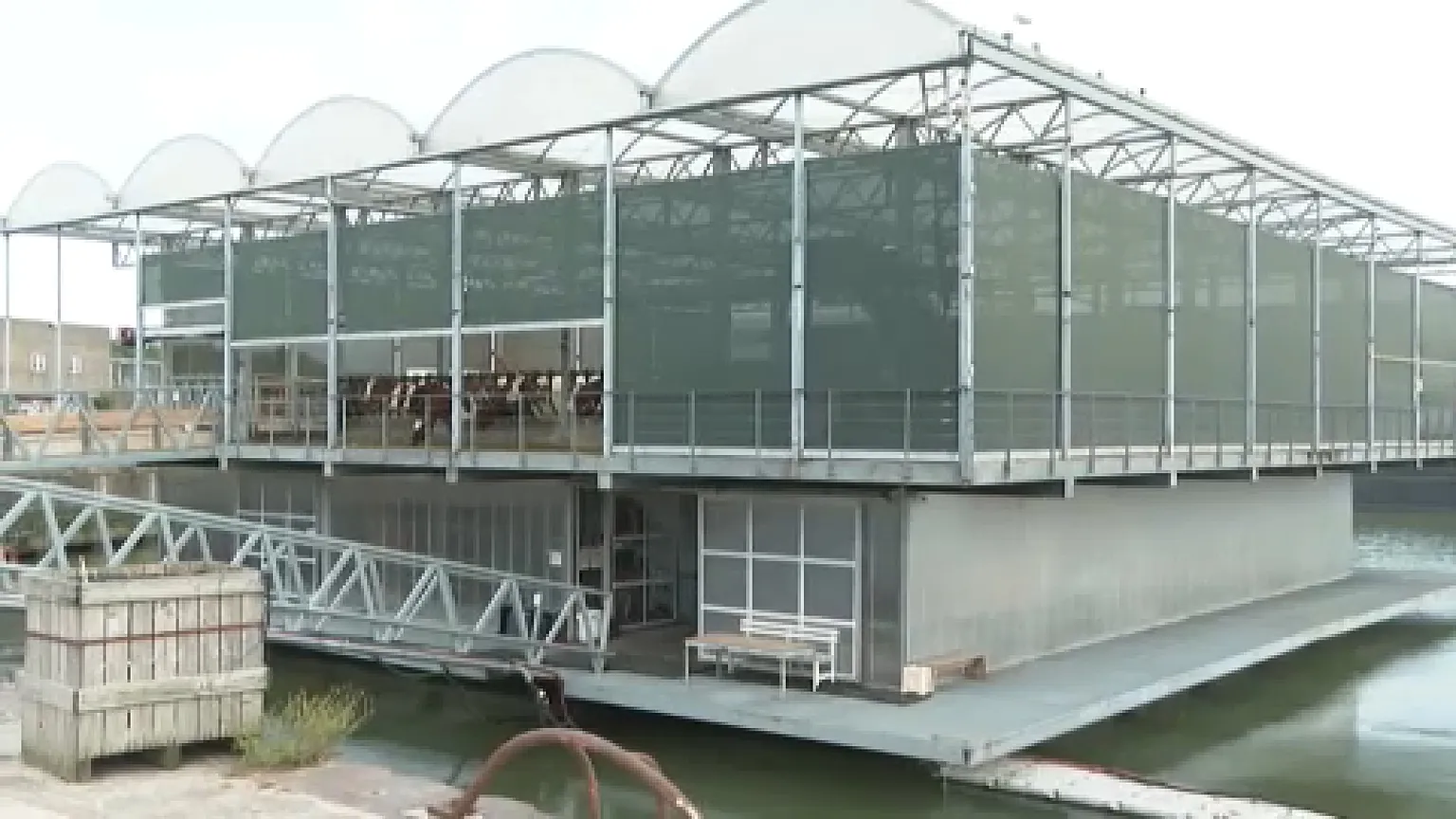
Sept 2025 : In the port of Rotterdam, Netherlands, where the Nieuwe Maas tidal river meets the city’s landscape, an architectural marvel has transformed the way we think about food production. The world’s first and largest floating farm was opened here in 2019. It has three storeys and is a 27×27 metre structure anchored to the quay. It houses a herd of 40 Meuse-Rijn-Ijseel cows, which are a Dutch breed. The largest floating farm is indeed a revolutionary structure, a living laboratory for practising urban farming and a statement on global food security.
Today, when the global population is on the rise, and urbanisation has taken away agricultural lands for ‘development’, such an innovative concept gives hope that hunger can be eradicated if appropriate measures are taken by governments and organisations. The idea of a floating farm emerged from a crucial observation. Peter and Minke van Wingerden, founders of Beladon, tried to find solutions to the problems of land scarcity, climate change, rising sea levels and extreme weather conditions; factors which affect traditional farming practices, especially in low-lying delta-regions like the Netherlands.
They questioned that if we can make houses on water, why not make a farm on water? This idea gave birth to the world’s largest farm. The cows, affectionately called the ‘upcycle ladies’ by the owners, produce 800 litres of milk every day, which is processed into fresh milk, cheese and yoghurt on site.
Structure of the largest floating farm –
The architectural design was executed by Goldsmith Company, which gave it the unique, multi-layered look, shaped like a milk-bottle, and integrated all the technologies for its proper functioning. They built it on the basis of nautical principles, ensuring stability and buoyancy. Its structure is compact and stacked, designed to be resilient and functional.
The entire structure is built on 3 interconnected pontoons, which form the base of the farm. These pontoons hold the heaviest parts, like the machines for processing milk, recycling rainwater and other installations. Keeping the heavy elements in the submerged part of the building is a key feature of the design, which enhances stability and keeps the centre of gravity low.
After this level is the ‘cow-garden which is the main floor housing the cows. It is a lightweight and enclosed structure made of translucent polycarbonate panels. This allows natural light to enter while offering shelter for the cows.
The floor is covered with a soft, rubber material for the animals’ comfort. The upper level is an open-air area, also called the roof, which has a steel frame and solar panels. This offers shade and also helps to collect rainwater for purification and use on the farm.
The floating farm is self-sufficient, and all the processes from feeding to milking the cows, waste management and product processing happen under a single roof. Galleries and glass walls are included to create an educational route for visitors, allowing them to see all the activities without disturbing the animals.
Minimal Environmental Impact –
The floating farm minimises environmental impact. The cows do not consume traditional feed; instead, they eat unwanted byproducts from the city, like grass cuttings from golf courses and public parks, vegetable peelings and grain. This provides the cows with fresh feed and also helps the city manage its organic waste.
The solar panels, which float alongside the main structure, help generate 45% of its energy. Additionally, rainwater collected from the roof is purified for the cows, ensuring a constant supply of fresh water. It also boasts an automatic manure processing plant, which recycles cows’ dung into organic fertiliser, a very high-demand product among local farmers.
Animal Welfare: A Priority –
The cows are given more space than on conventional farms, with individual beds that can be adjusted to their preferences. They also have the freedom to decide when they want to be milked, as a robotic system is used for the same. The cows can go to the onshore meadow and playground through the ramp, though they often prefer the shade and breeze of the floating barn during hot weather. The world’s first and largest floating farm is more than a commercial enterprise. It is an educational hub and a prototype for future food systems.
The founders are planning to expand their model and build a second floating farm in the harbour for growing veggies and herbs indoors. The next phase would be to irrigate the vegetables with the water purified using heat from the cows’ manure.
The Floating Farm is an inspiration for how cities can innovate to become more sustainable and self-sufficient. By growing food close to urban centres, the supply chains are shortened and transportation-related carbon emissions are reduced. It also enables people to get a closer look at how food is grown and where it comes from. Though the concept is still in its infancy, it can be viable in the long term.
Team Maverick


World Leaders Congratulate Prime Minister Narendra Modi on Becoming India’s Longest-Serving Elected Prime Minister
Prime Minister Shri Narendra Modi received warm congratulations from world leaders on the …

World Leaders Congratulate Prime Minister Narendra Modi on Becoming India’s Longest-Serving Elected Prime Minister
Prime Minister Shri Narendra Modi received warm congratulations from world leaders on the eve …