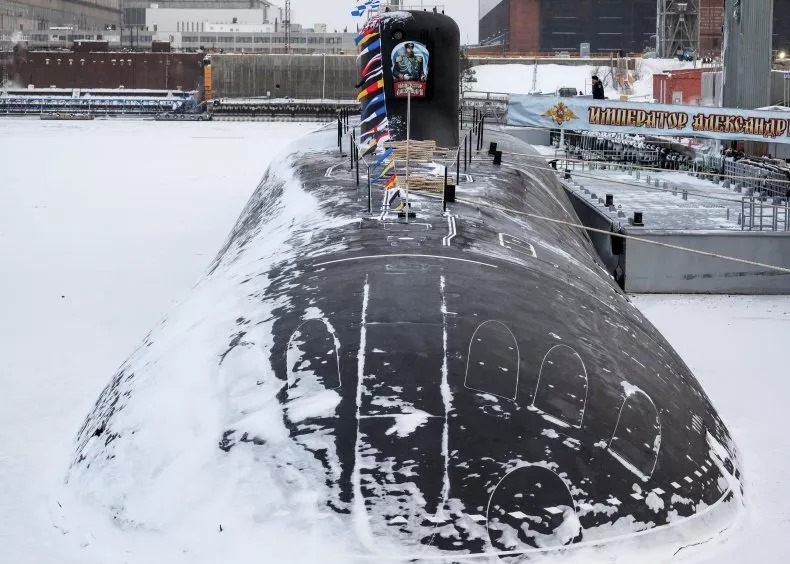
Russia reveals Nuclear Submarine Mission in Pacific Region.

Sept 2025 : Russia continues to flex its naval power in the Pacific as one of its submarines armed with long-range nuclear missiles concluded a three-month deployment in the region. Russia maintains a military presence in the country’s Far East region while engaging in its war in Ukraine. It recently conducted a joint naval exercise and patrol with China in the Pacific, while a conventionally armed missile submarine completed a deployment.
Possessing the world’s largest nuclear arsenal by warhead count, Russia operates a fleet of 12 nuclear-armed ballistic missile submarines, which are tasked with deterrent patrols and launching missiles for nuclear strikes once they receive an order to do so. Russia’s disclosure of a nuclear-armed submarine mission comes amid U.S. President Donald Trump’s calls for the denuclearisation of major powers and after China unveiled its newest nuclear weapons, including submarine-launched missiles.
The Russian Pacific Fleet announced on Monday that the Project 955A ballistic missile submarine Emperor Alexander III completed “combat missions” in the fleet’s area of responsibility and returned to its Far Eastern home port on the Kamchatka Peninsula. Rear Admiral Valery Varfolomeev, the commander of the Russian Pacific Submarine Forces, praised the submarine crew for the “successful completion” of tasks, noting the importance of their contribution to ensuring the country’s security.
The crew will resume scheduled “combat training” after a rest and replenishment of the submarine’s supplies to the required standards, according to the Russian Pacific Fleet. The Emperor Alexander III can carry up to 16 Bulava ballistic missiles, which have an estimated range of 5,157 miles, the Center for Strategic and International Studies said.
According to a Federation of American Scientists report on Russian nuclear weapons, each Bulava missile can carry up to six warheads. However, the number may have been reduced to four to meet the New START treaty’s limit on deployed strategic warheads. The U.S. and Russia signed the New START treaty, which is due to expire in February 2026, to reduce and limit their deployments of strategic nuclear weapons.
During the submarine’s commissioning ceremony in 2023, Russian President Vladimir Putin described the vessel as a “formidable missile carrier” unmatched in its class, which would reliably safeguard the country’s security by fulfilling strategic deterrence missions. What Mr. Putin had said was, “We will strengthen the combat readiness of the Russian Navy quantitatively, and enhance our naval power in the Arctic, the Far East, the Black Sea, the Baltic Sea, and the Caspian Sea which are crucial strategic regions in the world oceans“. Following sea trials and a test launch of a ballistic missile, the Emperor Alexander III conducted a cross Arctic Ocean voyage for a transfer from the Northern Fleet in the Barents Sea to the Pacific Fleet. It reached its current home port in September 2024.
The Federation of American Scientists wrote in its report on Russian nuclear weapons in May: “The Russian Navy operates 12 nuclear-powered, nuclear-armed ballistic missile submarines (SSBNs) of two classes: five Delta IV-class SSBNs (Project 667BRDM Delfin) and seven Borei-class (Borey) SSBNs (Project 955/A), four of which are improved Borei-A (Project 955A) submarines”.
It remains to be seen whether Russia will assign additional submarines to the Pacific Fleet as the U.S. Navy gradually expands its submarine fleet in the region.
Team Maverick






Assam Exports First International Consignment of Purabi Ice Cream to Bhutan
Chief Minister Dr Himanta Biswa Sarma Flags Off First Purabi Ice Cream Export Consignment …

Assam Exports First International Consignment of Purabi Ice Cream to Bhutan
Chief Minister Dr Himanta Biswa Sarma Flags Off First Purabi Ice Cream Export Consignment …