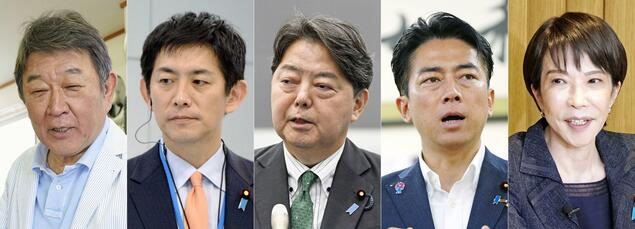
In Japan campaigning for LDP leadership race begins with Five Aspirants.

Sept 2025 : Earlier this month, Shigeru Ishiba announced his intention to step down while accepting responsibility for the ruling bloc’s loss of a majority in the 20nd. July House of Councillors election, bringing forward the next LDP leadership contest originally scheduled for 2027. With reference to the resignation of Ishiba, campaigning for the ruling Liberal Democratic Party’s presidential election to choose a successor to outgoing Prime Minister Shigeru Ishiba kicked off today (22nd. September, 2025), with five lawmakers vying to become Japan’s next leader amid political turmoil. With the LDP-led coalition losing its majorities in both chambers of parliament, the contenders vowed to revive the party, curb inflation and advance foreigner-related policies, from over-tourism to stricter immigration rules highlighted in recent elections.
The outcome of the LDP leadership race may hinge on the candidate able to secure votes that previously went to Ishiba, while another central question is how they position themselves regarding possible alliances with opposition parties.
Former internal affairs minister Sanae Takaichi, who aims to become Japan’s first female prime minister, and farm minister Shinjiro Koizumi, son of former Prime Minister Junichiro Koizumi, appear locked in a two-horse race, according to media polls.
Former economic security minister Takayuki Kobayashi, former Foreign Minister Toshimitsu Motegi and Chief Cabinet Secretary Yoshimasa Hayashi have also declared their candidature for the 04th. October election. In this election, Hayashi is trailing Koizumi and Takaichi, lawmakers said. However, the next elected chief of the LDP is not assured of becoming prime minister as the ruling coalition with its junior partner, the Komeito party, lost control of the House of Representatives following the general election in October 2024.
At a party-hosted speech session later Monday, Takaichi, 64, who shares the hawkish security views of slain former Prime Minister Shinzo Abe, pledged to build a “strong economy, resilient land and safe society for future generations“. Given that issues involving foreign residents and travelers, such as overstayers and over-tourism, have been attracting public attention, Takaichi emphasised she would take resolute measures to “defend Japan’s old traditions”.
Koizumi, 44, the youngest of the five candidates, reaffirmed that he would “immediately consider” for an economic package to ease rising living costs, while calling for talks with broader opposition forces on “high-priority policies“, including social security. The current minority coalition requires opposition support to pass budgets and bills. Under Ishiba’s leadership, the LDP has coordinated policy with opposition parties, frequently incorporating their requests and making concessions.
Koizumi, who has recently gained the spotlight for his efforts to tackle surging rice prices, also thanked Ishiba for leading a minority government and praised the past achievements of his contenders, apparently appealing for LDP unity. If Koizumi is elected and reaches a coalition deal with a relatively large opposition party, he could become Japan’s youngest postwar leader.
Kobayashi, 50, a former Finance Ministry bureaucrat widely regarded as a conservative, said he plans to cut taxes to benefit “child-rearing and working generations”, while stressing his focus on technology and science as drivers of Japan’s growth.
On the other side, Motegi, 69, promised to pursue “bold and stubborn” diplomacy, recalling how U.S. President Donald Trump once called him a “tough” negotiator. He also committed in moving ahead with “zero tax hike” policies and taking steps to encourage investment.
Hayashi, 64, a dovish moderate known for his practical experience, voiced eagerness to loosen business regulations as a growth strategy and promote green transformation and decarbonisation in a bid to attain an average 01% real wage growth.
Taking into account of the political funds scandal that has severely damaged the LDP and contributed to the ruling camp’s loss of control in both chambers in the past two national elections, the candidates expressed their determination to reform the party.
Meanwhile, as per a News Poll conducted, Former economic security minister Sanae Takaichi is seen as the most suitable candidate to lead Japan’s ruling Liberal Democratic Party.
According to a two-day telephone survey conducted, Takaichi was chosen by 28.0% of the respondents, followed by farm (agricultural) minister Shinjiro Koizumi with 22.5%. The two are seen as the main contenders in the October 04th. leadership contest to elect a successor to Prime Minister Shigeru Ishiba, who announced his resignation on Sunday.
Nevertheless, 76.4% of respondents said Ishiba’s departure would not help the party regain public trust. Support for his Cabinet, however, rose to 34.5%, up by 1.8 percentage points from the previous week, while disapproval edged down 0.2 point to 51.4%.
Of the other expected candidates, Chief Cabinet Secretary Yoshimasa Hayashi was chosen by 11.4%, followed by former Foreign Minister Toshimitsu Motegi with 6.1%, and former Economic Security Minister Takayuki Kobayashi with 3.6%.
The survey suggests that no candidate will likely win an overwhelming majority in the first round of the election, making a runoff vote more likely. In the first round, each of the LDP’s 295 Diet members will cast a vote, and another 295 votes will be determined based on ballots of rank-and-file members.
Koizumi, meanwhile, is the most popular candidate among respondents who support the LDP, as 36.0% of them said he is most fit to be the party head, surpassing Takaichi with 15.7% and Hayashi with 14.9%.
In the LDP presidential race, cooperation with opposition forces and reforming the party, which has held power almost continuously since 1955, are expected to be key issues. The LDP’s performance in the past two national elections was lackluster, partly due to a political funds scandal. When asked which parties the LDP should seek cooperation with, 34.3% of respondents chose the Democratic Party for the People, followed by 31.2% for the largest opposition Constitutional Democratic Party of Japan, 25.0% for the Japan Innovation Party and 16.4% for the populist Sanseito party.
The DPP is the second-largest opposition party in the upper house, while the JIP holds that position in the lower house.
Team Maverick







Deschamps Admits France Fell Short as Spain End World Cup Dream with 2-0 Semifinal Win
Arlington (Texas), July 2026 : France head coach Didier Deschamps admitted his side was ou…

Deschamps Admits France Fell Short as Spain End World Cup Dream with 2-0 Semifinal Win
Arlington (Texas), July 2026 : France head coach Didier Deschamps admitted his side was …