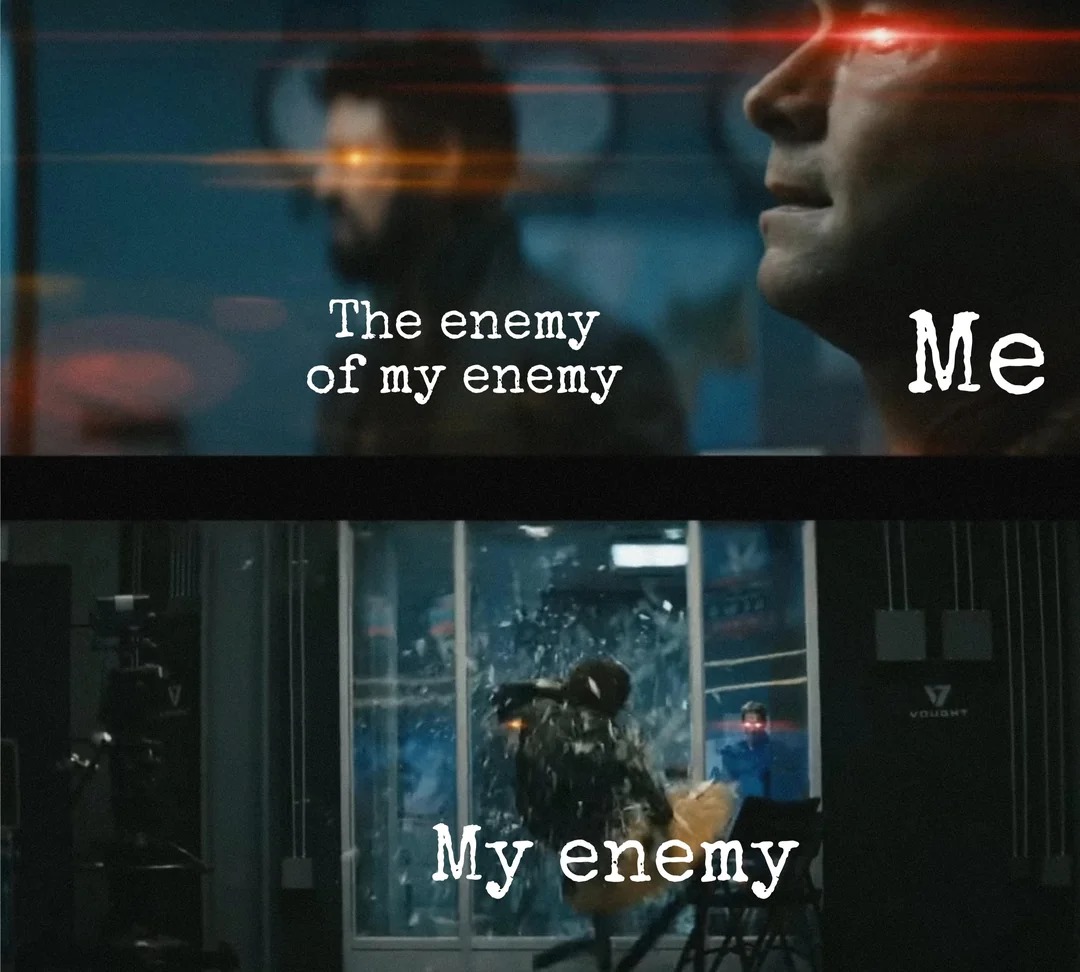
Enemy’s Enemy is a Friend.

Sept 2025 : While this principle can explain why temporary alliances form and can be supported by some psychological theories of social balance, real-world relationships are complex, and a common enemy does not automatically guarantee a lasting friendship or a stable alliance. The principle is often applied in politics and warfare, where two rivals might temporarily unite to defeat a greater, more dangerous enemy.
Psychological Aspect: The idea aligns with social balance theory, which suggests that people naturally seek harmony in their social circles, forming balanced relationships. The shared opposition to a common enemy can provide a strong, albeit unstable, bond that brings people closer.
We have seen that since the Donald Trump Era 1, protest is the continuity from the first Trump presidency to the second. From the iconic Women’s March after Inauguration Day in 2017 to the historic uprisings in the summer of 2020, no other president in modern U.S. history has endured thousands of protests and demonstrations against almost every facet of his administration. During Trump’s first term, the Crowd Counting Consortium tracked upwards of 60,000 protests involving at least 21 million people, describing the outpouring as probably “the biggest sustained protest movement in U.S. history”. The mass movement of 2020 was instrumental in pushing Trump out of office and ushering in the Joe Biden presidency. But even as Biden began to betray his campaign promises, his administration met little resistance. That’s until the Palestine solidarity encampments broke through in the spring of 2024.
In the early days of Trump’s second term, scrappy federal workers organised to protest his plan for mass layoffs. Local activists targeted Tesla dealerships across the country with pickets and protests to oppose Elon Musk’s role in dismantling federal agencies and firing federal workers. The protests were likely instrumental in helping to tank Tesla’s stock and push Musk out of the Trump administration in late May. Yet his nefarious influence in disrupting the operations of the federal government has persisted.
During April, 2025 the demonstrations had grown to sizes similar to those that had dogged the first Trump administration. Hundreds of thousands of people gathered at Hands Off demonstrations in April to stop what the organizers called “the most brazen power grab in modern history”. At Trump’s behest, the typically anodyne Flag Day, June 14, was transformed into a bellicose parade celebrating Trump’s birthday, and the 250th anniversary of the U.S. Army. The No Kings protests held the same day were the largest anti-Trump demonstrations yet. Organisers claimed that more than five million people participated in some 2,000 locations nationwide, considered to be the largest single-day protest since the first Trump term, and proof that Trump doesn’t have a mandate.
While President Donald Trump claims that he has a mandate on “mass deportations”, 62% of the public opposes his draconian immigration policies. Outraged people in liberal and conservative towns and cities nationwide have come together to defend their neighbors from the terror of abductions by Immigration and Customs Enforcement. Meanwhile, more than 60% of adults blame Trump for the rising costs of groceries, a signature campaign issue of his, and as per millions quoting his policies are making them worse off financially.
But given the scale of the onslaught, there is a sense that people aren’t resisting enough. There’s less hope and more resignation now compared to Trump’s first term. In the last election Trump won the popular vote, and most demographics shifted rightward. The resistance has seemed exhausted and demoralised, and leaders in business, law and academia have found to have been adjusting parri passu.
Mass protests have demonstrated disagreement with the Trump agenda. But protests have generally been fragmented and localised, giving a notion that there is a need to build a more sustained resistance, one that can pose a real threat to the Trump regime, are more rooted, sustained local and regional networks.
But the protests are not large or politically cohesive enough to pose an actual threat to the regime. His opposition has yet to cohere into a formation with a clear political agenda. Part of the reason is that the politics of these demonstrations and the liberal opposition more broadly are muted, if not murky. The No Kings demonstrations were organised to reject “authoritarianism, billionaire-first politics and the militarization of our democracy”, according to the organisers, without offering a vision for how to move forward. What should we do other than protest? What are the constructive demands that could attract a broad base of people? The vague demands of liberals may lead ordinary people to assume their goal is to get society back to how things were before Trump returned to power, as the organisers aren’t offering enough political clarity.
Even worse, if protest organisers and liberals make calls to return Democrats to power in the upcoming national elections without insisting on major political changes, people may become even more checked out. Americans are disappointed with Democrats’ weak resistance to the GOP. Any opposition that offers simplistic defenses of our democracy or that aspires to return Democrats to office and get back to normal may deepen the right wing’s hold on power.
When student activists flooded the streets to show support for Palestine in the spring of 2024, Democrats denounced them as antisemitic, and then-President Biden maligned their largely peaceful protests as violent and disorderly. The Democratic Party wants protests of the Republican Party’s political agenda (unless those protests are led by a progressive Democrat). But if you call Israel’s war on Palestinian’s genocide or criticise arms shipments to Israel, the Democratic National Committee will label you antisemitic and may mobilise the police to destroy your protest. Even internally, the Democratic Party is hostile to democratic expression it does not control. The gun control activist David Hogg was hectored out of an elected leadership position in the Democratic National Convention. His transgression? Suggesting that Democrats who were out of step with the politics of the base should face primary challenges. Political protests are not like water faucets that Democrats can turn on and off depending on whether they approve.
Trump’s attacks prove once again that political movements are not guaranteed. They need more to grow than worsening conditions. We’re still in the early days of this miserable presidency, and no one knows what might lead to the kind of political outpouring that could curtail or even stop Trump’s reactionary agenda. An incalculable mix of confidence and consciousness combine in unpredictable ways to give millions of people the belief that they can stop a government on a rampage. In an April poll, 59% of Americans described the beginning of Trump’s second presidency as “scary”. Adding to that is the ongoing horror of the ICE raids and the heartless policies that leave victims of climate catastrophes in Texas, New Mexico, and elsewhere on their own. Systematic efforts to roll back the civil rights infrastructure that took 100 years to build will also motivate those appalled by racism to act.
At the heart of such efforts is a politics of togetherness and solidarity, an us-against-them orientation. This reflects the growing class polarisation in the country, evinced by a government led by billionaires and elites who loot public coffers to engorge their bank accounts even further. These kinds of local ties and networking are important, especially when the befuddled Democratic Party remains politically paralysed. They have offered no hint of leadership on any relevant issue, especially immigration, leaving every city to chart its own course. The development of a coherent opposition is coming together through local responses to a wide range of political and economic attacks instead. It’s not just the size of the protest and demonstrations in defense of an abstract idea of democracy that matter. The day-to-day reality of how people defend against the cruel attacks on workers will define the opposition required to survive this era.
Team Maverick


Solar Defence Showcases Indigenous ‘Bhargavastra’ Counter-Swarm Drone System to Indian Army
New Delhi, July 2026 : Solar Defence and Aerospace Ltd. (SDAL) on Friday showcased its ind…

Solar Defence Showcases Indigenous ‘Bhargavastra’ Counter-Swarm Drone System to Indian Army
New Delhi, July 2026 : Solar Defence and Aerospace Ltd. (SDAL) on Friday showcased …