Mysterious “will-o’-the-wisps” ignited by microlightning.

Persistent Electrical Discharge from Microscopic Bubbles
offers a new explanation for Fleeting Flames of Folklore.
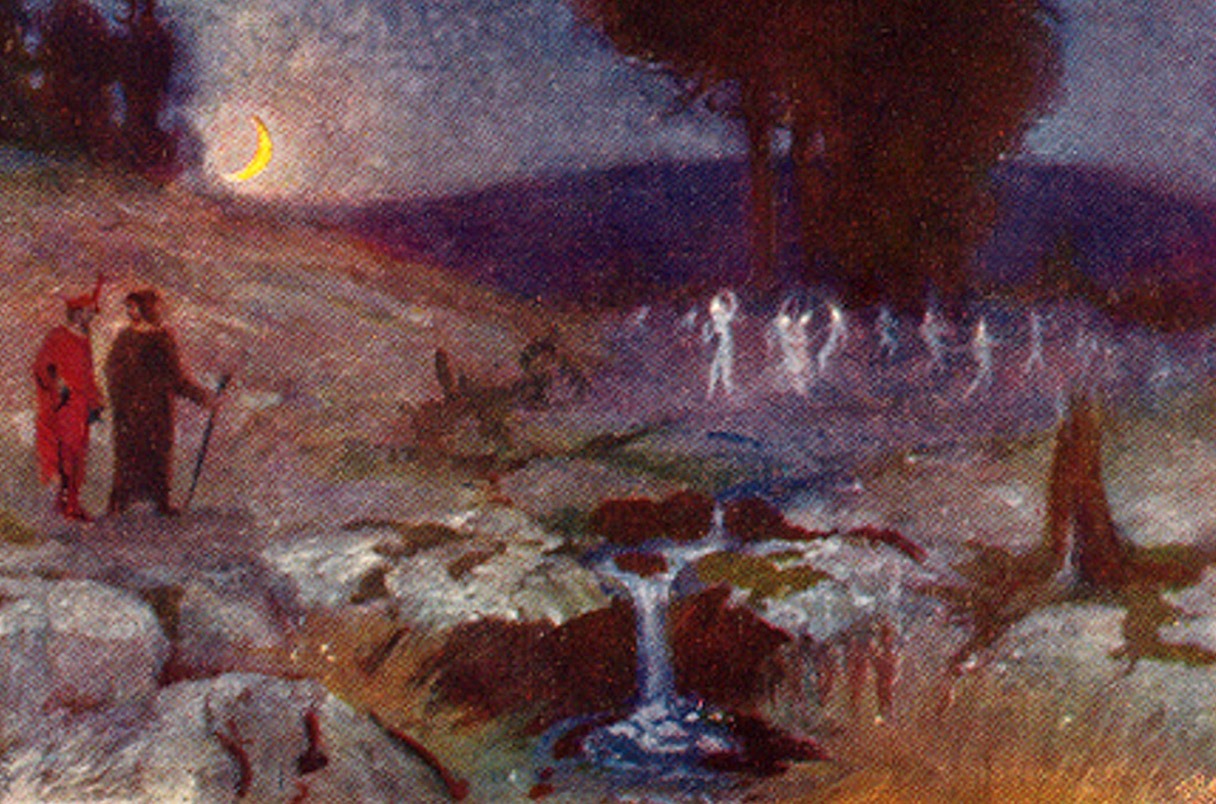
Oct 2025 : The eerie phenomenon has been said to be dancing bones, the hovering souls of dead children, and ghost lights meant to confuse travellers. For hundreds of years, folklore has sought to explain the “will-o’-the-wisp”, the fleeting flames occasionally seen above swamps and graveyards in the dark of night. Scientists have long suspected the flickers arise from flammable methane gas produced by decaying organic matter. But it’s been unclear how this gas could catch fire. Now, new research suggests that tiny lightning bursts jumping between microscopic bubbles can spark the phenomena, sometimes also called a jack-o’-lantern.
“This is really an interesting step forward”, says James Anderson, a chemist at Harvard University. “It reveals a mechanism by which chemical reactions can be initiated”, Anderson says the power of microbubbles to trigger reactions could also help explain how essential biomolecules formed prior to the dawn of life.
In recent years, Richard Zare, a chemist at Stanford University, and his colleagues have studied how tiny bubbles, just nanometres to micrometres in size, can generate strong electric fields, sparking reactions. When bubbles of different sizes form at the interface between water and air, charges on their surfaces separate, with negative charges accumulating on smaller bubbles, leaving larger ones more positively charged. This creates electric fields across small distances that trigger what amounts to bursts of microlightning as the charges attempt to equalise.
Zare wondered whether these electrical outbursts could explain the “will-o’-the-wisp” of lore. To find out, Zare’s team designed a machine with a submerged nozzle that blew microbubbles of methane and air into water. High-speed cameras then caught tiny light flashes as bubbles collided. Zare notes that flashes occurred even when only air was injected, suggesting the microlightning results from the charge separation, not from spontaneous ignition of the methane. However, when methane bubbles were present as well as air, the amount of light increased and temperatures rose. The team also detected ultraviolet light consistent with fluorescence from formaldehyde, which is produced when methane burns.
Graham Cooks, a chemist at Purdue University, says that chemical reactions triggered by microbubbles “is going to turn out to be a much bigger and general phenomenon”. He says his team is already using a variation of Zare’s approach to initiate thousands of separate chemical reactions simultaneously in hopes of discovering novel routes to synthesising compounds. His and Zare’s teams have also shown that bubble driven reactions can forge bonds between amino acids to make peptides, as well as bonds between nucleic acids to make polynucleotides, both of which are essential building blocks for life.
Because microbubbles would have been ubiquitous on the early Earth, Zare says they might have provided the sparks that gave rise to biomolecules necessary for life, without the need for the atmospheric lightning invoked by the famed Miller-Urey origin-of-life experiments.
Still, for now, that conclusion remains a bit tenuous, just like the delicate flames of the “will-o’-the-wisp”.
Team Maverick




Parliament Paralysed for Second Day as Opposition Protests Over NEET Leak, Student Crackdown
New Delhi, July 2026 : Parliament remained deadlocked for the second consecutive day of th…
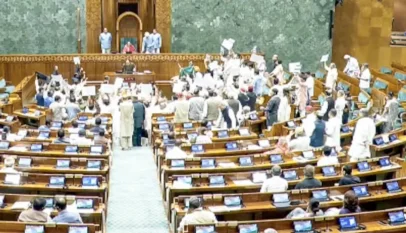
Parliament Paralysed for Second Day as Opposition Protests Over NEET Leak, Student Crackdown
New Delhi, July 2026 : Parliament remained deadlocked for the second consecutive day of …