India’s BARC Developing Nuclear Reactors That Could Power Commercial Ships.

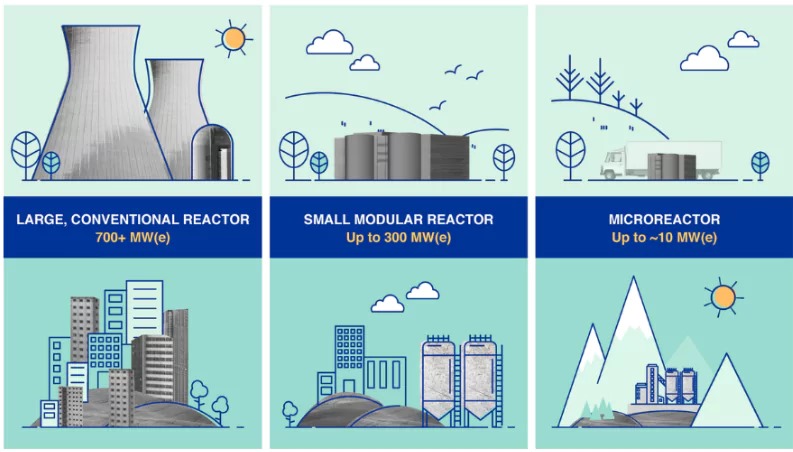
Oct 2025 : India is developing compact nuclear reactors, including a 200 MW design, that could be installed on commercial ships or used at captive power plants for energy-intensive industries. Sources explained that nuclear power is generated through nuclear fission, a process that produces heat, which is then converted into electricity. The new reactors are designed to be deployable wherever needed, including on ships.
Scientists at the Bhabha Atomic Research Centre (BARC) are currently working on two reactors, one rated at 55 MW and another at 200 MW, for sectors such as cement manufacturing. Officials said that these Bharat Small Modular Reactors (BSMR) meet high safety standards and could even power merchant navy vessels, while avoiding comments on potential use in nuclear submarines.
India currently operates two home-built nuclear submarines, INS Arihant and INS Arighaat, both powered by 83 MW reactors, with a third, INS Aridhaman, undergoing trials.
The government also plans to amend the Atomic Energy Act (AEA), 1962, to allow private companies to take part in India’s civil nuclear sector. Under the proposed changes, private firms could run nuclear power plants and handle the early stages of the nuclear fuel cycle. They may also be allowed to buy nuclear fuel from foreign countries, with the spent fuel sent back to its country of origin.
Additionally, amendments to the Civil Liability for Nuclear Damage Act (CLND) are under consideration. These would limit the liability of suppliers of nuclear equipment, as defined in the contracts between suppliers and operators. The amendments also seek to formally define a ‘supplier’ as a provider of critical equipment.
Prime Minister Narendra Modi has set a target of expanding India’s nuclear power capacity to 100 GW by 2047, a significant increase from the current 8.8 GW. Bharat Small Modular Reactors are expected to play an important role in this expansion, providing scalable and flexible solutions to meet the country’s growing electricity demand.
The “Bharat Small Modular Reactor” (BSMR) refers to a series of advanced nuclear reactors being developed in India, with the primary one being the BSMR-200, a 200 MWe pressurised water reactor.
Designed by BARC and NPCIL, it will have passive safety features and is intended for applications like repurposing old coal plants, industrial use, and remote locations. Other SMRs are also in development, including a smaller 55 MWe version and a High-Temperature Gas-Cooled Reactor (HTGCR) for hydrogen production.
BSMR-200:
- Power: 200 MWe (Megawatt electric).
- Technology: Based on pressurized water reactor (PWR) technology, which uses slightly enriched uranium as fuel.
- Safety: Incorporates both passive safety features and engineered safety systems to ensure safety during normal and off-normal conditions.
- Purpose: Designed for use in repurposing retiring coal power plants, powering energy-intensive industries, and providing power to remote locations.
- Development: The concept design is complete, and detailed engineering is underway.
- Deployment: Construction of the demonstration unit is expected to take around 6 years after financial approval.
Other SMRs under development:
- SMR-55MWe: A smaller, more modular design being developed specifically for deployment in remote locations.
- HTGCR: A High-Temperature Gas-Cooled Reactor being developed to generate high-temperature heat for hydrogen production via the copper-chlorine and iodine-sulphur processes.
- Molten Salt Reactor: A reactor for utilizing India’s thorium resources is also planned.
Benefits of SMRs:
- Flexibility and scalability: Their modular design allows for factory manufacturing, which can reduce construction times and costs, making them suitable for various applications and locations.
- Energy security: They play a key role in India’s energy transition strategy, complementing renewable energy sources and ensuring reliable power.
- Low-carbon power: They provide a stable, 24/7 source of clean energy, which helps achieve climate goals.
Team Maverick




Dewald Brevis Stars with 44 as CSK Post 180/7 Against SRH in IPL 2026 Clash
Chennai, May 2026 : Chennai Super Kings produced a strong batting effort led by Dewald Bre…

Dewald Brevis Stars with 44 as CSK Post 180/7 Against SRH in IPL 2026 Clash
Chennai, May 2026 : Chennai Super Kings produced a strong batting effort led by …