The consequences of Europe’s 12 Point Plan On Ukraine.

Oct 2025 : With the proposed summit between US President Donald Trump and his Russian counterpart, Vladimir Putin, in Budapest seemingly postponed, European countries are once again scrambling to make themselves relevant in any potential settlement of the Ukraine war.
Western countries, including the US, EU, and UK, imposed new sanctions on Russian oil and gas companies Rosneft and LUK oil to pressure Moscow over its invasion of Ukraine. Furthermore, the EU expanded measures to include sanctions on 117 vessels in Russia’s shadow fleet, restricted Russian diplomats’ movements, and planned a phased ban on Russian liquefied natural gas imports.
Moreover, the European Union followed suit on October 23, agreeing to a “tightened transaction ban on two Russian oil majors”, meaning Rosneft and Gazpromneft, a subsidiary of the state-controlled Russian gas giant Gazprom. It has also targeted Russian liquefied natural gas (LNG) and restricted the movements of Russian diplomats within the EU.
But the latest attempts is a leaked 12-point plan, initiated by Finland that has been circulating in European capitals in recent weeks. The document is not a ready-made peace deal, something that its tentative title, “Elements Towards Peace In Ukraine”, makes clear. It has also not been discussed at a higher EU level nor officially endorsed by any country. Rather it is something that has been worked on by the Coalition of the Willing, a collection of over 20 countries supporting Ukraine, since the war has commenced.
The 12 points are framed around two phases:
THE FIRST ONE, being the “cease-fire”, an approach that most European nations have been pushing for ever since the Trump administration started talking with the Kremlin. The document states that such a cease-fire “will begin 24 hours after the parties have accepted this plan” and that a line of contact “will be frozen at the point where it is at the start of the cease-fire”.
In a nod to the United States being in the driving seat of the talks, it is also suggested that the monitoring of the cease-fire will begin “immediately under US leadership, using satellites, drones, and other technological tools“. Also, during the cease-fire phase, the plan is that Ukraine and Russia agree on a “nonaggression pact” meaning that while Moscow will stop attacks on Ukraine, Kyiv also must refrain from trying to take back Russian controlled territories in Ukrainian regions such as Crimea, Donbas, Kherson, and Zaporizhzhia by military means.
Regarding the nuclear power plant in the latter region, the proposed idea is to transfer it from Russian control to an unnamed third party and start negotiations on letting Ukraine take it over again.
Under the plan, there would also be “confidence-building measures”, which are spelled out as “selected, symbolic sanctions being lifted once the cease-fire has lasted for an agreed number of days”.
Another idea is that Russia would be reinstated to international organisations. While not explicitly spelled out, it could be assumed that this would mean the Council of Europe, which Russia was excluded from in 2022 and the International Olympic Committee. It is also proposed that during the cease-fire phase, a “Board of Peace” would be established, chaired by President Trump, to oversee the implementation of an eventual peace plan, an idea seemingly borrowed from a recently unveiled 20 -points peace plan for Gaza.
THE SECOND ONE, being the “negotiations”, involving an armistice. The text notes that “negotiations on a final line of contact will begin, which will remain in effect until the parties have agreed on permanent governance of the occupied territories”.
This will also involve security zones established around the line of contact where no military activities will be allowed and monitoring by a multinational, civilian mission on both sides of the line.
Security guarantees, something the Coalition of the Willing has been working on for months, is the 8th point even though no further details are offered.
The proposed 9th point is controversial as it concerns a high-level dialogue between Kyiv and Moscow to “increase mutual understanding and respect for diversity of language, culture, and religion”.
Officials from eastern EU countries believe that this point plays up Russian allegations, often regarded as baseless, that Russian-language speakers in Ukraine were discriminated against and needed protection by Moscow.
The next point is controversial for many European governments as it mentions “the start of negotiations on the permanent governance of the occupied territories”, This goes against the “maximalist” views that many EU capitals hold that Ukraine shouldn’t relinquish any new territories and that its territorial integrity is crucial.
The penultimate point involves reconstruction, in which a fund will be established for Ukraine. It is noted that frozen Russian assets might be used for the fund.
Finally, there is a line on Russia sanctions gradually being lifted as the plan is being implemented. Here, it is also mentioned that Ukraine and Russia will start a process on agreeing compensation for war damage with the frozen assets in the West, amounting over 200 billion euros ($233 billion), proposed to be returned once an agreement between Kyiv and Moscow has been reached. A so-called snapback mechanism in which all sanctions and isolation measures automatically are imposed if Ukraine is attacked again is also suggested here.
Team Maverick


Govt. to formulate policy to provide relief in encroachment cases involving poor and landless families: CM
Chief Minister Thakur Sukhvinder Singh Sukhu today laid the foundation stone of the new Mu…
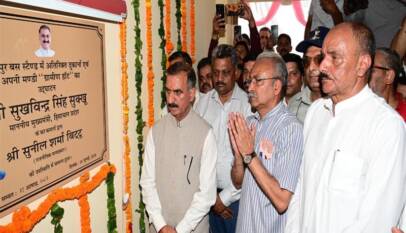
Govt. to formulate policy to provide relief in encroachment cases involving poor and landless families: CM
Chief Minister Thakur Sukhvinder Singh Sukhu today laid the foundation stone of the new …