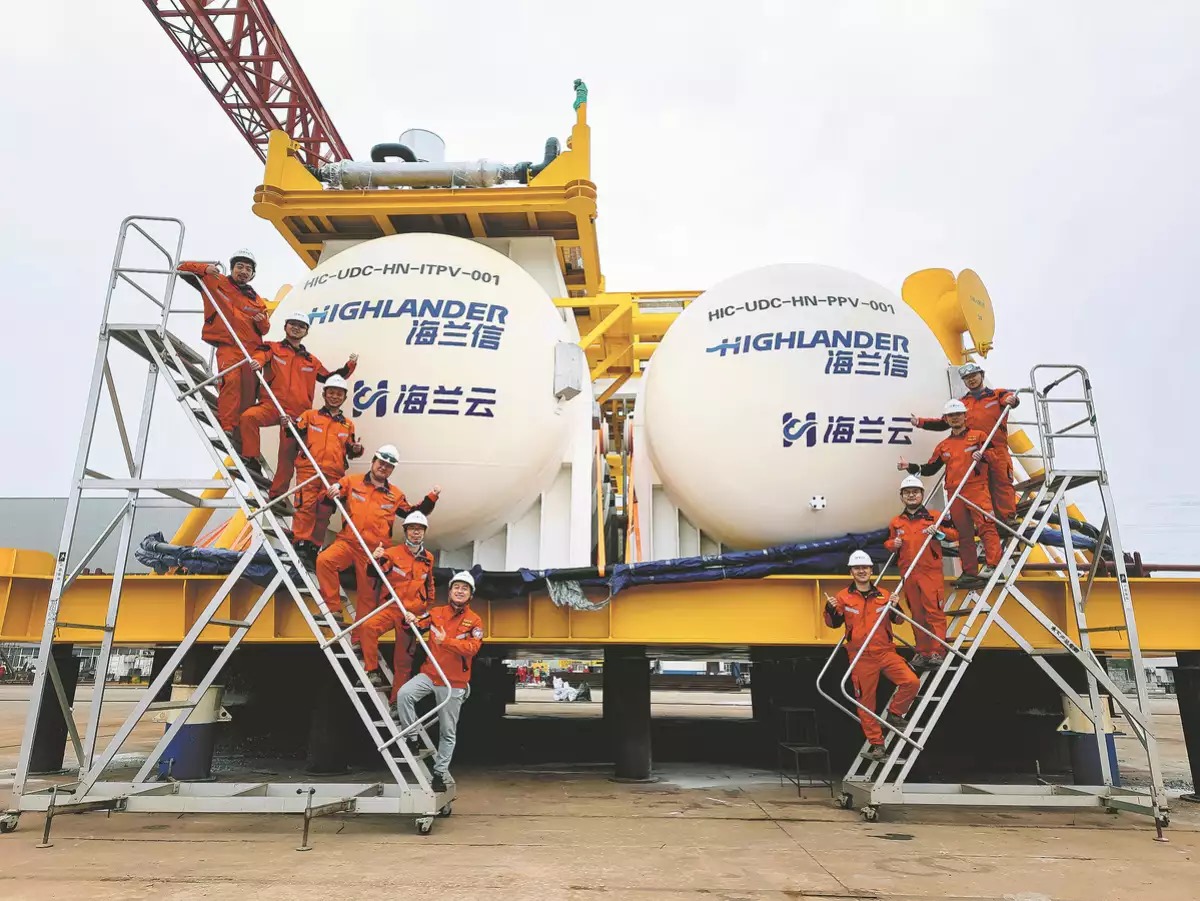
China launches first wind-powered underwater centre.

Oct 2025 : A few days ago, China inaugurated the first phase of the world’s first underwater data centre powered entirely by wind energy in Shanghai, a project that marks a milestone in technological innovation and sustainability. According to the developers, this model revolutionises the data centre industry by offering a more efficient, secure, and sustainable alternative to traditional land-based complexes requiring large amounts of energy and space.
The infrastructure developed by the Highlander company is located underwater off the coast of Zhoushan and is designed to reduce energy consumption and carbon emissions, two of the main challenges facing the digital sector.
This project has been commissioned at the crucial juncture, when the world is thriving to mitigate the hidden cost: the enormous energy consumption of data centres. These facilities, essential to the functioning of the internet, the cloud, and artificial intelligence (AI), have become one of the greatest challenges to global sustainability. However, China’s big leap forward in harnessing natural resources sustainably without jeopardising technological progress is considered to be a global trend setter.
According to estimates by the International Energy Agency (IEA), data centres consume between 1.5% and 3% of the world’s electricity, a figure which is well apprehended to double in the next decade if more efficient measures are not adopted. Demand is skyrocketing with the rise of AI, streaming, cryptocurrencies, and massive cloud storage.
Some industry giants, such as Google, Amazon, and Microsoft, have launched wind or solar-powered data centre projects for underwater installations or in cold regions to reduce cooling consumption. However, despite the progress China has made, the transition to truly green infrastructure is progressing more slowly than the growth of digital traffic.
According to the Environmental and Energy Study Institute, large data centres can consume up to 1 Crore 90 Lakh Litres of water per day, equivalent to the water consumption of a city populated by 10,000 to 50,000 people. Most of this water is used for cooling systems, especially in facilities located in hot or arid regions.
Technology companies like Google and Meta have acknowledged the water impact of their operations. According to annual sustainability reports, Google reported using 2310 Crore Litres of water, while Meta used more than 1136 Crore Litres of water.
The problem lies not only in the overall volume of water consumption, but also in the location of many data centres in water-stressed areas, where they compete with communities and agricultural sectors for an increasingly scarce resource. The World Economic Forum (WEF) warns that the expansion of data centres, driven by AI, e-commerce, and cloud computing, could exacerbate tensions on natural resources if sustainable measures are not adopted.
“Farmers are facing reduced crop production due to irrigation water shortages and frequently rising water prices. Some cases are causing social unrest, as seen in the Netherlands, Chile, and Uruguay“, the WEF adds.
Unlike traditional data centres, which require enormous amounts of fresh water for their cooling systems, the underwater model implemented by the Asian country takes advantage of the low ocean temperatures to dissipate heat from the equipment. Seawater flows through sealed heat exchangers, without coming into direct contact with the electronic components, ensuring safety and energy efficiency.
The state agency also highlights that the power supply comes from nearby offshore wind farms, enabling 100% renewable energy operation. According to the developers’ statements, this configuration allows for a reduction of up to 40% in total energy consumption and virtually eliminates the use of fresh water.
In addition to thermal efficiency, the underwater environment offers greater stability and safety: the capsules are protected from fires, extreme weather events, and temperature fluctuations, improving operational reliability and reducing maintenance costs.
Highlander estimates that once the entire project is completed, the system will be able to house hundreds of interconnected modules, forming a network of marine data centres capable of meeting the growing demand for storage and processing driven by artificial intelligence and cloud computing.
With this initiative, according to the WEF and international organisations, China not only seeks to increase its digital capacity but also to position itself at the forefront of green technological innovation, demonstrating that digital transformation can advance without compromising the planet’s natural resources.
Suvro Sanyal – Team Mavericks







Pope encourages youth in Medjugorje to rediscover beauty of encountering the Lord
In a message signed by Cardinal Secretary of State Pietro Parolin for the opening of the Y…

Pope encourages youth in Medjugorje to rediscover beauty of encountering the Lord
In a message signed by Cardinal Secretary of State Pietro Parolin for the opening …