Vladimir Putin’s reminiscing traits is the hindrance to the peace initiative with Ukraine.

Oct 2025 : The habit of reminiscing is a natural process of reminding or reiterating about past experiences to gain a sense of identity, connect with others, and make sense of one’s life. While often a source of comfort and connection, it can also become negative if it leads to dwelling on past mistakes or feeling sadness about the present. It can be practiced through talking, writing, or using objects and serves as a way to strengthen relationships and preserve memories.
Although the positive aspects of reminiscing elicit positive feelings and enhances one’s wellbeing, the negative aspects are far reaching devastating. Dwelling on the past – Constantly focusing on past mistakes or negative events can lead to unhappiness and regret. Bittersweet emotions; those reflecting on good times can sometimes evoke sadness because it reminds you that the experience is over.
Vladimir Putin the quintessential dictator of Russia in the year 2021 had penned a history-laden pamphlet arguing that Ukrainians and Russians are kindred nations, artificially divided by outsiders.
Those cherry-picked historical narratives and outright distortions were Putin’s casus belli for an all-out war. Seven months later, Putin’s Russia was bombing Ukraine, illegally “annexing” large swathes of territory while killing untold thousands of people in the name of historical revisionism. It is since then, the Machiavellian Russian leader has continued to draw on past events to justify Moscow’s ongoing aggression.
Wider Western audiences became more familiar with Putin’s penchant for history during his interview with Tucker Carlson in February 2024. The Kremlin’s chief expounded at length on his version of Ukrainian and Eastern European history, beginning with the founding of Kyivan Rus in the 9th century, a proto-state for modern Ukraine and Russia.
A similar lecture was rendered to the U.S. President Donald Trump during the 15th August summit in Alaska this year.
Putin uses history as “an arsenal where he can select weapons to defeat his adversaries“, Françoise Thom, a French historian specialising in Soviet history has said. Historians call this as Putin’s weaponisation of history. This weapon is primarily aimed at Ukraine. They add that his focus on Ukraine reaches the level of obsession, saying that the 73 years old leader has drowned in a world that doesn’t exist.
Studying Russian history is never an easy task, as one of the country’s leader put it in the early 2000s that Russia was a country with an unpredictable past. Moscow’s history textbooks were rewritten as soon as a new ruler, or regime, had been installed, be it a tsar, a Communist party leader, or a post-Soviet autocrat. Putin has, meanwhile, taken rewriting the country’s history to heart, justifying his war against Ukraine with passages from cherry-picked events from centuries back.
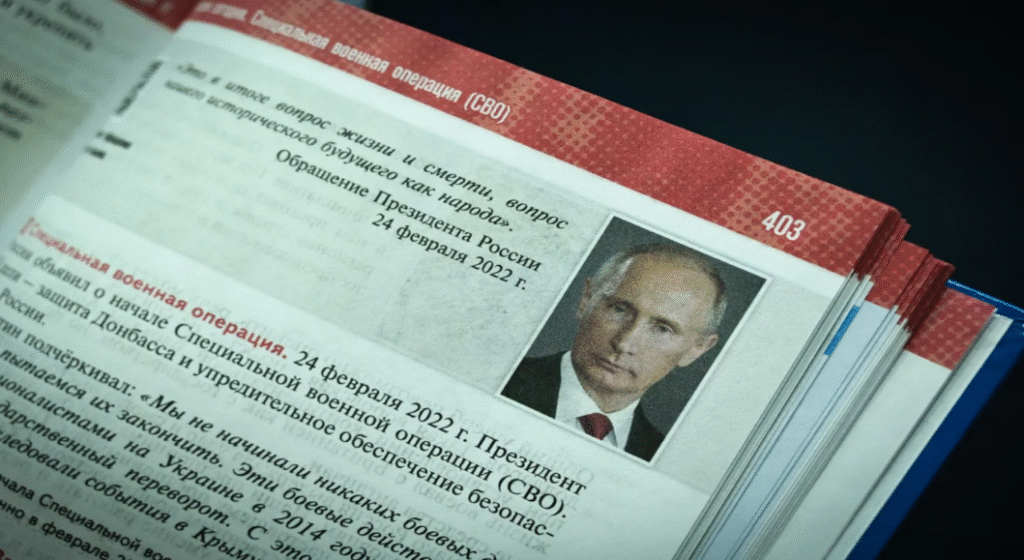
Putin “needs to legitimise the war against Ukraine, so he has chosen the strategy to present the Russian and Ukrainian peoples as one”, says Serhii Hromenko, a historian and publicist serving with Ukraine’s Armed Forces.
Kyivian Rus, a medieval polity founded in the 9th century from which Ukraine, Russia, and Belarus claim their descent, has been used by Putin as an argument that Ukrainians and Russians are effectively one people. After the fall of Kyivian Rus, the successor states and territories of modern-day Ukraine were eventually incorporated into Poland and Lithuania, becoming integral parts of the Polish Lithuanian Commonwealth
Yaroslav Hrytsak, a Ukrainian historian and professor at the Ukrainian Catholic University in Lviv, dismissed this interpretation as “nonsense”, citing noting that it ignores the changes every nation undergoes over centuries. The Grand Duchy and later Tsardom of Muscovy, in the meantime, evolved largely separately from Ukrainian history until the late 17th century.
An anti-Polish Cossack rebellion led by Bohdan Khmelnytskyi sought allies against the Polish king, eventually concluding the 1654 Treaty of Pereiaslav with the Muscovy tsar. Khmelnytskyi and Pereiaslav fit well into Putin’s discourse that Russia is a “peaceful nation”, to which others seek to join of their own volition, Hrytsak explains. The complexities of the event, including the other alliances Khmelnytskyi sought, are left out.
That is the case with many parts of history that do not fit into Putin’s desired narrative. Hromenko notes that topics like Ivan Mazepa, a Cossack leader who waged war against Russian Tsar Peter I, are often omitted. So is the 1917 Ukrainian Revolution, which negates Putin’s favorite claim that Ukraine was “created” only years later by Bolshevik leader Vladimir Lenin.
Another omitted fact is that large parts of Ukraine, where Ukrainian language and culture had flourished for centuries, were annexed by the Soviet Union only in 1940, and were held by Moscow for less than half a century.
“Putin wants to destroy Ukraine as a nation. And a nation is supposed to have its own history“, Hrytsak says. When a nation is stripped of its history and collective memory, it makes it vulnerable to being absorbed by another, he adds.
Putin has long been using perceived historical grievances to attack adversaries and justify political goals. As Thom says: “For him, history is a bottomless conservatory of offenses inflicted on the Russian people by the hostile West since Byzantium“. Yet, historians say Putin’s focus on Ukraine reaches the level of obsession.
The shared Russo-Ukrainian history has been marked by centuries of subjugation and repression. Russian and Soviet leaders, from tsars to Joseph Stalin, have viewed the Ukrainian nation with suspicion.
Nevertheless, Sergey Radchenko, a historian specialising in Soviet and Russian foreign policy, says “the obsession with Ukraine is peculiar to Putin. If you look back through decades to see how Soviet and Russian leaders have drawn on history, you’ll see that while they have all done that, they did not obsess over it“, he asserted.
Hrytsak links this directly to the full-scale invasion. While acknowledging Russian-Ukrainian relations would be difficult regardless of who sits in the Kremlin, the Ukrainian historian believes that Putin’s obsession with Ukraine plays an outsized part. For him, it’s personal, Hrytsak adds.
Team Maverick

Museums will be named after India’s National Heroes, not invaders: Chief Minister
Grand museum named after Chhatrapati Shivaji Maharaj being constructed at a rapid pace: CM…
Museums will be named after India’s National Heroes, not invaders: Chief Minister
Grand museum named after Chhatrapati Shivaji Maharaj being constructed at a rapid pace: CM …