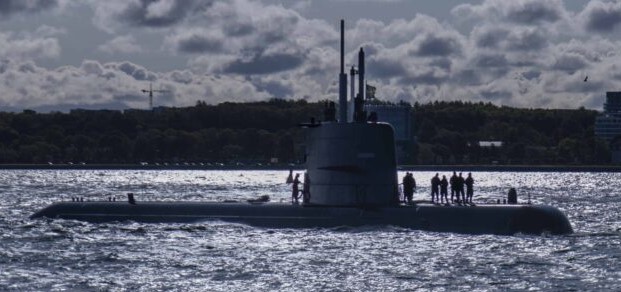
Sweden’s entry into NATO has dramatically shifted the formerly Non-Military aligned Nation’s Naval Doctrine.

For Sweden, its entry into NATO in March 2024 has dramatically shifted the formerly non-military aligned nation’s naval doctrine: no longer just defending its own shores, the Swedish navy now guards the alliance’s eastern flank, with the “border” effectively on Finland’s and the Baltic States’ coasts eastwards. As the Navy Chief Rear Admiral Johan Norlén put it, “We are also defending our nations on the other sides. … The border is on the eastern shore right now”.
This positions Sweden as a frontline state in the Baltic Sea, cluttered waterway with an average depth of 200 feet, ideal for anti-submarine warfare (ASW) but vulnerable to Russian hybrid threats, including submarine incursions, shadow fleet sabotage, and infrastructure attacks like severing of undersea cables.
Open-source intelligence indicates that Russia has two to three Kilo-class, conventional diesel-electric submarines typically operating from bases like Baltijsk in the Russian enclave Kaliningrad, but currently there’s a handful of Kilo diesel submarines in the Baltic Sea.
As the NATO anti-submarine warfare exercise kicked off this week, top commanders said that with Sweden in the alliance, the Baltic Sea is now a “lake full of NATO submarines” under unified command.
“With Sweden’s addition, that was our first opportunity to add another submarine nation to NATO. And now we have, basically, a Baltic lake full of NATO submarines”, NATO’s top submarine commander, US Rear Admiral Bret Grabbe, said at a press briefing at the Dutch frigate HNLMS Van Amstel docked in Stockholm.
The exercise, NATO’s dedicated Baltic anti-submarine warfare drill called “Merlin”, brings together subs (short of submarines) from Sweden and Germany, surface ships and helicopters from France, Germany, Netherlands and Sweden, and a maritime patrol aircraft from the United States to practice all-domain ASW in the shallow, mine-prone, relatively shallow Baltic environment.
Right now, there’s a three or four-to-one ratio of NATO ships to adversary ships around the Area of Responsibility (AOR), and “that’s quite an impressive deterrent feature that we have when we’re working together”, Bret Grabbe said. NATO’s edge in the Baltic Sea also lies in its multi – mission submarines, which double for intelligence, surveillance, reconnaissance (ISR), special forces activity, and future unmanned operations, Grabbe stressed.
Sweden’s conventional submarines, renowned for their stealth and air-independent propulsion (AIP) systems, bring unique value to the table. The Gotland-class boats have a storied history, including a 2005 exercise where one “sank” the US Navy carrier USS Ronald Reagan in a simulated attack. But aging vessels and NATO commitments demand more. Sweden is beefing up its navy with new subs and surface combatants, while upgrading existing assets. However, chronic delays and soaring costs risk leaving gaps in capability just as tensions rise in the Baltic Sea.
Sweden’s current fleet includes 03 upgraded Gotland-class and 01 Södermanland-class submarines, plus 05 Visby-class stealth corvettes, all optimised for Baltic ASW with quiet propulsion and advanced sonars. Next-generation A26 Blekinge-class submarines (HMS Blekinge and HMS Skåne) are under construction by Saab Kockums. These Stirling AIP-equipped subs feature multi-mission portals for divers/UUVs, Torpedo weapons, and seabed warfare tools are described as perfect for Baltic littorals and protecting cables/pipelines.
However, the submarine programme has been hit by major setbacks. Saab received a firm order in 2015 with delivery planned for 2022–24. In 2021 the budget rose and delivery slipped to 2027–28. In mid-October 2025 Saab and FMV confirmed a new renegotiation: costs now 25 billion kronor ($2.6 billion), which is a 100% increase since 2015, with the 02 new subs delayed to delivery in 2031 and 2035.
The Swedish Defence Materiel Administration (FMV) said in a written statement when the new timeline and price tag were revealed that building a new submarine class is a “very complex project associated with economic and technical risks”. The manufacturing of the submarines has now progressed so far that “these risks are at a significantly lower level”. In a move to enhance its maritime defense amid evolving regional threats, Sweden is also set to introduce larger frigates (Lulea-class), surpassing the size of its current Visby-class corvettes.
Norlén revealed the vessels could measure around 120 metres (nearly 400 feet), signaling a strategic shift toward more robust and versatile naval assets. The decision stems from multiple factors, primarily the need to accommodate advanced air defense systems. To harbour these kinds of air defence systems, silos and weapon systems by itself, is quite large, which requires a bigger ship. Additionally, the expanded size, from 72 metres to circa 120 metres, will allow for integration of future technologies, including unmanned systems.
However, there are also delays with the new surface combatants: four new larger frigates to replace older ships and complement the Visby-class vessels, which are under mid-life upgrades into the 2040s, adding air defense like Sea Ceptor.
Saab and British Babcock are among the strong candidates for handling the design of the new frigates. The French Naval Group and the Spanish Navantia are also bidding on the contract, according to the Swedish public broadcaster, which stresses that Navantia is “a dark horse” due to being able to deliver on limited time. The first two new frigates are due in 2030, with all completed by 2035. The price tag is unknown.
Team Maverick







Rahul Gandhi, INDIA Bloc Hold Candlelight Vigil at Gandhi Smriti Over NEET Paper Leak Row
New Delhi, July 2026 : The Opposition intensified its campaign over the alleged NEET exami…

Rahul Gandhi, INDIA Bloc Hold Candlelight Vigil at Gandhi Smriti Over NEET Paper Leak Row
New Delhi, July 2026 : The Opposition intensified its campaign over the alleged NEET …