India and the United States have conducted Joint Air Drill for Four Days.

The United States Air Force and Indian Air Force are undergoing a 04 days bilateral air exercise from November 10th to 13th, 2025, pairing USAF’s B-1B Lancer with IAF combat aircraft over southern India, as reported by the Indian Air Force on their X account on 12th November 2025.
The event blends a long-range U.S. strategic bomber with Indian frontline fighters to refine tactics, communications, and mission planning under realistic conditions. It underscores how Washington and New Delhi are translating a growing strategic partnership into practical airpower integration at a time of sharpening competition in the Indo-Pacific. The IAF has publicly released images and details, highlighting the goal of mutual learning and improved interoperability.
The exercise brings together the B-1B, a high-payload, supersonic, long-range conventional bomber, with Indian Sukhoi-30MKI and Mirage-2000 fighters to practice escort, composite air operations, strike package deconfliction, and airspace control measures.
According to the IAF’s public statement, the USAF contribution centres on the Lancer, while Indian assets provide multirole fighter cover, sensor fusion, and air dominance at varying altitudes and speeds. The IAF’s release notes the serial runs are designed specifically “to foster mutual learning and enhance interoperability”, a focus that typically includes secure voice / data links, tanker procedures, EMCON discipline, and counter air strike sequencing.
Operationally, both forces are building on a record of prior touchpoints. For the United States, the B-1 has been a recurring symbol of rapid global reach, featuring in Bomber Task Force missions and previous appearances alongside Indian events such as Aero India; for India, mixed-fleet orchestration with Su-30MKI and Mirage-2000 has matured through bilateral and multilateral drills with Western platforms. What is understandable is the current iteration as the first focused integration of IAF fighters with a U.S. bomber in this specific configuration over southern airspace, elevating complexity beyond airshow sorties toward missionised training.
The advantages of this setup are concrete. At the tactical level, Indian and U.S. crews can rehearse time-on-target coordination for long-range conventional strike, test data-link gateways and cryptographic interoperability, and stress-test air-to-air refueling and EM spectrum management against realistic timelines. B-1 crews gain country-specific terrain familiarity, airspace procedures, and exposure to Indian fighter tactics; IAF pilots refine bomber-escort and composite strike playbooks, including standoff-weapons routing, threat rings, and recovery concepts in a mixed package. The ability to choreograph high-speed, heavy-payload ingress by a Lancer under an Indian fighter umbrella is precisely the kind of muscle memory both sides would need in a real contingency.
Strategically, the drill signals that U.S.–India defence ties are deepening even when trade or tariff issues complicate the broader relationship. Practical integration with a U.S. strategic bomber telegraphs credible, conventional strike options in the wider Indian Ocean Region and the Indo-Pacific, complementing U.S. global presence and India’s growing role as a security provider. For Washington, training over the subcontinent with a partner designated a “Major Defence Partner” extends the reach, basing flexibility, and partner capacity that underpin U.S. force posture without permanent stationing.
For India, it refines combined air operations with a key technology partner while preserving strategic autonomy, adding a capable, practiced option set for crisis response, HADR air corridors, or deterrence messaging. Indian reporting surrounding the event has explicitly framed it as first-of-its-kind bomber–fighter integration on Indian ranges, underscoring the exercise’s step-change significance.
This week’s sorties show more than camaraderie on the ramp: they harden the operational bridge between U.S. long-range strike and Indian frontline fighters. That bridge, built on shared procedures, tested communications, and repeatable mission choreography, is what turns diplomatic alignment into credible airpower, and it is why this exercise matters for U.S. readers watching the balance of power across the Indo-Pacific.
Team Maverick





Team Special Olympics Bharat Accorded Grand Send-Off Ahead of Special Olympics Unified Football World Cup 2026
Faridabad July 2026 : Team Special Olympics Bharat was accorded a warm send-off at Manav R…
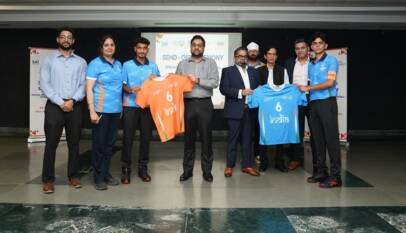
Team Special Olympics Bharat Accorded Grand Send-Off Ahead of Special Olympics Unified Football World Cup 2026
Faridabad July 2026 : Team Special Olympics Bharat was accorded a warm send-off at …