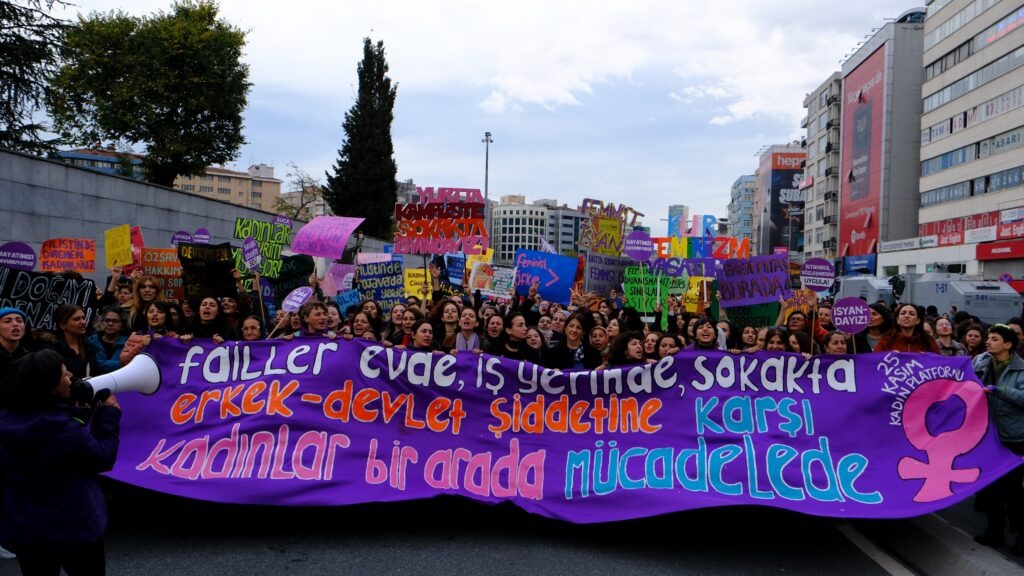
November 25th Statement of the Country: Turkiye Withdrawing from the Istanbul Convention.

The assassination of the ‘Three Mothers’ – Patria, Minerva, and María Teresa Mirabal, who resisted the Trujillo dictatorship in Dominica in 1960, became a turning point for the world. A regime sought to silence them, but on the contrary, it marked the beginning of a time when violence against women could no longer be dismissed as a “private sphere“.
Born on 25th November, the International Day for the Elimination of Violence against Women; Its neither emerged spontaneously nor is it merely a day of commemoration. This date is a call to entrust responsibilities directed at states and societies: Violence is not isolated, it is structural. It can be prevented, but only through policy and will. It was the manifestation that violence is not women’s fate, but a reality that can be changed through struggle.
The European Union emphasised in a statement on November 24th, that gender-based violence is “unacceptable”. It noted that one in three women across the Union experiences violence and said that every number represents “a life and dignity violated”.
With the EU’s accession to the Istanbul Convention and the adoption of the first EU law in May 2024, a binding framework has been established. The new Directive explicitly criminalises forms of digital violence such as non-consensual image sharing, deepfakes, cyberstalking, and online harassment. Member states are required to transpose the law into national law by 2027. The message is clear: the fight is no longer a wish; it is a political obligation.
While the world is expanding its law on combating violence, Türkiye has narrowed its own framework.
While the EU is strengthening the Istanbul Convention as a binding framework, Turkey is the only Council of Europe member to have withdrawn from it. Therefore, it faces the most pressing question: What have they replaced it with? There are Action Plans to Combat Violence Against Women, but without implementation, budgeting, and oversight, no text saves lives. Violence is still presented as an isolated incident. Yet, hundreds of women are murdered every year in this country, where they should be safest.
According to data from the “We Will Stop Femicide Platform”, at least 235 women were killed by male violence between January and October 2025. During the same period, at least 247 women were found dead under suspicious circumstances. While the perpetrators or circumstances of these suspicious deaths remain unclear, the women are known to be at risk. Many of these deaths occurred despite repeated appeals for help. The cause of femicide in Türkiye is not solely violence; it is the “protection gap” that results in death, a point at which the state should intervene.
The problem is not just violence; it is a dysfunctional state protection chain.
The Cycle of Impunity and the Broken Chain of Protection; The most painful data about violence in Türkiye isn’t just how many women are killed; it’s how many remain unprotected while they’re alive. Official data is fragmented, and there’s still no comprehensive national database available to the public. Despite this, civil society records reveal the same reality: Violence is often known in advance, reported, and filed, but because the chain of action isn’t properly addressed, it ends in death.
Law No. 6284 is very strong on paper. But delayed injunctions, unmonitored suspensions, limited electronic tracking, and a lack of coordination among law enforcement officers are costing lives. Impunity isn’t just about low sentences; it’s about a justice system that’s normalized by extenuating circumstances. When women face the state without protection, perpetrators become more emboldened.
Not a Case, But Systematic Violence; In this country, women are often killed in their homes, by those closest to them. For seeking divorce, for refusing to reconcile, for making life decisions. These tragedies are not momentary outrages. They are predictable and preventable forms of violence.
Some women were murdered after repeatedly going to the police station, obtaining restraining orders, and documenting the threats. The cases of Emine Bulut, Pınar Gültekin, and Şule Çet revealed the same truth: These murders were not sudden rages; they were forms of known, preventable violence that resulted in death.
Some were not protected simply because they “withdrew their complaints”. Yet, this withdrawal is often a strategy to avoid violence. Each file is a silent map of where the state must intervene:
Violence begins → an application is made → precautions are delayed → inspections fail → the woman is killed. So, the problem is not individual perpetrators, but a dysfunctional protection architecture.
Combating Violence: What Should Be Done? The answer is, to change the situation in Türkiye, existing mechanisms need to function rather than a new law:
- Return to the Istanbul Convention: The single binding framework ensuring prevention, protection, prosecution and policy integrity.
- Full implementation of 6284 in the field: Precautionary measures should be implemented without delay. Electronic bracelets should be widespread. Law enforcement units should receive
regular and mandatory training. Implementation should be independently monitored.
- National data system: Policy cannot be established without data. All applications, measures, and results should be centralized.
- Shelter and support services: Capacity inequalities must be addressed. Women’s right to a safe life must be a state guarantee.
- Clear definition of digital violence: Threats and harassment targeting women’s online presence must be met with legal action.
- Local governments are the primary actors: From housing and lighting to public transportation and post-disaster policies, urban safety is shaped by municipalities. Solidarity hotlines and on-demand drop-off programs demonstrate that this is possible.
Turkiye’s November 25 Resolution –
The reality of November 25th in Turkey remains unchanged. Femicide rates are on the rise, while marches by women’s organizations are banned on “security” grounds. Taksim Square, Kızılay, and many other squares have been closed for years. Women who speak out against violence can be met with violence.
But the world is heading in a different direction. The European Union reaffirmed its commitment to the Istanbul Convention and established a binding framework for online and offline violence with the law it adopted in May 2024.
As the only country to have withdrawn from this agreement, we are faced with a fundamental question: What sentence can a country utter on November 25th if it does not implement the agreement named after it?
Today is not a day of remembrance. It is a day of confrontation. Because violence is not destiny. It is the result of a lack of policy. It can be prevented, but only with data, a budget, independent institutions, and women’s participation in decision-making.
The legacy of the Mirabal Sisters lies right there: Courage is not just about resisting oppression. It is about being persistent enough to force states to take responsibility.
The way to amplify their voices today is not through mourning. It’s through escalating the struggle.
So that no woman in this country has to be a butterfly for her own life.
Team Maverick








Netanyahu Meets Trump at White House for Eighth Bilateral Talks Amid Regional Tensions
Jerusalem/Washington, July 2026 : Israeli Prime Minister Benjamin Netanyahu arrived at the…

Netanyahu Meets Trump at White House for Eighth Bilateral Talks Amid Regional Tensions
Jerusalem/Washington, July 2026 : Israeli Prime Minister Benjamin Netanyahu arrived at the White House …