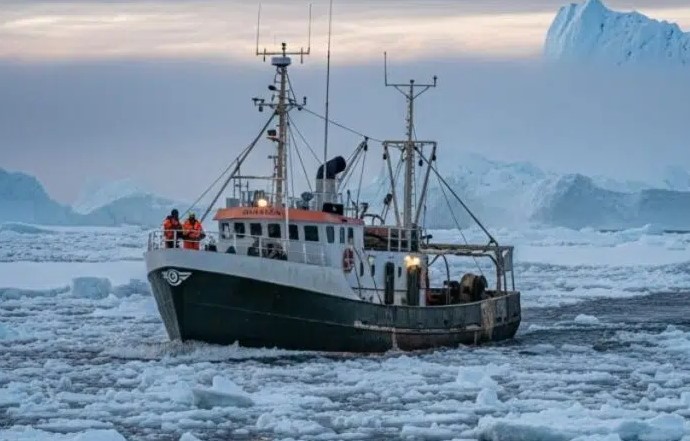
New Polar Code Amendments 2026.

December 2025: Polar waters of the Arctic and Antarctic are witnessing more maritime traffic as the ice caps are melting, allowing cargo-laden ships to traverse the once pristine waters. This is precisely why amendments to the International Code for Ships Operating in Polar Waters (Polar Code) are going to come into effect starting in 2026, related to the safety of navigation and voyage planning.
IMO Polar Code – It is a mandatory framework established to ensure safe ship operations and prevent pollution in the polar regions since it presents harsh weather with low temperatures, strong winds, icebergs, remote locations, which limit search and rescue and a lack of accurate charts and hydrographic data.
The code is implemented through amendments to the International Convention for the Safety of Life at Sea (SOLAS) and the International Convention for the Prevention of Pollution from Ships (MARPOL).
The Polar Code is divided into two parts:
Part I (Safety): Mandatory provisions and guidance for ship design, construction, equipment, operational procedures, and crew training.
Part II (Pollution Prevention): Mandatory provisions and guidance related to the prevention of pollution from ships.
All ships covered by SOLAS operating in defined polar waters must carry a Polar Ship Certificate and an approved Polar Water Operational Manual (PWOM).
New Polar Code Amendments:
The amendments to the Polar Code were adopted through the IMO Resolution MSC.538(107) in June 2023. They will enter into force on 1 January 2026.
They would expand the mandatory safety requirements for voyage planning and navigation to include a few categories of non-SOLAS Ships to improve operational safety and preparedness in polar environments.
Vessels constructed before 01st January 2026 must achieve full compliance by 01st January 2027.
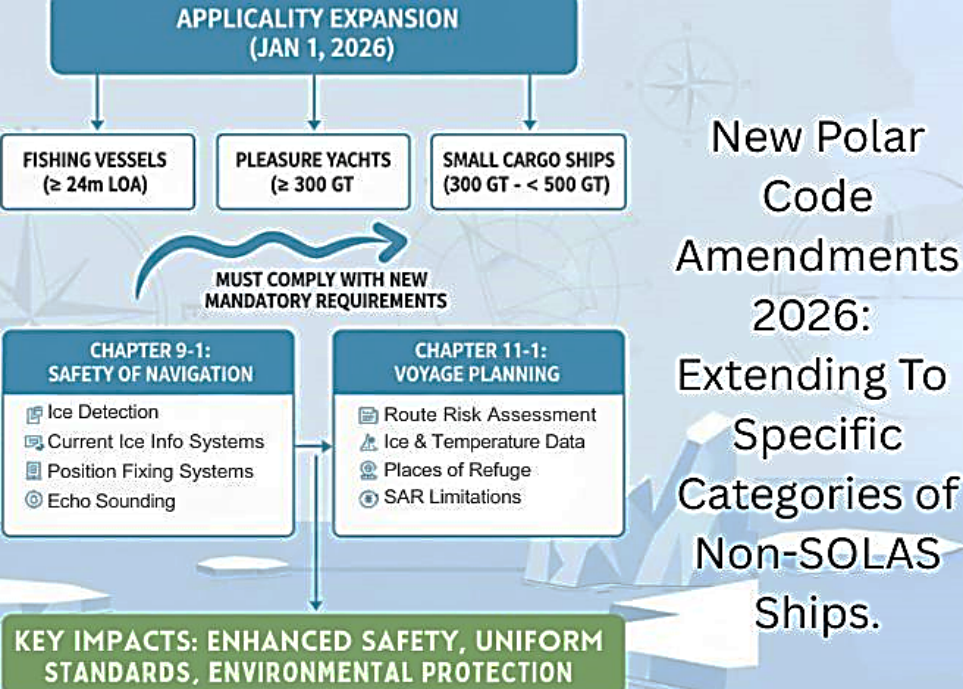
New Vessel Types Under Mandatory Safety Requirements –
From January 01, 2026, the following vessel types must comply with new, bespoke safety of navigation and voyage planning requirements (introduced in new Chapters 9-1 and 11-1 of Part I-A of the Code):
Fishing Vessels: Those of 24 metres in length overall and above.
Pleasure Yachts: Vessels of 300 gross tonnage (GT) and upwards not involved in trade.
Small Cargo Ships: Those of 300 GT and upwards but below 500 GT.
Compliance Note: New vessel constructions after 1 January 2026 must comply with the new rules before operating in polar waters. Existing ships must comply by the first intermediate or renewal survey, whichever occurs first, after 1 January 2027.
Mandatory New Requirements for Safe Navigation –
The amendments introduce mandatory safety requirements, primarily focusing on Chapters 9-1 and 11-1 for the newly included non-SOLAS ships.
Chapter 9-1: Safety of Navigation:
Ships must ensure their navigational equipment and systems are suitable for operating in the harsh conditions of the polar regions.
Key changes include:
Ice Detection: Ships must be able to visually detect ice when operating in darkness (unless operating solely in 24-hour daylight areas), and be equipped with two means of illumination.
Current Information: Means of receiving and displaying current information on ice conditions in the area of operation is mandatory.
Position Fixing: Systems for providing reference headings and position fixing must be suitable for the intended areas of operation.
Echo Sounding: Ice-strengthened ships built on or after January 1, 2026, must have either two independent echo-sounding devices or one device with two independent transducers.
Chapter 11-1: Voyage Planning:
The requirements mandate detailed and informed polar voyage planning procedures, including-
- The Master must consider a route through polar waters, factoring in limitations of hydrographic information and aids to navigation.
- The voyage plan must incorporate current and statistical information on the extent and type of ice and icebergs on the intended route.
- Operators must identify places of refuge and account for the limited Search and Rescue (SAR) capabilities in the operating area.
- If no safety management system is implemented, there should be a documented procedure for operation in polar waters.
- Measures to take when the vessel encounters marine mammals. Information about their seasonal migration areas should also be available.
- Information about the designated protected areas along the route.
Significance for the Maritime Industry –
The 2026 Polar Code safety amendments are important to improve maritime governance in the rapidly changing polar regions.
Small and medium-sized ships like pleasure yachts and fishing vessels are at higher risk when they operate in polar waters due to less robust construction compared to SOLAS vessels. Extending the mandatory safety regulations to these vessels closes a regulatory gap.
The IMO is aiming to establish a uniform global standard for all kinds of vessels to reduce the operational uncertainty for maritime companies and to ensure all the ships contribute to polar risk management.
The amendments demand better planning and equipment on vessels and contribute to preventing accidents while supporting the principles of sustainable Arctic shipping and Antarctic environmental protection.
Team Maverick.






Solar Defence Showcases Indigenous ‘Bhargavastra’ Counter-Swarm Drone System to Indian Army
New Delhi, July 2026 : Solar Defence and Aerospace Ltd. (SDAL) on Friday showcased its ind…
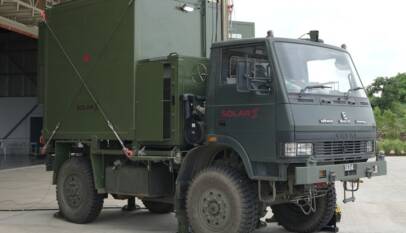
Solar Defence Showcases Indigenous ‘Bhargavastra’ Counter-Swarm Drone System to Indian Army
New Delhi, July 2026 : Solar Defence and Aerospace Ltd. (SDAL) on Friday showcased …