Russia’s Hidden Assault On Europe.

December 2025: It was Russia, who had long ago updated its doctrine for 21st century warfare; whereas in a sharp contrast Europe is still fighting with 20th century tools and reflexes as it pretends this is just “hybrid mischief” rather than an economic war it is now losing piece by piece.
In the current geo political scenario, the West needs to get serious about offensive countermeasures, those which are evitable in the guise of targeted sanctions that actually hurt the specific Russian intelligence units, cut-out companies, and oligarchs who finance and execute these operations.
Western security services those which tracks the Russian economic-intelligence operations say they have seen playbook (the set of tools, conditions, business logic, flows, and tasks that are used to respond to security events and threats in a SOAR environment) before it actually works. Even inside Ukraine, corruption is being weaponised. Recent multibillion-dollar scandals in the energy sector did not just enrich a few well-connected oligarchs; they delayed repairs to the grid, slowed the integration of Western aid, and increased the risk of winter blackouts. Some of the key figures involved have direct ties to Andriy Derkach, a former Ukrainian member of parliament now sitting in the Russian Senate and formally designated as a Russian agent.
Kiev has to start treating certain corruption cases as hostile intelligence operations, not just domestic graft. Europe is defending itself the way a porcupine defends itself against a swarm of hornets, one quill at a time, in every direction, never quite sure where the next sting will land. That has to change. What is needed is simple in theory, but difficult in practice: Governments must finally accept that a phosphate mine in Norway or a liquid natural gas terminal in Germany is as strategic as an airbase, and protect them accordingly with intelligence coverage, mandatory cyber standards, and real-time monitoring of subsea infrastructure.
One of the most instructive current cases is Norge Mining, a British-Norwegian venture sitting on what may be Europe’s largest undeveloped deposit of phosphate, vanadium and titanium, those minerals which the continent desperately needs for fertilisers, batteries and fighter jets. Ever since the project moved toward final permits, it has been buried under waves of leaked emails, doctored environmental studies, sudden “whistle blowers”, cyberattacks and remarkably well-funded local opposition.
Let us be incisive in understanding, that a bizarre local accident that had occurred in western Norway should have set off every alarm bell in Europe. In April 2025, someone remotely seized control of a hydroelectric dam in Bremanger, opened its floodgates, and let millions of cubic meters of water roar downstream for hours. Only months later did Norway’s intelligence service quietly confirm that the culprits were linked to Moscow. And this act wasn’t meant to destroy the dam, rather a calling card.
While most Europeans extolled the peace, miraged by the United States and its allies; Russian artillery pounded Kherson and Kharkiv, a parallel, silence campaign being fought inside the engine rooms of Europe’s economy. The weapons are not tanks but malware, forged documents, anonymous leaks, shadow tankers and well-timed “grassroots” protests.
The targets are the very things Europe needs to free itself from Russian energy and Chinese raw materials: new liquid natural gas terminals, wind-farm control systems, undersea data cables, rare earth element mines, and the companies bold enough or foolish enough to build them. The numbers can no longer be ignored.
In 2024 alone, the European Union Agency for Cybersecurity logged more than 11,000 serious cyber incidents across the European Union, with attacks on industrial control systems jumping to nearly 20% of the total. The pattern is unmistakable. When Germany’s Enercon lost remote access to 5,800 wind turbines after the 2022 Viasat hack, it was an early proof of concept. Since then, Vestas, Nordex, French grid operators, and Italian substations have all been hit. In the Netherlands, someone briefly took over port-logistics systems in Rotterdam and Eemshaven, just as new liquid natural gas import facilities came online.
At sea, the sabotage has moved from plausible deniability to routine. The ruptured Baltic Connector gas pipeline and the severed Estonian data cable in 2024 both carried the same forensic fingerprints European services have learned to recognise. Meanwhile, Russian “research” ships linger suspiciously close to the arteries that carry 70% of Europe’s internet traffic. And Moscow’s shadow fleet comprising hundreds of aging and uninsured tankers keeps the Western sanctions at bay while creating convenient cover for “accidental” anchor-dragging exercises near critical infrastructure.
On dry land, the Russians has turned expropriation into an art form. For example, the Russian subsidiaries of Danone and Carlsberg were simply confiscated in 2023 and handed to regime-friendly oligarchs. Any Western company trying to leave Russia faces a forced fire-sale at a 50% discount, in addition to 15% “exit tax” that has quietly transferred more than $60 billion into Moscow’s war chest since 2022.
As a result of these onerous conditions, more than 11,000 companies, mostly from Germany and the U.S. have remained in Russia, where they contribute an estimated $5 billion in taxes to the nation.
The information war runs in parallel, and it is getting surgical. The Doppelgänger network of fake news sites is the blunt instrument; the sharper tool is the anonymous drip of real but carefully edited corporate documents to journalists and activists.
On the 14th of this month, Maverick News had reiterated that Politics is no longer the art of governing, but rather a field of emotional engineering. What a leader makes people feel is more effective than what they say. Voters often react not to the concrete facts themselves, but to how those facts are packaged. Now, it doesn’t require to violate a country’s borders to bring it down. It’s enough to target its security, stability, and reputation. A flawed strategy is longer the weapon to bankrupt a company; a well-orchestrated chain of rumours is sufficient. A few manipulative social media posts, a few targeted comments, and a few artificially created agendas are enough to destroy the most educated, coasted powerful individual.
Team Maverick.





HAL Set to Increase TEJAS MK-1A Production to 30 Jets Annually as GE Commits Higher Engine Deliveries
New Delhi, July 2026 : Hindustan Aeronautics Limited (HAL) is preparing to significantly r…
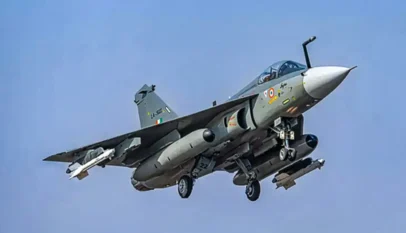
HAL Set to Increase TEJAS MK-1A Production to 30 Jets Annually as GE Commits Higher Engine Deliveries
New Delhi, July 2026 : Hindustan Aeronautics Limited (HAL) is preparing to significantly ramp …