Tamil Nadu Waives Motor Vehicle Tax For Electric Vehicles Until 2027.

Chennai; January 2026: The Government of Tamil Nadu has extended the 100% exemption from motor vehicle tax for all electric vehicles (EVs) in the state for a further two-year period, from January 01, 2026, to December 31, 2027. The order provides a complete waiver of motor vehicle tax for both transport and non-transport battery-operated vehicles. Exemption applies to all categories of EVs registered in the state.
The order forms part of the state’s continued implementation of the Tamil Nadu Electric Vehicles Policy, 2023, which aims to accelerate EV adoption, reduce dependence on fossil fuels, and lower the total cost of ownership for electric vehicles. Motor vehicle tax is a significant cost component for vehicle
buyers, and the exemption directly reduces acquisition costs for EV users across private and commercial segments.
The government has cited the steady growth in EV adoption as a key justification for the extension, noting that EV penetration in Tamil Nadu reached approximately 7.8% in 2025, reflecting sustained market momentum. The extension follows representations from vehicle manufacturers, who informed the government that EV uptake in the state has gained strong momentum and that continuation of the tax exemption is critical to sustaining growth across segments.
Acting on these representations, the Transport Commissioner, through a letter dated 02nd December 2025, formally recommended extending the exemption for a further two years in line with the Tamil Nadu Electric Vehicles Policy, 2023. In addition to granting the exemption, the order directs the
Transport Commissioner to submit a detailed analysis on the potential impact of imposing motor vehicle tax on EVs in the future and to compare Tamil Nadu’s EV taxation framework with practices followed by other Indian states.
EV sales in India has reached 560,637 units in the third quarter (Q3) of 2025, which is an 12.5% year-over-year increase from 497,974 units. EVs accounted for 8% of the overall automobile sales, which
totalled 5,796,216 units in Q3, according to data released by the Ministry of Road Transport and Highways through official sources. 150,000 new jobs over the next five years, according to the state government’s EV Policy 2023. Further, the policy would facilitate the manufacturing of EVs, EV components, and charging infrastructure in the state with an EV special manufacturing package.
Earlier in February 2023, Tamil Nadu had informed that the state plans to attract Rs.500 billion ($6.04 billion) in investments in the electric vehicle (EV) manufacturing segment and create 150,000 new jobs in the next five years, the state government’s EV Policy 2023 said.
Further, the policy would facilitate the manufacturing of EVs, EV components, and charging infrastructure in the state with an EV special manufacturing package. The policy will be valid for five years. The policy aims to make Tamil Nadu a preferred destination for EV manufacturing in Southeast Asia. Additionally, the policy seeks to accelerate EV adoption and enhance the EV ecosystem’s
development in the state. The policy has announced a host of concessions to be provided by the state government. These are broadly divided into three categories: supply side, demand side, and EV charging infrastructure.
Supply Side Measures – Eligibility: To avail incentives under the package, the investment in the eligible fixed assets (EFA) should be greater than Rs.500 million ($6.04 million) and create at least 50 direct jobs. For projects with investment in EFA below Rs.500 million ($6.04 million), the Tamil Nadu Micro, Small, and Medium Enterprises (MSME) Policy 2021 would be applicable.
Inclusion of R&D in EFA: To encourage research and development (R&D) in EV manufacturing, EFA shall include the following R&D-related expenditure, subject to a ceiling of up to 20% of EFA:
- Expenditure incurred on new R&D: Test and measuring instruments, prototypes used for testing, purchase of design tools, software cost, and license fee, expenditure on technology, patents, and copyrights for R&D
- Expenditure related to the transfer of technology agreements: This will include the cost of technology and initial technology purchase related to the goods that are used in manufacturing and R&D for EVs
Investment Promotion Subsidy: New projects in the manufacturing of EVs, EV components, EV
supply equipment, or EV charging infrastructure can avail incentives under one of the four options provided below based on their eligibility.
Reimbursement of SGST: New projects for manufacturing EVs will be eligible for 100% reimbursement of the State Goods and Service Tax (SGST) payable on the sale of EVs manufactured,
sold and registered in the state for 15 years from the date of commercial production.
Turnover-based Subsidy: New projects will be eligible for a subsidy of up to 2% of the project’s annual turnover, subject to a yearly cap of 4% of the cumulative investment in EFA for 10 years from the date of commercial production.
Capital Subsidy: New eligible projects can avail of a capital subsidy of 15% of investment in EFA, which will be disbursed in ten equal annual installments.
Special ACC Capital Subsidy: New projects in advanced chemistry cells (ACC) manufacturing will be eligible for a special capital subsidy of 20% of investment in qualified fixed assets, which will be disbursed in ten equal annual installments.
Electricity Tax Exemption: Projects will be provided 100% exemption on electricity tax for a period of five years on power purchased from the Tamil Nadu Generation and Distribution Corporation (TANGEDCO) or generated and consumed from captive sources.
Stamp Duty: Projects that obtain land by sale or lease will be entitled to a 100% exemption on stamp duty for the purchase or lease of land obtained from the government. In the case of private land, a 100% stamp duty concession will be provided.
Intellectual Property Creation Incentive: Under this incentive component, projects will be eligible for 50% reimbursement on the cost incurred for patents, copyrights, and trademarks, subject to a maximum of Rs.10 million ($120,757) for the period of the investment during the policy period.
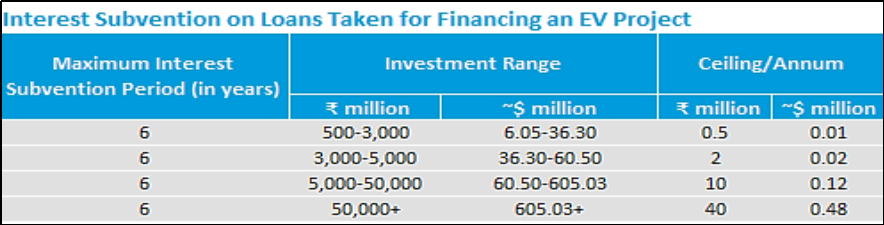
Interest Subvention: The state will provide an interest subvention of 5% as a rebate on the interest rate, on actual term loans taken to finance the project, for six years, subject to the limits mentioned in the table below.
Special Incentives for MSME Sector –
An additional capital subsidy of 20% will be offered over and above the eligibility limit under the existing capital subsidy program to MSME units engaged in manufacturing EV components or the development of charging infrastructure.
Demand Side Measures –
Electrification of Vehicular Fleets: The state will develop a roadmap to electrify public and institutional fleets operating in the state in a phased manner. The state transport undertaking buses constitute a substantial percentage of the public transport in Tamil Nadu. The state plans to increase the share of electric buses to 30% of the fleet by 2030. Vehicular fleets of educational institutions such as schools and colleges and private buses in the state will be encouraged to transition to EVs in a gradual manner. Also, staff bus operators for industrial establishments and service sector enterprises will be encouraged to transition to an EV fleet, given the advantage in the total cost of ownership.
Demand Aggregation: The government will undertake efforts to collaborate with demand aggregators such as Convergence Energy Services to conduct a demand assessment study and aggregate demand for EVs to enable cost discovery and reduce procurement costs.
Road Tax Exemption: The government plans to provide a 100% road tax exemption until December 31st, 2025, for battery-operated vehicles, namely, two wheelers, private cars, three-seater auto-rickshaws, transport vehicles, light goods carriers, and buses.
Waiver on Registration Charges: Waiver on registration charges will be provided until December 31st, 2025, for battery-operated vehicles, namely, two-wheelers, private cars, three-seater auto-rickshaws, transport vehicles, light goods carriers, and buses.
Waiver on Permit Fees: Waiver on permit fees will be provided for battery-operated vehicles, namely, auto-rickshaws, transport vehicles, light goods carriers, and buses.
Special Incentives: The state government will seek to provide the initial impetus for driving EV adoption in the state by incentivizing commercial vehicles by providing the following incentives until December 31st, 2025.
Charging Infrastructure –
Tariff for EV Charging: A new category has been created for public charging stations, and private charging stations will be treated as domestic consumption. To support the growth of public charging stations, the government will revise the energy tariffs, with due approval from Tamil Nadu Electricity Regulatory Commission (TNREC). The proposed revision will seek to decrease the cost of operations for
public charging stations operators with the following changes:
Reduction in demand charges: Reduction of existing charges by 75% for the first two years and after that by 50% for the subsequent two years
Reduction in energy charges: Reduction of charges by 50% between 08:00 Hours and 16:00 Hours to incentivise charging during non-peak hours to promote usage of renewable energy for EV charging. The supply of renewable energy will be ensured to public and private charging stations and public battery swapping stations on a preferential basis with applicable TNERC levies.
Public charging Stations – Firms planning to establish public charging stations in Tamil Nadu will be eligible for a 25% subsidy of the cost involved in the purchase of equipment and machinery during the policy period. Fast charging stations will be provided incentives up to Rs. 1 million ($12,076), and slow charging stations will be provided incentives up to Rs. 100,000. The government has decided to incentivise 20 fast charging stations and 500 slow charging stations.
Private Charging stations – The first 50 private charging stations set up in the state will be eligible for a capital subsidy of 25% on the cost involved in purchasing equipment and machinery during the policy period.
Incentives for Public Battery Swapping Stations – The first 200 public battery swapping stations set up will be eligible for a capital subsidy of 25% on the cost involved in the purchase of equipment and machinery limited to Rs. 200,000 ($2,415) per station.
Retrofitting – The government will also incentivise commercial vehicles, which will retrofit their existing internal combustion engine vehicles and convert them into EVs. The E-2 wheelers will be provided an incentive of Rs.10,000 ($120.8)/kWh, and E-3 wheelers will also be provided a subsidy of Rs. 10,000 ($120.8)/kWh. The government aims to incentivise 30,000 E-2 wheelers and 15,000 E-3 wheelers.
EV Cities – The government will declare Chennai, Coimbatore, Tiruchirappalli, Madurai, Salem, and Tirunelveli, as EV cities to provide an impetus toward EV adoption. The smart city commissioner will be
appointed as the nodal officer in each of these cities to coordinate and drive EV adoption.
In the last six months, many states have announced new EV Policies to facilitate the adoption of EVs.
Last October, the union territory of Chandigarh announced its new EV policy. Chandigarh has targeted 70% of all new vehicle registrations in the union territory to be EVs in the next five years. Chandigarh plans to establish itself as a ‘Model EV City’ by achieving one of the highest penetration of zero-emission vehicles amongst all Indian cities.
Team Maverick.


Gujarat Tops NITI Aayog’s Investment Friendliness Index 2026, Emerges as India’s Leading Investment Destination
Gandhinagar, July 2026 : Gujarat has secured the top position among India’s major St…
Gujarat Tops NITI Aayog’s Investment Friendliness Index 2026, Emerges as India’s Leading Investment Destination
Gandhinagar, July 2026 : Gujarat has secured the top position among India’s major States …