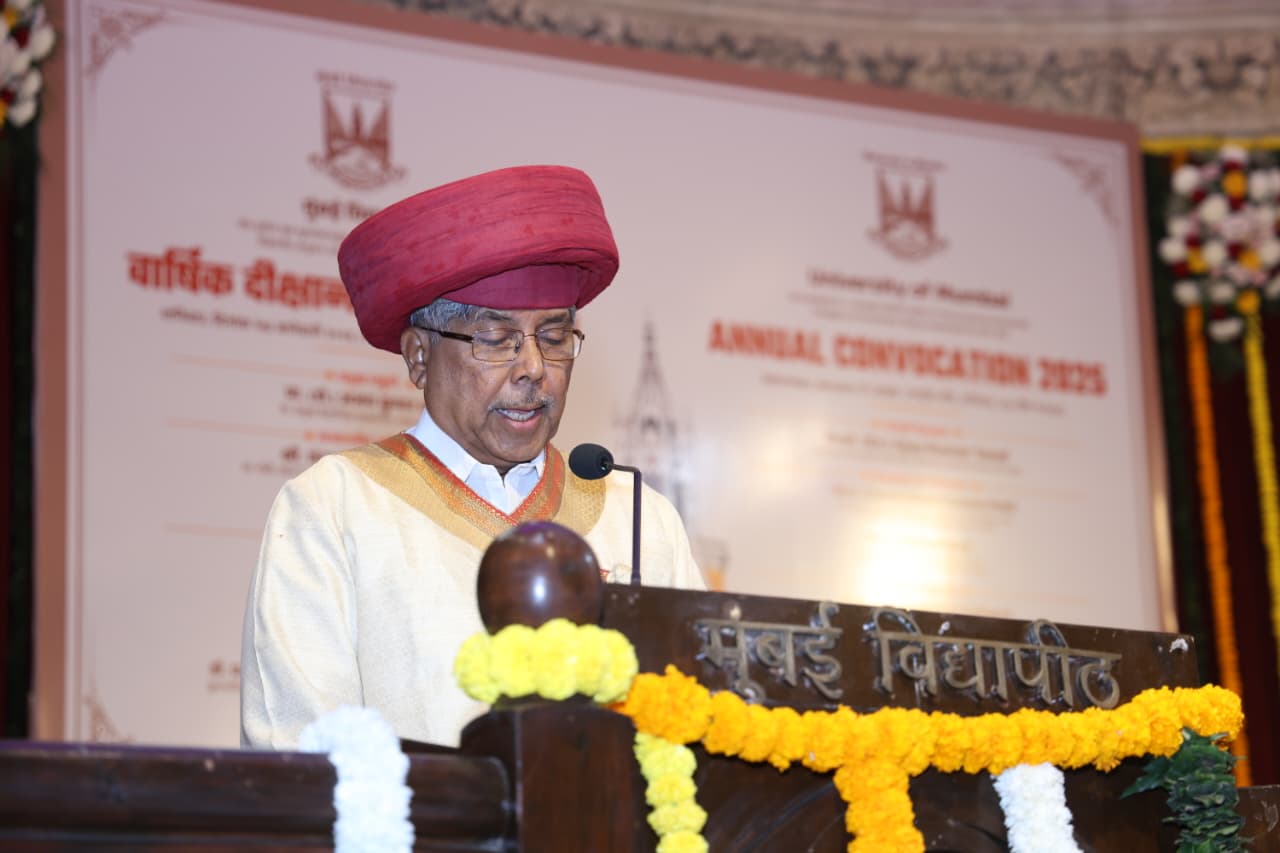
National Education Policy Will Shape a Capable and Creative India – Minister Chandrakant PatilUniversity of Mumbai Annual Convocation Ceremony

Mumbai, January 2026 : The University of Mumbai is one of the country’s leading institutions that has illuminated the path of modern education. Eminent personalities such as Justice Ranade, Lokmanya Tilak, Mahatma Gandhi, Dr Babasaheb Ambedkar, and Swatantryaveer Savarkar studied here. Following in their footsteps, newly graduated students should make meaningful contributions to the nation’s progress. The National Education Policy (NEP) 2020 is a strong foundational framework to build a capable, creative, and knowledge-driven India. Through this policy, students will be inspired toward innovation, research, and entrepreneurship, enabling their active participation in the country’s holistic development, said Minister for Higher and Technical Education Chandrakant Patil.
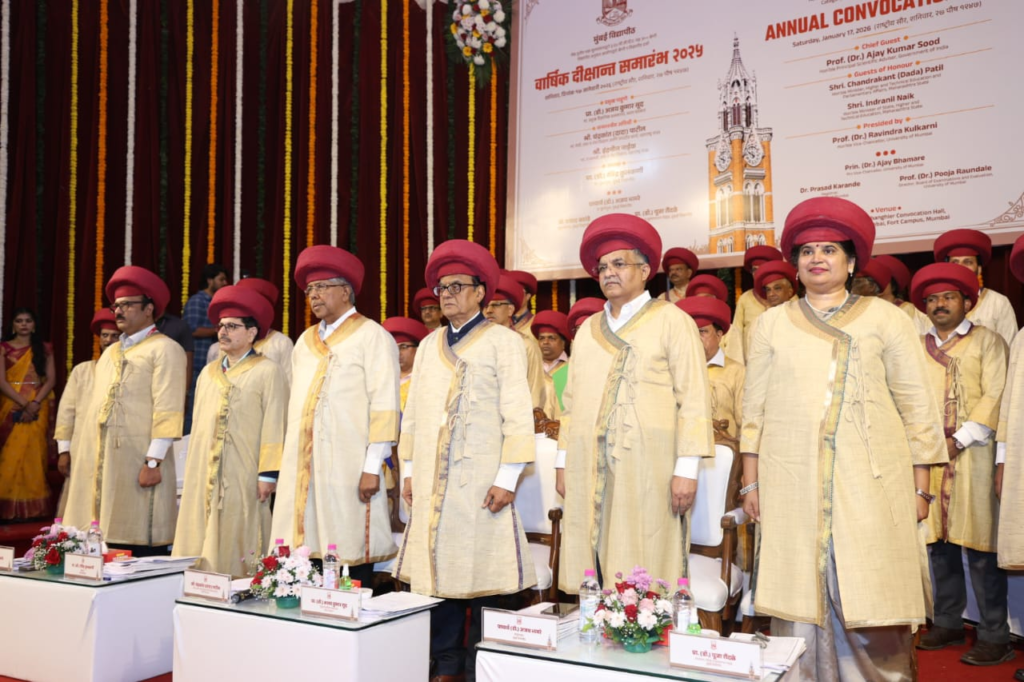
Minister Patil was speaking at the University of Mumbai’s annual convocation ceremony held at the Sir Cowasji Jehangir Convocation Hall, Fort, Mumbai. The Chief Scientific Adviser to the Government of India, Prof. Ajay Kumar Sood, was present as the chief guest. Also present were Vice-Chancellor Prof. Ravindra Kulkarni, Pro Vice-Chancellor Dr Ajay Bhamre, Registrar Dr Prasad Karande, Director of the Board of Examinations and Evaluation Dr Pooja Raundale, members of the Senate, Management Council and Academic Council, deans and associate deans of various faculties, principals, heads of departments, and professors from affiliated colleges.
Minister Patil said that the 21st century is witnessing rapid transformation in the fields of knowledge, science, and technology. Students must focus on learning “how to learn.” The National Education Policy will make education more experiential, inclusive, and joyful. Along with science, it integrates arts, sports, culture, and value education to nurture well-rounded individuals.
He further emphasized that teachers are the cornerstone of the education system. Empowering teachers and attracting the best intellectual talent to the education sector is the need of the hour. An education policy rooted in India’s ancient knowledge traditions will produce students with self-awareness, creativity, and a strong sense of social responsibility.
Curiosity, Creativity, and Innovation Are the Foundation of National Progress – Dr Ajay Kumar Sood
Chief Scientific Adviser Prof. Ajay Kumar Sood said that Indian youth are emerging as global agents of change, and education that combines curiosity, creativity, and innovation will be the pillars of India’s progress.
He stressed the need for three key shifts in teaching methods: curiosity-driven learning, conceptual understanding, and hands-on experimental education. Quality education, employability, and advances in artificial intelligence are helping India emerge as a global leader, he said.
Dr Sood elaborated on the ‘S-LIFE Framework,’ emphasizing the connection between science and daily life, revitalization of laboratories, integration of research into curricula, organization of science festivals, and digital engagement of youth. He noted that the Government of India’s ‘One Nation One Subscription’ (ONOS) initiative is democratizing access to research, enabling millions of students to access world-class research resources. He also called for leveraging AI-based DPI 2.0 to bring transformative change in health, agriculture, and sustainable development.
Walking in the footsteps of leaders such as Mahatma Gandhi, Dr Babasaheb Ambedkar, and Sardar Patel, today’s youth will build a strong India through courage, creativity, and commitment, Dr Sood said while motivating the graduates.
Vice-Chancellor Prof. (Dr) Ravindra Kulkarni presented the university’s annual report.
Degrees Awarded to 1,72,522 Graduates Across Disciplines
At this year’s convocation, degrees were conferred upon 1,72,522 graduates from various disciplines at the undergraduate and postgraduate levels. This included 84,318 male students, 88,202 female students, and two students from other categories. Of these, 1,49,982 students were from undergraduate programs and 22,540 from postgraduate programs.
602 PhD Degrees Awarded
A total of 602 candidates were awarded PhD degrees this year, including 269 in Science and Technology, 145 in Commerce and Management, 109 in Humanities, and 79 in Interdisciplinary Studies. Additionally, 21 medals were awarded to 19 meritorious students, including 12 women and seven men, along with two competitive awards.
Degree Certificates to Be Available on DigiLocker
After the convocation, the University has initiated the process of making degree certificates available to students on DigiLocker. For students with active ABC ID accounts, mark sheets and credit details will also be made available on DigiLocker.



Jaishankar, Rubio Push for Defence Pacts and Near-Final Trade Deal at Manila Meeting
Manila, July 2026 : India and the United States on Wednesday gave fresh momentum to their …
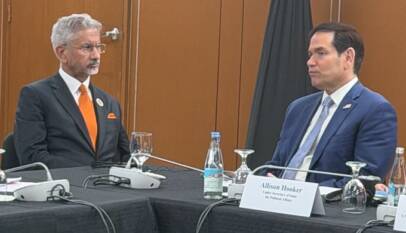
Jaishankar, Rubio Push for Defence Pacts and Near-Final Trade Deal at Manila Meeting
Manila, July 2026 : India and the United States on Wednesday gave fresh momentum …