Double the Profit Compared to Paddy Cultivation: Horticulture Transforms a Farmer’s Economic Prospects

Lower costs and higher income through technical guidance and government subsidies
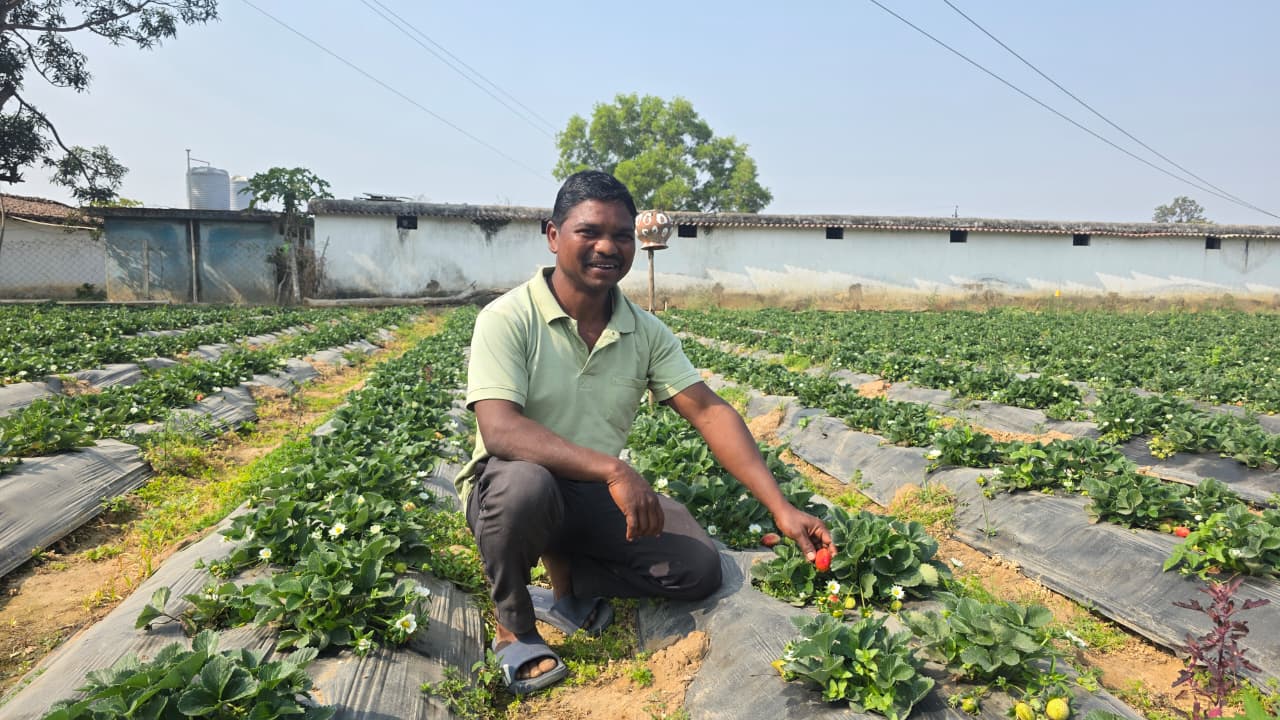
Ambikapur, January 2026 : With the support of government horticulture promotion schemes, farmers in the district are breaking away from the limitations of traditional farming and moving towards new, more profitable opportunities. Instead of relying solely on paddy cultivation, farmers are now adopting high-value crops that offer better returns. Lal Bahadur Singh, a farmer from Bhagwanpur Khurd village, has embraced this change and today has established himself as a progressive, self-reliant, and successful farmer.
Successful Shift from Paddy to Horticulture
Farmer Lal Bahadur Singh said that despite cultivating paddy for many years, the profits remained limited. Rising input costs and heavy dependence on weather conditions often reduced net returns. During this time, officials from the Horticulture Department informed him about high-value crops such as strawberries and explained their economic advantages. This guidance motivated him to bring innovation into his farming practices.
From a Small Beginning to Large-Scale Expansion
He began strawberry cultivation on just 50 dismil of land. Encouraged by the profits, he expanded the cultivation area to one acre in the following year. In the third and fourth years, he further increased the area to 2.5 acres. At present, he is successfully cultivating strawberries on 2.5 acres of land, earning a substantial income from the crop.
Lower Cost, Higher Returns with Strawberry Cultivation
According to Lal Bahadur Singh, the total cost of cultivating strawberries on 2.5 acres is approximately ₹2 lakh. From this, he expects an income of around ₹9 lakh, resulting in a net profit of nearly ₹7 lakh after expenses. In comparison, if the same 2.5 acres were used for paddy cultivation, the yield would be about 90 quintals. Selling this produce at government procurement centres would generate around ₹3 lakh in revenue. After deducting cultivation costs of nearly ₹1 lakh, the net profit from paddy would be only about ₹2 lakh.
Reduced Expenses and Increased Profit through Subsidies
He further explained that under the horticulture department’s scheme, the cost of saplings, fertilisers, and seeds is reimbursed through Direct Benefit Transfer (DBT). He expects to receive a subsidy of approximately ₹80,000 to ₹85,000. In addition, regular technical guidance provided by the department has helped make the cultivation more efficient and successful.
Technical Support Key to Success
Lal Bahadur Singh said that he procures the plants himself and carries out cultivation strictly according to the standards prescribed by the horticulture department. Departmental officers regularly inspect his fields and provide necessary advice, which improves both the quality and quantity of produce, enabling him to secure better prices in the market.
A Source of Inspiration for Other Farmers
He believes that other farmers can also benefit from government horticulture schemes. By adopting horticultural crops alongside traditional ones like paddy, farmers can significantly increase their income. Having become self-reliant and economically empowered through horticulture, he is now inspiring other farmers to follow the same path.
Gratitude to the State Government
Farmer Lal Bahadur Singh expressed his gratitude to Chhattisgarh Chief Minister Vishnu Deo Sai for promoting horticulture farming. He said that due to such government initiatives, farmers in the state are becoming stronger, self-reliant, and more progressive.







Congress Lines Up Rahul, Priyanka for Key Lok Sabha Debate on Anti-Paper Leak Bill
New Delhi, July 2026 : The Congress has fielded some of its top leaders, including Leader …

Congress Lines Up Rahul, Priyanka for Key Lok Sabha Debate on Anti-Paper Leak Bill
New Delhi, July 2026 : The Congress has fielded some of its top leaders, …