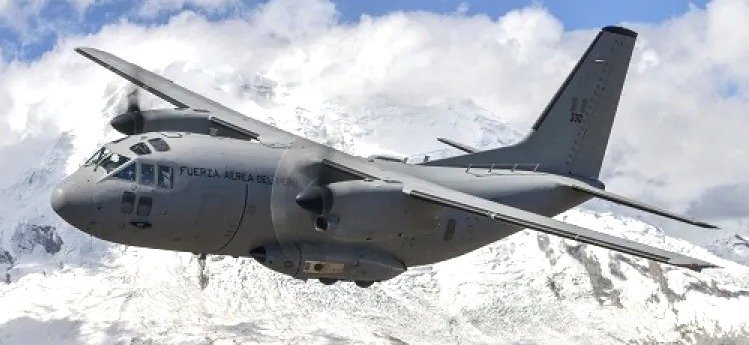
Santiago; November 2026: The Antarctic Affairs Division of the Chilean Ministry of Foreign Affairs has informed the Peruvian Air Force ( FAP ) that it will be able to operate the C-27J Spartan aircraft from Teniente Marsh Airfield , located at the Presidente Frei Antarctic Base. The aircraft will participate in the 33rd Peruvian Scientific Campaign to Antarctica (Antar XXXIII), and its flights are scheduled between December 2026 and February 2027.
The authorization was granted following a technical evaluation conducted by the Chilean Air Force (FACh) and the Directorate General of Civil Aeronautics (DGAC). The process determined that the tactical transport aircraft meets the requirements to operate on the runway of the Tenienite Marsh Antarctic airfield, from where it would be able to reinforce the airlink with the Machu Picchu Antarctic Scientific Station.
The Peruvian Air Force (FAP) submitted a technical dossier that included the aircraft's environmental impact study, its certifications, and documentation related to operational risk management. This documentation allowed them to obtain authorization to incorporate the C-27J Spartan into logistical operations and transport researchers, military personnel, and equipment destined for activities of the Peruvian Antarctic program.
The dossier also included contingency plans and emergency response procedures, in accordance with international provisions for the protection of the Antarctic ecosystem. Spartan operations will be subject to safety protocols and bilateral aeronautical coordination. Flight planning must comply with operational notices (NOTAMs) and procedures established in coordination with Chilean authorities.
The C-27J Spartan, manufactured by Leonardo, is notable for its ability to operate on short or unpaved runways and perform multiple missions. It can transport up to 60 troops or heavy cargo and be quickly reconfigured for medical evacuation missions with stretchers, long-range search and rescue operations thanks to its autonomy, or forest firefighting tasks using the modular Maffs II system.
This tactical transport aircraft has a maximum takeoff weight of 32,500 kg, a maximum landing weight of 30,500 kg, a maximum payload of 11,300 kg, and a maximum payload of 7,800 kg in a tactical flight profile.
It is powered by two Rolls-Royce AE 2100-D2A engines, each producing 4,637 shp, and two Dowty R-391 six-bladed propellers. It achieves a maximum cruising speed of 602 km/h, a service ceiling of 9,144 metres, a cruising altitude of 8,382 metres at 95% of maximum load, and a range of 5,056 km with a 4,536 kg payload.
It incorporates winglet devices that reduce fuel consumption and improve performance during takeoff in high-temperature or high - altitude conditions. Furthermore, it is equipped with an auxiliary power unit (APU), a digital cockpit with high-definition displays, precision navigation systems, encrypted communications equipment, and self-protection systems for safe operation in harsh environments, among other technologies.
Team Maverick