Abhijeet Dipke alleges electoral-roll manipulation and demands probe into SIR; Election Commission maintains decisions were unanimous
New Delhi, Sept 2026 : The Cockroach Janata Party (CJP) on Thursday demanded the resignation of Chief Election Commissioner Gyanesh Kumar within 48 hours and warned that it would launch a nationwide agitation if he failed to step down.
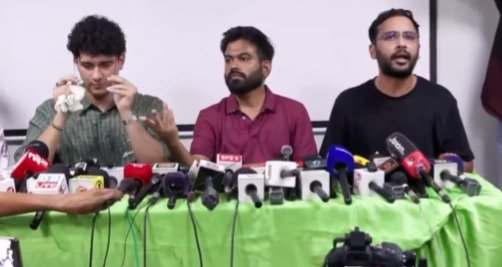
Addressing a press conference in New Delhi, CJP founder Abhijeet Dipke said the organisation would continue its campaign until Kumar resigned. The demand comes amid a fresh controversy surrounding the Election Commission of India (ECI) and the Special Intensive Revision (SIR) of electoral rolls.
“If within 48 hours Gyanesh Kumar doesn’t resign, the Cockroach Janata Party will start a nationwide agitation. We won’t step back till the time Gyanesh Kumar resigns,” Dipke said.
The CJP’s demand followed reports that Election Commissioners Sukhbir Singh Sandhu and Vivek Joshi had formally raised objections on at least 14 occasions over a period of 10 months on issues connected with voter registration, deletion and restoration of names, changes to Form 6 and the management of electoral-roll data.
The Election Commission, however, has rejected the suggestion that the reported differences amounted to a breakdown within the three-member constitutional body. In its response to the reports, the ECI said written suggestions and differing views were part of its internal decision-making process and maintained that decisions relating to SIR had been taken unanimously.
Dipke launched a strong attack on Kumar, accusing the CEC of undermining democracy and the right to vote. He alleged that the functioning of the poll panel under Kumar had created a situation in which the authorities, rather than citizens, were effectively deciding who could participate in elections.
“What did democracy mean in our country? Democracy meant that the people would choose the government; the people would decide whom they want to vote for,” Dipke said.
He alleged that changes in the electoral-roll system had fundamentally altered that principle and described the process as undemocratic. His remarks were political allegations and were not established findings against the CEC.
The CJP founder also linked his criticism to the 2024 Lok Sabha elections, arguing that the BJP's tally of 240 seats, below the 272 needed for a majority on its own, demonstrated a change in the political landscape. He alleged that subsequent electoral developments involving opposition leaders showed a broader pattern.
Dipke further alleged that voter deletions had affected constituencies associated with several opposition leaders and cited figures involving West Bengal, Tamil Nadu and Delhi. These specific claims were presented by him as evidence of a pattern, but he did not provide supporting documentation at the press conference, and they should not be treated as independently established facts.
He also accused the Election Commission of having played a role in the political dispute surrounding the Shiv Sena and the allocation of its election symbol, alleging that the poll panel had favoured a rival faction. The Election Commission's decisions concerning party recognition and symbols are governed by the election law framework and have been challenged and litigated by political parties in different cases.
Dipke said the controversy over the SIR had made the functioning of the Election Commission a matter of public concern. He referred to the recent investigation by The Indian Express, which reported that Sandhu and Joshi had objected to several decisions concerning electoral-roll management.
Among the issues highlighted in that investigation were the modification of Form 6, access to electoral-roll databases and the role of the Commission's information-technology systems. The report said the two Election Commissioners had raised concerns about what they described as the possible centralisation of control over electoral-roll data.
The report also examined an episode in Goa in which 97 voters were found eligible by Electoral Registration Officers but, according to the investigation, the software did not allow their decisions to be recorded before the final roll was published.
The Election Commission has maintained that such internal objections should be viewed in the context of institutional deliberation rather than as evidence that final decisions were taken without the authority of the full Commission. It has also stressed that the three-member body continued to function collectively and that its decisions were unanimous.
The controversy has nevertheless intensified political criticism of the poll panel. Opposition parties have separately demanded Kumar's removal, a probe into the functioning of the ECI and a review or halt to aspects of the SIR exercise.
The CJP has gone further, demanding that the SIR process be halted and that an independent inquiry examine the decision-making process surrounding electoral-roll revisions. Reports on Thursday said the organisation also sought a freeze on upcoming elections while the issues were examined.
CJP co-convenor Saurav Das also criticised the electoral system, describing it as “corrupt” and “broken” and arguing that young people were seeking fundamental changes.
He said the right to vote remained one of the most important constitutional instruments available to citizens to influence governance.
“But how will the system change? If your right to vote, which is the only tool you have to bring about change in your life, is taken away from you or stolen from you, then how will change come?” Das asked.
The CJP's ultimatum places the organisation's campaign against the Election Commission at the centre of the current SIR controversy. The group has said that if Kumar does not resign within 48 hours, it will begin protests across the country, while the Election Commission continues to maintain that its final decisions have been taken in accordance with its institutional processes.