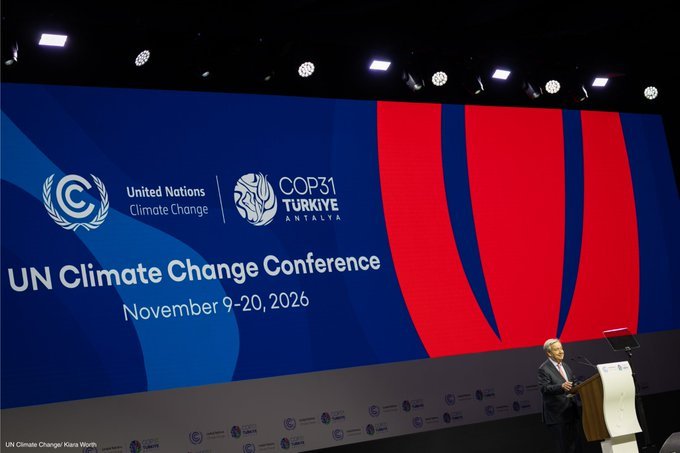
Antalya; November 2026: Since it was launched last spring, the UN High-Level Expert Group on the Net Zero Emissions Commitments of Non-State Entities has been pursuing its work amidst a confluence of crises:
·global economic impacts of a persistent pandemic;
·the Russian invasion of Ukraine, ensuing inflation and energy security concerns;
·climate change-fuelled extreme weather around the world.
The impacts of these crises have been felt everywhere, but they have been most acute in the world’s least developed countries, exacerbating the debt crisis they already face.
China had its driest summer in 60 years, shrinking the Yangtze River to half its width; while, Pakistan suffered floods that submerged one‑third of the country and displaced more than 30 million people. The southwest Gulf coast of Florida was ravaged by a turbocharged hurricane, while Western Europe suffered the highest temperature peaks during the summer. Furthermore, tens of millions of Africans face acute food insecurity in the drought-ravaged Horn of Africa. These and other climate-fuelled disasters are resulting in trillions of dollars of damages and displacing tens of millions of people. There have been 29 disasters which cost over $1 billion each so far this year. The toll isn’t only on humans, but on nature itself. Over the past five decades, global wildlife populations have plummeted nearly 70% due to climate change and other human activities.
In many instances, these impacts are unfolding even faster than scientists had predicted, which only increases the urgency of heeding their advice: to limit warming to 1.5°C, global emissions must peak by 2025 and be cut in half by 2030, on the way to net zero emissions by mid-century. Yet the most recent UNEP Emissions Gap Report finds that the international community is falling far short of that goal under present policies and Nationally Determined Contributions (NDCs). The International Energy Agency’s recent update of its net zero Scenario finds that the emission pathway “remains narrow but still achievable” with the need for a comprehensive government response.
While some with vested interest in the status quo have suggested that efforts to achieve net zero should be slowed on account of these crises, most recognise the interrelationship between these crises and the reality that accelerated climate action offers critical benefits, ranging from community health to energy and food security. The flip side of this is the heightened awareness, globally but most especially in the European Union, that reliance on fossil fuels not only drives climate change but presents clear and present threats to both economic and national security.
It’s clear that now is not the time to slow down, but to double down, on investments in equitable access to renewable energy and nature protection, especially in developing countries, and on efforts by non-state actors to reach net zero. While climate change is a threat multiplier, well-designed efforts to mitigate it can be a solution multiplier, enhancing food and energy security, equity, and affordability. It’s also clear that vast differences between developed and developing countries remain in terms of access to public and private finance, technology and data, among other issues. Least developed countries, small island developing states, African countries, landlocked countries, middle-income economies and even emerging economies all face specific challenges. They must be recognised and fully addressed.
The Expert Group was convened at this crucial moment in time. In the years after the call for a balance between sinks and sources of emissions in the Paris Agreement became the concept of “ net zero”, thousands of cities, regions, companies and financiers formed a voluntary groundswell and swung behind the concept. But net zero is now at an inflection point. Some of those non‑state actors did not follow their net zero pledges with action, in spite of the urgency set out in the science. Some may have underestimated the task or interpreted net zero differently. Some may never have intended to achieve their stated goals, aiming only to benefit from the positive press abounding at the time. Many others are making good faith efforts to work toward global climate goals but do not yet know exactly what is required, or lack capacity or resources to deliver on their targets.
What the Expert Group offers here is a roadmap to prevent net zero from being undermined by false claims, ambiguity and “greenwash”. We have built on the existing science and best-in-class voluntary efforts to create a universal definition of net zero, based on five principles and ten recommendations to guide the future of net zero, and focused on the actions that need to be taken by cities, states, corporations and those who regulate them.
The risk is clear. If greenwash premised upon low-quality net zero pledges is not addressed, it will undermine the efforts of genuine leaders, creating both confusion, cynicism and a failure to deliver urgent climate action. Which is why, ultimately, regulations will be required to establish a level playing field and ensure that ambition is always matched by action.
The ten recommendations go into more detail about what non-state actors need to consider through each stage of their progress towards being net zero aligned and what the successful attainment of that status can and must contribute to the global effort to address the climate crisis.
The key highlights of the recommendations include:
·A net zero pledge must be a commitment by the entire entity, made in public by the leadership, and be reflective of the city, region or corporation’s fair share of the needed global climate mitigation.
·A net zero pledge must contain stepping stone targets for every five years, and set out concrete ways to reach net zero in line with the Intergovernmental Panel on Climate Change (IPCC) or International Energy Agency (IEA) net zero greenhouse gas (GHG) emissions modelled pathways that limit warming to 1.5°C with no or limited overshoot. The plan must cover the entire value chain of a city, state or business, including end-use emissions. It needs to start fast and not delay action to the last minute, reflecting the fact that global emissions must decline by at least 50% by 2030.
·Non-state actors must prioritise urgent and deep reduction of emissions across their value chain. High integrity carbon credits in voluntary markets should be used for beyond value chain mitigation but cannot be counted toward a non-state actor’s interim emissions reductions required by its net zero pathway.
·Non-state actors must publicly share their comprehensive net zero transition plans detailing what they will do to meet all targets, align governance and incentivise structures, capital expenditures, research and development, skills and human resource development, and public advocacy, while also supporting a just transition.
·City, region, finance and business net zero plans must not support new supply of fossil fuels: there is no room for new investment in fossil fuel supply and there is a need to decommission and cancel existing assets.
·Non-state actors must lobby for positive climate action and not against it. By working with governments to create strong standards, non-state actors can help create an ambition loop and ensure a level playing field for ambitious net zero pledges and to further de-risk a speedy transition and maximise the economic benefits of rigorous net zero alignment.
·By 2025, businesses, cities and regions with significant land‑use emissions must make sure that their operations and supply chains don’t contribute to deforestation, peatland loss and the destruction of remaining natural ecosystems. Financial institutions should have a policy of not investing or financing businesses linked to deforestation, and should eliminate agricultural commodity-driven deforestation from their investment and credit portfolios by 2025.
·Non-state actors must report publicly every year, and in detail, on their progress, including greenhouse gas data, in a way that can be compared with the baseline they set. Reports should be independently verified and added to the UNFCCC Global Climate Action Portal. Special attention will be needed to build sufficient capacity in developing countries to verify emission reductions. The recommendations of this report are therefore relevant to both the UNFCCC global stocktake (GST) process and the anticipated mitigation work programme.
·To achieve net zero globally, while also ensuring a just transition and sustainable development, there needs to be a new deal for development which includes financial institutions and multinational corporations working with governments, Multilateral Development Banks and Development Finance Institutions, to consistently take more risk and set targets to greatly scale their investments in the clean energy transition in developing countries.
·To make net zero work and to create a level playing field, regulators should develop regulation and standards starting with high-impact corporate emitters, including private and state-owned enterprises and financial institutions. Countries should launch a new Task Force on net zero Regulation to convene regulators across borders and across regulatory domains, alongside leading voluntary and standard-setting initiatives and independent experts, to drive reconfiguration of the ground rules of the global economy to align to the goals of the Paris Agreement.
Team Maverick.