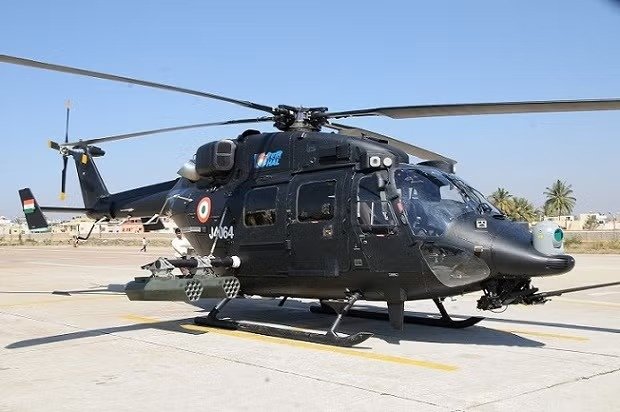
New Delhi, Oct 2026 : India is exploring a new dimension in battlefield technology with the Defence Research and Development Organisation (DRDO) examining the possibility of equipping the Advanced Light Helicopter (ALH) Dhruv and its armed Rudra variant with laser-based directed-energy weapons to counter the growing threat posed by drones.
The proposed capability is part of efforts to strengthen India’s counter-unmanned aerial system (C-UAS) architecture as unmanned platforms become increasingly important in modern warfare. According to a report by The Times of India, DRDO is studying the integration of an airborne laser pod that could enable helicopters to detect, track and engage hostile drones using concentrated laser energy.
The move comes against the backdrop of the rapid proliferation of surveillance drones, loitering munitions and coordinated drone swarms on modern battlefields. Such systems can be deployed relatively cheaply, operate at low altitudes and, when used in large numbers, potentially overwhelm conventional air-defence mechanisms.
A helicopter-mounted directed-energy weapon could provide Indian forces with a mobile counter-drone capability that complements existing missile and electronic warfare systems. The proposed laser pod is expected to combine thermal imaging sensors, a laser rangefinder and a precision beam-directing mechanism. Together, these components would enable the system to identify and track aerial targets before directing laser energy towards them.
Unlike conventional air-defence weapons, which rely on missiles or other physical interceptors, a laser-directed energy system seeks to defeat a target by focusing a high-energy beam on a vulnerable area. One of its key advantages is the speed of engagement, as the laser effect travels at the speed of light rather than requiring a projectile to cover the distance to its target.
This could become particularly significant in counter-drone operations, where several inexpensive unmanned platforms may approach a protected area simultaneously. Conventional interceptors can impose substantial costs when used against relatively low-cost drones. A laser system, by contrast, relies primarily on electrical power and does not require a separate missile for every engagement.
The proposed technology could therefore offer an additional layer of protection to Indian military formations operating in sensitive areas. Dhruv and Rudra helicopters deployed near the Line of Control, for instance, could potentially use such a system to engage hostile surveillance drones before they collect information on troop positions, military infrastructure or logistics movements.
The capability could also have applications in protecting forward operating bases and military convoys. Helicopters equipped with airborne lasers could potentially respond to emerging drone threats while operating alongside ground-based air-defence and electronic warfare systems.
The concept is also in line with a broader international effort to develop directed-energy weapons as militaries seek new ways to address the proliferation of unmanned aerial systems. The increasing use of drones in surveillance, targeting and strike roles has encouraged defence establishments to explore technologies capable of engaging multiple aerial threats without relying exclusively on conventional missiles.
India has already been pursuing indigenous directed-energy technologies through DRDO. The organisation has demonstrated a 30-kilowatt-class laser-directed energy weapon designed to engage drones, unmanned aircraft and other aerial threats. During testing, such systems have demonstrated the ability to cause physical damage to drone targets and disrupt or disable sensors.
DRDO’s wider directed-energy programme is aimed at developing increasingly capable systems with greater range and effectiveness. These efforts are part of a broader approach towards creating layered counter-drone and air-defence capabilities that can combine detection, electronic disruption and physical destruction of hostile platforms.
The proposed airborne laser represents a potentially important extension of that approach. Ground-based laser systems can provide protection to fixed installations and designated areas, but an airborne platform could offer greater mobility. A helicopter can reposition quickly and operate across difficult terrain, allowing a directed-energy weapon to be deployed where conventional ground-based systems may be difficult to move or establish.
Such mobility could be particularly useful in mountainous and remote areas. Indian armed forces operate across a wide variety of environments, including high-altitude regions, deserts and coastal areas. An airborne counter-drone system would therefore have to function effectively under widely varying operational and environmental conditions.
However, developing a laser weapon for a helicopter presents substantial engineering challenges. One of the most important is power generation. High-energy lasers require significant electrical power, and integrating the necessary power-generation and storage systems into a helicopter without adversely affecting its performance will be a major design consideration.
Thermal management is another critical issue. High-energy laser systems generate heat during operation, particularly when used repeatedly. A helicopter-mounted system would require an efficient cooling arrangement capable of managing thermal loads without adding excessive weight or compromising the aircraft’s endurance and manoeuvrability.
Atmospheric conditions could also influence the effectiveness of a laser weapon. Dust, smoke, haze, water vapour and other particles in the atmosphere can absorb or scatter laser energy, potentially reducing the effectiveness of the beam at longer distances. Performance could therefore vary depending on weather, terrain and battlefield conditions.
The system will also have to be sufficiently compact and lightweight for integration with the Dhruv and Rudra platforms. Designers would need to balance the laser’s power, targeting equipment, cooling requirements and electrical systems against the helicopter’s payload and aerodynamic constraints.
Another important consideration would be the ability of the weapon to work as part of a larger battlefield network. A laser interceptor would be most effective when connected to sensors and command systems capable of detecting and classifying threats before assigning them to an appropriate weapon system.
The development of such systems reflects the changing economics of air defence. Modern drones can be inexpensive compared with conventional aircraft or missiles, yet they can perform valuable military functions, including reconnaissance, surveillance, target acquisition and attack. Large numbers of drones can also create saturation challenges for traditional defensive systems.
Directed-energy weapons are consequently being examined as one possible response to this emerging battlefield reality. Their ability to engage targets rapidly and potentially conduct repeated engagements without carrying large stocks of physical interceptors makes them an attractive component of layered counter-drone architectures.
For India, integrating such technology with the Dhruv and Rudra could eventually provide an additional mobile defensive capability for forces operating in vulnerable areas. It could also strengthen the indigenous defence technology ecosystem by bringing together helicopters, sensors, power systems, precision tracking and directed-energy technologies.
The concept remains under development, and significant technical challenges must be addressed before an operational helicopter-mounted laser system can become a reality. Power management, thermal control, atmospheric performance, target tracking, weight and integration will all require extensive testing and validation.
Nevertheless, DRDO’s exploration of laser weapons for the Dhruv and Rudra highlights the growing importance of directed-energy technology in India’s future counter-drone strategy. As unmanned aerial threats continue to evolve, the ability to detect and neutralise them quickly, economically and at scale is becoming an increasingly important requirement for modern armed forces.
If successfully developed and integrated, an airborne laser system could give India’s rotary-wing fleet a new role in countering drones, complementing conventional air-defence missiles and electronic countermeasures while providing a mobile response option for the next generation of battlefield threats.
(Disclaimer :The content of this article is sourced from a news agency and has not been edited by the Mavericknews30 team.)