New Delhi, Oct 2026 : Indian defence technology company IG Defence is preparing to conduct the first experimental flight trial of JWALA, an indigenous private-sector micro-missile being developed as a dedicated hard-kill interceptor against hostile drones, following the successful test-firing of two solid rocket motors.
The propulsion trials mark a significant milestone for the programme and are expected to pave the way for system-level testing in the coming months. According to details reported by The Economic Times, the company has already developed most of JWALA’s major components, including its seeker and target-acquisition systems, avionics, warhead and associated electronic subsystems.
JWALA is being developed as a compact, scalable and comparatively low-cost kinetic Counter-Unmanned Aircraft System (C-UAS) capability. Unlike electronic warfare-based systems that seek to disrupt or disable drones, a hard-kill interceptor is designed to physically neutralise an incoming aerial threat.
The programme comes amid the rapid expansion of drone warfare and the growing requirement for air-defence systems capable of dealing with large numbers of relatively inexpensive unmanned platforms. The economics of modern warfare have created a challenge for conventional air-defence systems, as deploying expensive interceptors against low-cost drones can quickly deplete defensive stocks.
IG Defence has designed JWALA for an intended strike range of between 2 km and 5 km, while its engagement envelope is expected to extend from 50 metres to 5,000 metres. This would allow the interceptor to address a range of low-level and higher-altitude aerial threats. The company has set a design objective of achieving a circular error probable (CEP) of less than two metres at maximum range.
The missile uses a dual-pulse solid rocket motor combined with fin-control mechanisms. The successful firing of two rocket motors was therefore an important validation of a critical element of JWALA’s propulsion architecture. The trials are expected to support the next phase of development, involving integration of the missile’s various subsystems into a complete interceptor.
According to the company, JWALA is planned to carry a pre-fragmented high-explosive warhead weighing between 0.5 kg and 1.5 kg. A proximity fuze is intended to enable the interceptor to engage drone targets without requiring a direct physical impact in every engagement scenario.
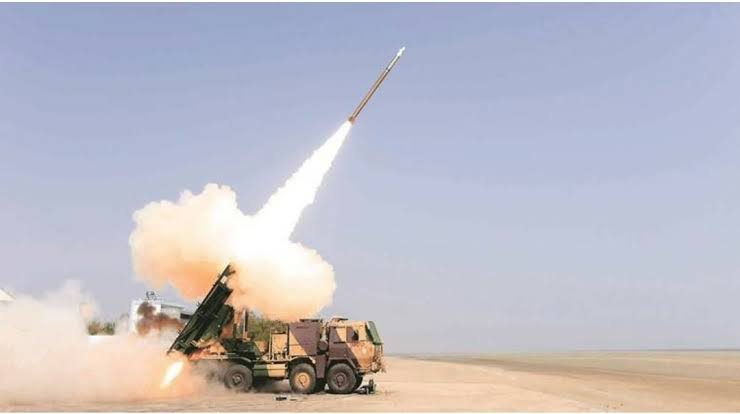
The proposed weapon system is also being configured around a truck-mounted multi-canister launcher. The mobile launcher is intended to carry multiple interceptors, allowing operators to respond to successive or multiple drone threats while maintaining mobility. IG Defence has projected a reaction time of less than seven seconds from detection of a target to missile launch, a feature aimed at enabling rapid engagement of emerging aerial threats.
A major element of the JWALA programme is its planned integration with IG Defence’s AI-enabled GRID Defend battle-management ecosystem. The company is developing JWALA not as a standalone missile but as the hard-kill effector within a broader sensor-to-shooter architecture.
GRID Defend is designed to connect surveillance sensors, command systems and effectors while bringing target detection, identification, tracking, threat assessment and engagement management into a common operational framework. Inputs from multiple sensors can be combined to create a common operational picture, allowing the system to identify and track aerial threats before coordinating an authorised response.
Bodhisattwa Sanghapriya, founder and CEO of IG Defence, said the company was developing JWALA as part of an integrated defence architecture in which sensors, artificial intelligence, command systems and effectors work together. Under the concept, GRID provides the mission-management layer while JWALA performs the hard-kill interception role.
The company’s approach reflects the wider evolution of counter-drone warfare, where layered systems are increasingly being developed to combine detection, electronic disruption and physical interception. A single defensive mechanism may not be sufficient against drones with varying levels of autonomy, speed, altitude and resistance to electronic countermeasures.
IG Defence has already demonstrated another element of its counter-UAS portfolio. Its T-SHUL BEAM system was showcased during the Indian Air Force’s Dronathon 2026 exercise. Unlike JWALA, T-SHUL BEAM uses electronic countermeasures as a soft-kill solution. Both systems are designed to operate through the company’s broader GRID architecture, highlighting its focus on combining different counter-drone technologies.
Wing Commander Anoop Sharma (Retd), AVP at IG Defence, said the rapidly changing drone threat required counter-UAS systems to evolve alongside it. He stressed the need for affordable interceptors that can be manufactured and deployed in meaningful numbers, describing the successful propulsion trials as an important step towards an indigenous hard-kill capability.
The successful rocket-motor trials do not yet establish operational readiness. JWALA still has to undergo system integration, flight testing, reliability assessment and further development related to manufacturability and scalability. The company has said it will continue testing the system as it moves towards greater technological maturity.
If the upcoming experimental trials and subsequent evaluations meet their objectives, JWALA could add an indigenous short-range kinetic layer to India’s expanding counter-drone ecosystem. Its combination of a compact interceptor, mobile multi-canister launcher and AI-enabled battle-management architecture reflects the growing role of private-sector companies in developing specialised defence technologies for emerging battlefield requirements.