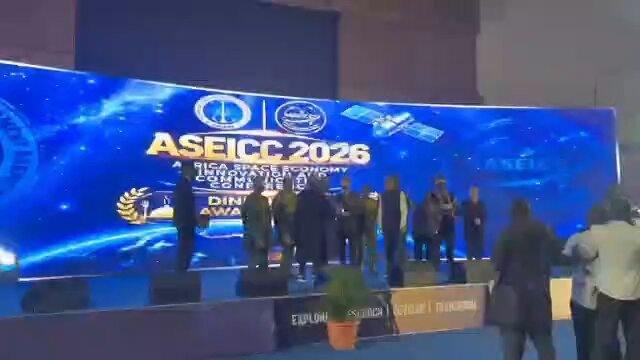
Abuja, November 2026 : The High Commission of India in Abuja has received the Space Diplomacy Award in Nigeria, while the Indian Space Research Organisation (ISRO) was presented with a certificate of appreciation for the historic achievements of the Chandrayaan-3 Mission. The recognition was announced by the Indian mission on Saturday.
The awards were presented during the Africa Space Economy, Innovation and Communication Conference (ASEICC 2026), held in Abuja from November 24 to 27. India's High Commissioner to Nigeria, Abhishek Singh, received the award on behalf of the High Commission.
In a post on X, the High Commission said the recognition celebrated India's achievements in space exploration and acknowledged ISRO's contribution to advancing space science and technology. A separate certificate of appreciation was presented to ISRO in recognition of the Chandrayaan-3 Mission.
According to the Indian mission, the honour reflects India's growing international standing in space science, technology and innovation. It also highlighted the country's progress in space exploration under Prime Minister Narendra Modi's leadership and the technological capabilities developed by ISRO.
Chandrayaan-3 marked a historic milestone for India's space programme on August 23, 2023, when its lander successfully touched down near the Moon's south pole. With the achievement, India became the first country to accomplish a successful landing in the region, which is considered important for future lunar exploration because of the possibility of water ice.
The successful landing was widely recognised as a major achievement in India's scientific and technological journey. August 23 is observed in the country as National Space Day to commemorate the mission's success.
ISRO is also working on technologies aimed at extending the operational life of future lunar landers. In June, ISRO Chairman V. Narayanan said the organisation was exploring ways to increase the survival period of lunar landers from the 14-day operational lifespan achieved by Chandrayaan-3 to as much as 100–200 days.
The initiative, being undertaken in collaboration with the Department of Atomic Energy (DAE), focuses on overcoming one of the major challenges of lunar exploration: surviving the Moon's extremely cold night-time conditions, when temperatures fall sharply and solar power is unavailable.
Narayanan said the proposed technology would involve developing artificial heating systems to protect landers during these conditions. If successful, the innovation could significantly extend the duration of future lunar missions and enable longer scientific operations.
The recognition at ASEICC 2026 has brought further international attention to India's space programme and the achievements of ISRO, particularly the Chandrayaan-3 mission.