August 2026 : Thousands of years ago, humans began domesticating wild animals and making them part of their lives. With the advent of agriculture and settled communities, animal husbandry also evolved. Cows and buffaloes were not merely sources of food; they became integral to farming, milk production, transportation, manure and the rural economy. In those days, livestock breeders had to rely on experience and observation to determine which animals produced more milk, were stronger or adapted better to local conditions.
Today, that scenario has changed dramatically. Earlier, livestock breeders selected superior animals based largely on experience. Modern science has now reached a stage where the genetic quality of an animal can be studied to determine how its future generations can be improved. Thousands of years of animal husbandry traditions are now being complemented by advanced laboratory technologies. The growing use of Sex Sorted Semen (SSS) and Embryo Transfer Technology (ETT/IVF) in Maharashtra’s dairy sector marks a significant new chapter in this transformation.
From Selection Through Experience to Selection Through Science
Animal husbandry has an extremely ancient history in the Indian subcontinent. Cattle and buffaloes were part of human life even during the Indus Valley Civilisation. Genetic studies on the domestication of river buffaloes have linked their origins to the Indian subcontinent, with indications that the domestication process began before or around the later phase of the Indus civilisation.
In those times, the selection of superior animals was based primarily on observation and experience. Cows that produced more milk, buffaloes that remained healthy and animals whose offspring demonstrated desirable characteristics were preferred for breeding. Over generations, such selective practices contributed to the development of different indigenous breeds and types of livestock.
Today, science has given this process a new direction. Genetic quality is no longer assessed merely through physical appearance or experience. Selective breeding, sex-sorted semen, embryos and advanced reproductive technologies are being used to produce better-quality future generations.
From One Calf in the Cowshed to Multiple High-Quality Calves Through the Laboratory
Under natural or conventional breeding methods, a cow generally produces approximately one calf a year. Consequently, spreading the genetic qualities of an exceptionally superior donor cow across a large number of offspring could take several years.
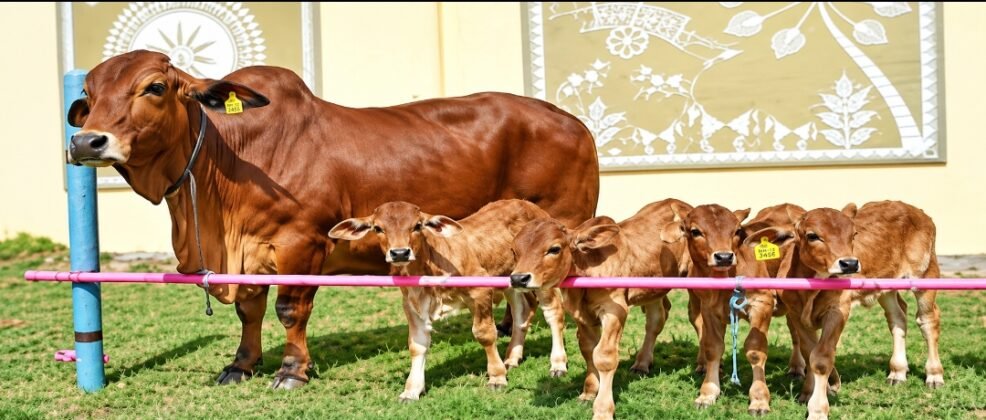
Embryo Transfer Technology has brought a major change in this regard. Oocytes are collected from a donor cow possessing superior genetic characteristics and fertilised in a laboratory using semen from a selected high-quality bull. The resulting embryo is then transferred into the uterus of a recipient cow or buffalo.
This makes it possible to multiply the genetic potential of a superior donor animal across a much larger number of offspring.
With this technology, a high-quality donor cow can potentially produce 40 to 50 high-quality calves in a year. Earlier, the genetic potential of an exceptional cow was effectively limited to one calf a year. Today, that same genetic potential can be multiplied across numerous calves. In this sense, ETT/IVF is often described as the “test-tube baby” technology of animal husbandry.
Male or Female? Science Now Adds Choice
For dairy farmers, female calves have particular economic importance because they can eventually become milk-producing animals. Under conventional artificial insemination, the probability of a male or female calf is approximately 50:50.
Sex Sorted Semen technology, however, is designed to increase the probability of producing female calves to more than 90 per cent. The process involves selecting sperm carrying the X chromosome and preparing semen doses for breeding.
This can increase the number of female calves available for future milk production. When semen from a genetically superior bull is used, the possibility of obtaining higher milk-producing heifers also increases. At the same time, farmers can potentially reduce the unnecessary expenditure involved in rearing male calves.
However, the technology should not be used indiscriminately for every animal. The health and condition of the heifer, healthy cows or buffaloes in their first or second lactation, appropriate timing of heat and expert veterinary guidance are important considerations. Since sex-sorted semen contains a comparatively lower number of sperm cells, conception rates can sometimes be somewhat lower than those achieved with conventional semen.
From Preserving Breeds to Improving Them
For ancient livestock breeders, preserving the breeds and characteristics of animals adapted to their region was a priority. Modern animal science goes a step further, providing opportunities not only for breed conservation but also for genetic improvement.
Alongside national breeds such as Gir, Sahiwal and Tharparkar, Embryo Transfer Technology is becoming important for conserving and improving Maharashtra’s indigenous cattle breeds, including Khillar, Dangi, Deoni, Lal Kandhari and Gaolao, as well as buffalo breeds such as Nagpuri, Marathwadi and Pandharpuri.
The objective is not merely to produce animals that yield more milk. It is also to develop livestock that are adapted to local climatic conditions, possess better disease resistance, are physically robust and have good milk-producing potential.
Maharashtra’s Journey Towards a Laboratory-Driven White Revolution
Maharashtra has made significant progress in the use of Embryo Transfer Technology. As of December 2025, 14,698 embryo transfers had been carried out through government, semi-government and private institutions across the state, resulting in the birth of 2,473 high-quality calves.
The In Vitro Fertilisation and Embryo Transfer Laboratory at Tathawade in Pune, operating under the Maharashtra Livestock Development Board since March 2021, has also achieved important milestones. So far, the facility has completed 240 OPU (Ovum Pick-Up) sessions, produced 780 embryos, transferred 556 embryos into recipient animals and cryopreserved 150 embryos.
By July 2026, the technology had resulted in the birth of 63 calves, while more than 50 pregnant animals were expected to give birth subsequently.
One of the laboratory’s significant achievements was the birth on July 23, 2022, of “Sheetal”, reportedly the country’s first Pandharpuri buffalo calf born through embryo transfer. Another notable achievement was the birth of four buffalo calves from a single oocyte collection in a Murrah buffalo.
Bringing Expensive Technology to the Farmer’s Cowshed
The biggest challenge associated with advanced technology is often its cost. Therefore, ensuring that technologies developed in research laboratories reach farmers is critical.
While the original cost of a sex-sorted semen dose is approximately Rs 1,200 to Rs 1,500, the Maharashtra Government has entered into agreements with relevant companies to make it available at Rs 575 per dose.
With a 45 per cent Central Government subsidy, 30 per cent State Government subsidy and Rs 100 assistance through MahaLDB/cooperative milk unions, the dose is being made available to livestock farmers for as little as Rs 81 per dose.
By December 2025, approximately 3.66 lakh semen doses had been distributed.
Meanwhile, the National Dairy Development Board is developing indigenous sex-sorted semen technology. A Memorandum of Understanding between the Maharashtra Livestock Development Board and NDDB is reportedly at an advanced stage, raising expectations that the technology could become available to farmers at an even lower cost in the future.
Even Low-Producing Cows Can Become Recipient Animals
Another important advantage of modern reproductive technology is that an animal does not necessarily have to possess superior genetic quality to serve as a recipient for a high-quality embryo.
Low-yielding or locally adapted cows and buffaloes can be used as recipient animals. This means that even a relatively low-producing animal in a cowshed can contribute to the birth of a calf carrying superior genetic characteristics.
A government resolution dated October 5, 2023, has made the technology available to gaushalas and ordinary livestock farmers as well. If a healthy calf is born through embryo transfer, the concerned farmer or gaushala receives an incentive of Rs 10,000.
This creates an additional avenue for income generation in rural areas while simultaneously supporting livestock conservation and genetic improvement.
Embryo Transfer Laboratories in Every Revenue Division
Efforts are also underway to ensure that the benefits of this technology are not restricted to a handful of centres.
The Maharashtra Government has decided to establish embryo transfer laboratories in every revenue division. The Tathawade laboratory is already operational, while work is underway on facilities at Pen for the Mumbai division, Hetikundi for Nagpur, Harsul for Chhatrapati Sambhajinagar, Loni Budruk for Nashik and the District Artificial Insemination Centre in Akola for the Amravati division.
These facilities are expected to reduce the distance between advanced reproductive laboratories and livestock farmers.
100 Per Cent Subsidy Opens the Door to Technology
To ensure that modern reproductive technologies are not restricted to financially well-off farmers, eligible livestock farmers under the Chief Minister’s Rural Livestock Entrepreneurship Scheme are being provided access to both ETT and SSS technologies with 100 per cent subsidy.
Various facilities are also available to livestock farmers under the Rashtriya Gokul Mission.
As a result, advanced reproductive technology is gradually moving beyond laboratory research and becoming an integral part of the rural economy.
Thousands of Years of Tradition Meets Modern Science
The story of animal husbandry in India is ultimately a story of coexistence between humans and animals. Thousands of years ago, livestock breeders relied on their experience to identify better cows, buffaloes and goats. Over generations, such choices contributed to the development of diverse livestock breeds.
Today, that traditional knowledge is being complemented by genetic science, artificial insemination, sex-sorted semen, OPU, IVF and embryo transfer technology.
Earlier, the question was: Which is the better animal? Experience provided the answer. Today, science is addressing a more complex question: How can the genetic qualities of a superior animal be transferred more effectively to future generations?
Earlier, producing one calf a year was a natural limitation for an exceptional cow. Today, the genetic potential of a superior donor animal can potentially be multiplied across numerous calves.
Earlier, farmers had to wait to see whether a male or female calf would be born. Today, sex-sorted semen technology can increase the probability of female calves to more than 90 per cent.
And earlier, an exceptional cow or buffalo was essentially an asset of a single cowshed. Today, its superior genetic potential can be multiplied across the wider livestock sector.
This represents the real leap from traditional animal husbandry to modern animal science.
Maharashtra’s next phase of the White Revolution will therefore not simply be about increasing livestock numbers. It will focus on superior genetics, higher milk production, healthier animals, lower costs and increased incomes for livestock farmers.
The thousands-year-old tradition of livestock rearing is now being connected with cutting-edge laboratory science. By combining farmers’ experience with modern technology, Maharashtra is taking a significant step towards making its dairy sector more productive, profitable and sustainable—and laying the foundation for a new White Revolution driven by science and genetic improvement.