New York, August 2026 : Rashtriya Swayamsevak Sangh (RSS) Chief Mohan Bhagwat has called for greater religious harmony, social service and dialogue among communities, saying that humanity is one despite differences in faith, culture and individual beliefs.
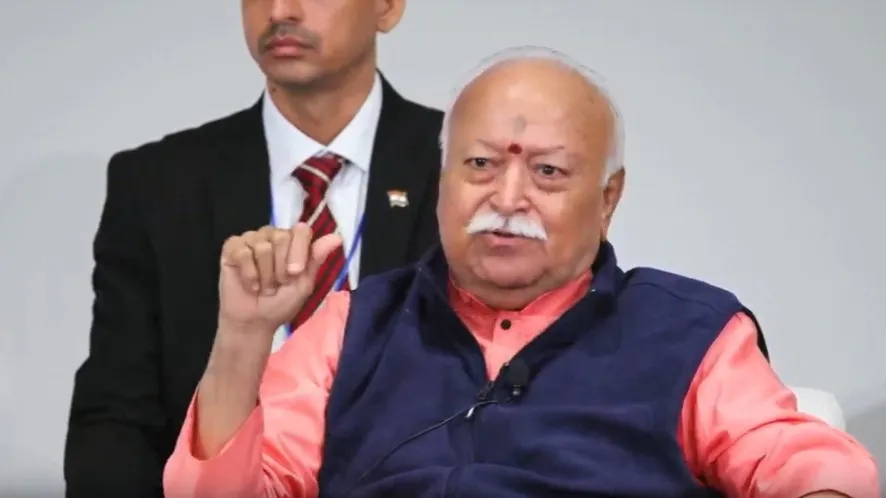
Addressing the “One World, One Humanity” gathering of religious leaders in New York, Bhagwat said dialogue between communities should go hand in hand with service. He described service as a fundamental part of the RSS’s work and said its volunteers assist people without discriminating on the basis of religion or identity.
“Dialogue is the first step. Service is another. Not one step after that. It had to start simultaneously,” Bhagwat said, underlining the need for both communication and action to build trust among communities.
Bhagwat said service has been at the heart of the RSS since its inception and claimed that volunteers do not ask about the religious identity of people seeking assistance. According to him, the organisation, with support from society, is currently involved in around 130,000 service initiatives of varying sizes.
Citing Charkhi Dadri Air Disaster
Bhagwat cited the 1996 Charkhi Dadri mid-air collision in Haryana as an example of the organisation’s approach to humanitarian service. The disaster involved a Saudi Arabian Airlines aircraft and a Kazakhstan Airlines plane and claimed the lives of all 349 people aboard the two aircraft.
Recalling the response of RSS volunteers, Bhagwat said they reached the accident site and assisted victims without considering their religious identities. Most of the passengers, he noted, were Muslims.
He said volunteers helped survivors, recovered bodies and assisted with funeral arrangements. They also supported relatives in identifying the victims.
“We never thought at that time that these are Muslims,” Bhagwat said, arguing that humanitarian assistance should not be determined by religious identity.
He attributed this approach to the organisation’s social orientation and said the RSS could undertake such work because it was not motivated by electoral politics or expectations of material returns.
“We do it. We only give. We don't want anything,” he said.
Bhagwat acknowledged that public perceptions of the RSS have sometimes been shaped by narratives that, in his view, do not adequately reflect its social work. He said the organisation has not always publicised its activities and invited people to examine its functioning directly before forming opinions.
“If a Hindu Says Muslims Have No Place, He Ceases to Be a Hindu”
Bhagwat also addressed questions surrounding Hindu identity and religious diversity. Recalling a lecture series in Delhi in 2018, he said members of the Muslim community had asked him whether Muslims would have a place in India if the RSS supported the idea of a Hindu Rashtra.
According to Bhagwat, he responded that excluding Muslims from India would not be consistent with Hindutva.
“If any Hindu thinks that there should be no Muslim in Bharat, he ceases to be a Hindu,” he said.
Bhagwat said Hindu thought, as he understands it, recognises the dignity of every human being and accepts the existence of different religious paths. He said differences among people are a natural feature of the world and should be acknowledged rather than treated as a reason for division.
He emphasised the idea that different faiths can represent different approaches to the same ultimate truth. Humanity, he said, remains fundamentally united despite differences in religious practice and individual understanding.
Bhagwat told the gathering that he was not a religious scholar or religious authority but spoke from his experience of working within Indian society. He said India has traditionally upheld the idea that religions may differ while humanity remains one.
Service Can Inspire Further Service
The RSS chief also spoke about the impact of social service on beneficiaries. He said people who receive assistance during difficult periods sometimes develop an urge to help others once they overcome their own hardships.
Bhagwat said such individuals can later return voluntarily to contribute to society, without being instructed or persuaded to do so.
“This project has given me so much. I have to give back,” he said, describing the sentiment expressed by some beneficiaries.
According to Bhagwat, such a response demonstrates how service can create a cycle in which assistance received during a crisis eventually becomes assistance offered to someone else.
He urged religious leaders gathered in New York to develop similar initiatives in their respective countries and combine them with sustained dialogue between communities.
Message of Unity and Coexistence
Bhagwat also said India’s tradition of coexistence had survived periods of foreign invasion and historical upheaval. While acknowledging that aspects of India’s civilisational heritage had been lost over time, he argued that the underlying principle of accepting different communities continues to exist.
He said India has historically provided space to people belonging to different denominations and traditions and described this as part of the country’s broader civilisational ethos.
The RSS chief cautioned that religious leaders have a continuing responsibility to reinforce the message of human unity. He said the task is challenging and requires sustained effort because social divisions can re-emerge when communities lose sight of shared human values.
He also warned against social pressures arising from materialism, the pursuit of influence and feelings of superiority. Societies, he said, must develop the resilience to resist such tendencies and maintain harmony.
The RSS was founded in Nagpur in 1925 by Keshav Baliram Hedgewar and completed 100 years in 2025. It describes itself as a volunteer-based cultural organisation with a nationwide network, while affiliated organisations work in areas including education, social service, labour and tribal welfare.
Bhagwat, who has served as the organisation’s Sarsanghchalak since 2009, used the New York gathering to present a message centred on religious coexistence, social service and human unity.
His remarks brought together two themes he described as essential to social harmony: dialogue and service. While dialogue can help communities understand one another, Bhagwat argued that selfless service can transform those principles into practical action.
At the heart of his address was the proposition that religious and cultural diversity need not undermine human unity. Instead, he said, differences can coexist with a broader recognition of shared human dignity and responsibility.