New York, August 2026: Rashtriya Swayamsevak Sangh (RSS) chief Mohan Bhagwat has described dharma as a universal principle that goes beyond religion, worship and rituals, saying it represents the force that sustains existence and enables individuals, society and the environment to progress together.
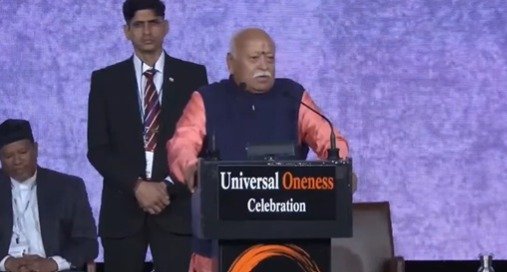
Addressing the Universal Oneness Celebration at Madison Square Garden in New York, Bhagwat said dharma should not be narrowly understood as a religious identity or a particular form of worship. Instead, he presented it as a broader principle governing how human beings should conduct their lives while maintaining harmony between different dimensions of existence.
“Dharma is not religion. It is not a worship. It is beyond all this,” Bhagwat said. He described it as the principle through which the universe is sustained and through which human beings can navigate the contrasting experiences and challenges of life.
According to Bhagwat, the essence of dharma lies in balance. Progress, he said, should not come at the expense of another part of society or the natural environment. Individual advancement cannot require the suppression of society, just as collective progress should not come at the cost of individual freedom and development.
“Individual society and the environment, they have to proceed together, progress together,” he said.
He extended this concept of balance to the individual as well, arguing that physical, mental and intellectual development should advance together. A healthy and meaningful human life, in his view, requires harmony among the body, mind and intellect rather than the dominance of one over the others.
Bhagwat described dharma as a middle path that connects different aspects of existence while preventing them from coming into conflict. He said the principle unites and sustains different elements while maintaining balance and avoiding divisions.
Unity as the Foundation of Dharma
Bhagwat said the foundation of the Indian understanding of dharma is the idea of the oneness of existence. Although people differ in nationality, language, religion, culture and lifestyle, he said these visible differences do not erase the deeper connection shared by all human beings.
“Our destiny is to give that to world and the solid foundation on which this Dharma is perceived is the oneness, unity of existence,” he said.
He urged people to recognise the same underlying principle within themselves and in others and to translate that understanding into action for the welfare of society.
“You have to see that principle inside you. And at the same time, you have to see that principle inside others,” Bhagwat said, calling for work towards the welfare of everyone and everything in the world.
He argued that human life itself has a larger purpose and is neither meaningless nor accidental. According to Bhagwat, human beings have a responsibility to understand their place in the world, pursue self-realisation and use that knowledge for the benefit of others.
“Human life is not purposeless. It is not meaningless. It is not a simple coincidence,” he said.
He added that the purpose of human life includes acquiring knowledge, seeking personal liberation and contributing to the welfare of the wider world.
India’s Civilisational Message
Bhagwat also spoke about what he described as India’s broader civilisational mission. He said nations should not be viewed merely as geographical territories because every nation develops its own distinctive values, responsibilities and purpose.
“Nations are not merely geographical entities. Every nation has a message to deliver. Every nation has a mission to accomplish. Every nation has a destiny to fulfil,” he said.
According to Bhagwat, India’s civilisational contribution lies in demonstrating how unity can coexist with diversity. He argued that differences should not be eliminated in the pursuit of unity; instead, diversity should be accepted, respected and celebrated while maintaining awareness of the underlying unity of humanity.
“We are one and due to diversity that oneness is decorated. So diversity has to be celebrated, has to be respected, has to be accepted,” he said.
He contrasted the concepts often associated with the United States and India, observing that the US is frequently described through the idea of pluralism, while India is commonly associated with the phrase “unity in diversity”.
For Bharat, he said, both unity and diversity are integral to its civilisational identity.
Diversity and Human Responsibility
Bhagwat acknowledged that the world is characterised by enormous diversity. People belong to different nations, speak different languages, follow different religions and maintain different ways of life. Yet these distinctions, he said, do not negate humanity’s fundamental connectedness.
He also argued that human beings have a special responsibility towards the world because they possess the capacity for thought and discernment.
“Human beings are responsible for the world because they have been given special quality of thinking,” he said.
That ability, according to Bhagwat, creates an obligation to protect the environment, care for fellow human beings and make choices that contribute to collective welfare.
His interpretation of dharma therefore linked personal development with social responsibility and environmental stewardship. Rather than viewing these objectives as competing priorities, he said they must be pursued simultaneously.
Practice Over Preaching
Bhagwat stressed that India’s message should be conveyed through conduct rather than merely through speeches or religious instruction. He said Bharatiyas should demonstrate the principles of unity, diversity and balance through their everyday lives.
“That is the mission Bharat has to accomplish. That is the message Bharatiya’s world over have to give by their own example, not by preaching, by practice,” he said.
He suggested that such an approach could offer a constructive example to a world facing numerous challenges and divisions.
“If we do that, that will be a boon for the world struggling with all these problems and stumbling at every step,” he said.
Bhagwat’s remarks placed the concept of dharma within a broader framework of social harmony and human welfare. His address argued that the principle should not be restricted to religious observance but should guide relationships between individuals, communities and the environment.
The RSS was founded in Nagpur in 1925 by Keshav Baliram Hedgewar and completed its centenary in 2025. The organisation describes itself as a volunteer-based cultural organisation and has developed a nationwide network with affiliated bodies active in areas including education, social service, labour and tribal welfare.
Bhagwat became the organisation’s sixth Sarsanghchalak in 2009 after serving in several senior positions. His New York address during the RSS’s centenary period placed particular emphasis on India’s civilisational ideas of unity, diversity, balance and service.
At the centre of his message was the argument that diversity is a natural feature of existence while unity represents a deeper truth. Bhagwat said recognising both principles and incorporating them into everyday life could help individuals and societies pursue progress without creating divisions between people, communities or the environment.