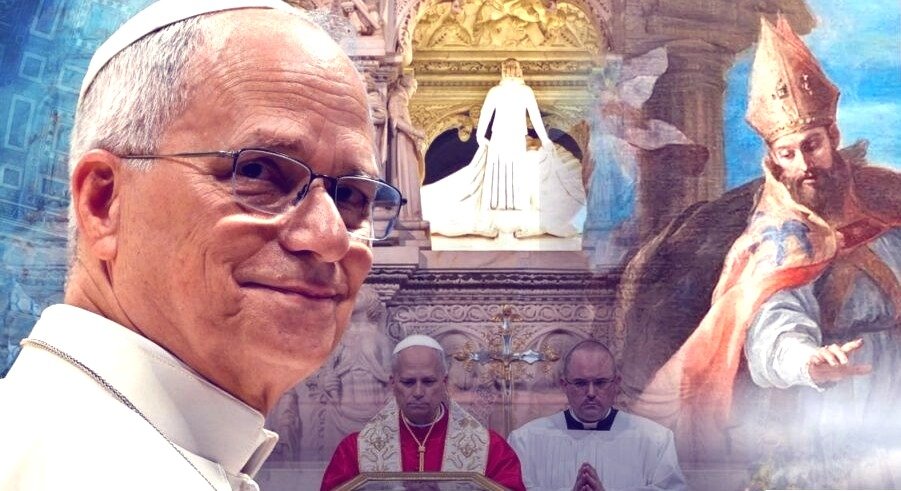
Vatican City; August 2026: More than 16 centuries after his death, St. Augustine of Hippo continues to draw pilgrims searching for the truth that transformed his life. Amongst them is Pope Leo XIV, the first Augustinian Pope.
For Leo, a pilgrimage to Augustine’s tomb in Pavia, northern Italy, was more than a visit to one of Christianity’s most important saints. It was a journey to the spiritual roots that have shaped his own life, vocation and ministry. “The figure of St. Augustine shines with a precious light”, Pope Leo said during his visit. Pointing to Augustine’s famous call to turn inward in the search for truth, the Pope recalled his words: “Do not go outside yourself; return within yourself. Truth dwells in the inner man”.
St. Augustine died in 430 in Hippo, in present-day Algeria, where he had served as bishop for more than 30 years. His remains eventually reached Pavia in 723, transferred there at the request of the Lombard King Liutprand.
Today, they rest in the historic Basilica of San Pietro in Ciel d’Oro, or St. Peter in the Golden Sky. Above his relics rises one of the basilica’s greatest treasures: the Ark of St. Augustine. Created in the 14th century from white Carrara marble, the monumental tomb is considered a masterpiece of Gothic sculpture. Its detailed panels tell the story of Augustine’s life, conversion and ministry.
At the heart of that story is a restless man searching for happiness. Before becoming a bishop, theologian and Doctor of the Church, Augustine spent years searching for truth. He pursued intellectual achievement and worldly success, but remained dissatisfied. Fr. Gianfranco Casagrande, Prior of the Augustinians in Pavia, explained that Augustine possessed nearly everything he could have wanted materially, yet he was not happy.
A decisive moment came while Augustine was struggling with his conscience. He heard what sounded like the voice of a child repeating the words “tolle lege, tolle lege — take and read”. Augustine interpreted the words as a call from God and picked up a book containing the letters of St. Paul.
His eyes fell upon a passage calling him away from the pleasures of the flesh and toward a new life in Christ: to “put on the Lord Jesus Christ”. The words pierced his heart, bringing his long search and struggle toward a decisive moment of conversion.
The Ark of St. Augustine preserves this story in marble alongside other defining moments in the saint’s life. One panel depicts Augustine listening to the preaching of St. Ambrose, the bishop of Milan. Augustine had initially been attracted to Ambrose’s eloquence, but as he listened, he also became increasingly convinced by the Christian faith the bishop proclaimed.
Augustine was eventually baptized by St. Ambrose in Milan in 387, beginning a new chapter in the life of the man who would become one of Christianity’s most influential thinkers.
Another central panel of the monument depicts Augustine presenting his Rule to his followers. The Rule of St. Augustine would become one of the most influential rules of religious life in Western Christianity, centered on a simple but demanding vision: Christians living together in unity and seeking God with one heart and one mind.
Father Casagrande said the Rule calls friars, monks, sisters and laypeople to “live the Gospel with unity of purpose”, and in a communion of mutual love. That emphasis on community remains a defining element of Augustinian spirituality today and an important part of the tradition that formed Pope Leo XIV.
Before his election to the papacy, Pope Leo IV has spent decades as a member of the Order of St. Augustine and eventually served as its Prior General. When he appeared before the world after his election, he publicly identified himself as a “son of St. Augustine”, immediately drawing new attention to the spiritual tradition that had shaped his life.
At the center of the elaborate marble monument is a reclining statue of Augustine supported by six deacons. Around him, the sculpture presents the faith and virtues that shaped his life. The monument was designed to rest above figures of the 12 Apostles, each holding a scroll bearing a portion of the Nicene-Constantinopolitan Creed. Other figures represent virtues associated with Augustine, including obedience, chastity, humility, justice and temperance.
Taken together, the Ark is more than a tomb. It presents Augustine’s life as a journey from restlessness to conversion, from conversion to communion, and from communion to mission. The Basilica of San Pietro in Ciel d’Oro also preserves a physical connection to the land where Augustine spent much of his life. A mosaic incorporated into the church comes from the Basilica Pacis in Algeria, Augustine’s cathedral in Hippo.
The mosaic was given by Algerians at the end of the 19th century as a reminder of Augustine’s ministry and evangelization. Fr. Casagrande said it recalls “his feet, his mission” and the work of evangelisation Augustine carried out not only in his own diocese but for the universal Church.
For Pope Leo XIV, the connection between Augustine, Italy and North Africa has taken on particular significance. During his second apostolic journey to Africa, Leo began his trip in Algeria — the land of St. Augustine — becoming the first pope to visit the country.
For Pope Leo, Augustine also offers a bridge between peoples and religions. “I am very happy to visit again the land of Saint Augustine, who also offers a very important bridge in interreligious dialogue,” the Pope said during his journey.
Leo described his return to Augustine’s homeland as a blessing not only for him personally, but also for the Church and the world. “We must always seek bridges to build peace and reconciliation,” he said.
The Pope traveled to Annaba, the modern city near ancient Hippo, and visited the archaeological site where Augustine served as bishop for more than three decades until his death in 430.
Although Algeria today is overwhelmingly Muslim, Augustine remains an important figure in the country’s history. Fr. Juan Antonio Cabrera Montero, O.S.A., president of the Pontifical Patristic Augustinian Institute, noted that Augustine was born, studied and served as bishop in territory that is now Algeria.
“For Algerians, even though the vast majority of them are Muslim, St. Augustine is considered an Algerian,” he explained. According to Fr. Cabrera, there was great joy in the country when Leo appeared after his election on May 8 and introduced himself to the world as a son of St. Augustine.
Pope Leo XIV is pope of the universal Church, not simply of the Augustinian family. Yet his formation in the spirituality of St. Augustine offers an important window into the influences that have shaped his approach to the papacy.
Augustine’s life was marked by a relentless search for truth. His Rule emphasized communion and mutual love. His ministry as bishop was devoted to teaching and pastoral care, while his writings repeatedly returned to the human heart’s deepest longing for God.
Those themes — truth, interior life, communion, peace and reconciliation — have also emerged throughout Pope Leo’s ministry. For the Augustinian family, seeing one of their own elected pope has brought new attention to a spirituality that stretches back centuries.
Father Cabrera described it as a source of pride and satisfaction to know that the Pope shares Augustine’s spirituality, including his “way of seeing the world” and his understanding of the Church through Augustine’s theology and pastoral vision.
It is more than 1,600 years which separate St. Augustine from Pope Leo XIV. One lived as a bishop in Roman North Africa during a period of profound political and social upheaval; the other leads the Catholic Church in the 21st century. Yet Augustine’s fundamental questions remain strikingly current: Where is happiness found? How can people divided by religion, culture and conflict live together? And where should we search for truth?
For Augustine, the journey ultimately led inward, but not into isolation. It led him to God and, from God, back toward community, service and the search for peace.
That is why Pope Leo’s pilgrimage to Augustine’s tomb in Pavia and his journey to the saint’s homeland in Algeria tell two parts of the same story. One brought him to the place where Augustine’s remains have rested for more than a millennium; the other brought him to the land where the saint preached, served and died.
Together, the two journeys reveal the spiritual roots of the first Augustinian pope and the enduring influence of a saint whose restless search for truth continues to speak to the Church more than 16 centuries later.
Team Maverick.