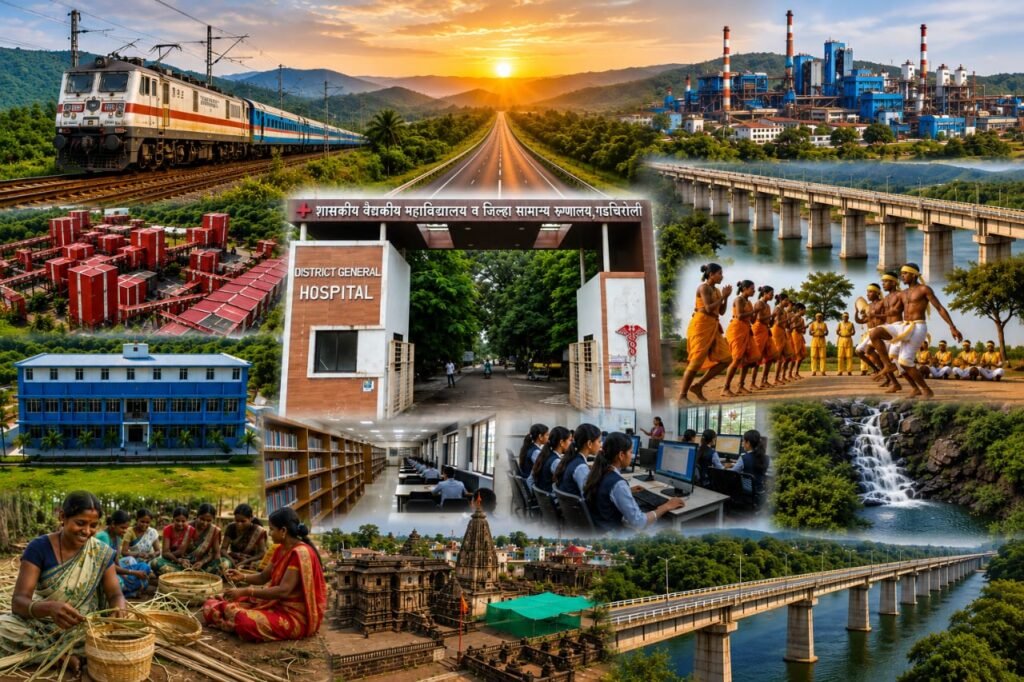
Gadchiroli, Aug 2026 : Gadchiroli, which came into existence as a separate district on August 26, 1982, is today at a historic and decisive stage of transformation. Known for decades for its dense forests, abundant mineral resources, rich biodiversity and distinctive tribal culture, the district was once widely identified as an extremely remote and Naxal-affected region. That identity, however, is changing rapidly. Once cut off from development opportunities because of the shadow of Naxalism, Gadchiroli is now emerging as a new growth centre of Maharashtra, powered by peace, security, industry, modern infrastructure and human development.
Under the leadership of Chief Minister and Guardian Minister Devendra Fadnavis, sustained efforts on both the security and development fronts have created a strong foundation of peace and stability in the district. Effective operations by the police and central security forces, surrender and rehabilitation policies, and an increased security presence in remote areas have brought the influence of Naxalism close to an end. This has expanded the reach of the administration and accelerated development projects that had remained stalled for years. As the atmosphere of fear recedes, people's faith in the government and democratic institutions is also growing stronger.
Beyond Security: Building Public Trust Through ‘Police Dadalora Khidki’
The Gadchiroli Police have moved beyond their traditional security role through the ‘Police Dadalora Khidki’ initiative, creating an important bridge of trust between the administration and remote tribal communities. The initiative has helped citizens access government schemes, certificates, healthcare services, employment and skill-development opportunities. Efforts are also underway to integrate surrendered Naxal cadres into mainstream society through literacy and employment-oriented training.
The transformation is also reflected in the democratic process. In areas where election boycotts were once regularly called for, citizens are now coming forward to vote without fear. Record voter participation in the 2024 Lok Sabha and Assembly elections became a symbol of the district's journey from fear to confidence.
Administration Reaches the Doorstep
The functioning of the administration is also changing in post-Naxal Gadchiroli. Through initiatives such as Dharti Aaba, Special Survey, Seva Samruddhi, Chhatrapati Shivaji Maharaj Revenue Campaign and Gram Samvad, officials are travelling to remote villages and interacting directly with residents.
The state's Chief Secretary interacted with citizens at Gurnoli, while the District Collector personally visited Binagunda, once considered a stronghold of Naxalism, to understand the problems faced by residents. A new administrative culture is emerging in which the government does not wait for citizens to approach it; instead, the administration reaches out to people.
Keeping in mind the rapid pace of industrialisation and urbanisation, a separate ‘Gadchiroli Region’ has been declared for the entire revenue district. This is expected to provide a long-term framework for balanced development encompassing industry, agriculture, forests, transport, housing and environmental protection.
From Remoteness to Connectivity
One of the most visible changes in Gadchiroli's development story is the expansion of connectivity. Several areas that were earlier cut off from the rest of the world during the monsoon are now being connected through all-weather roads and bridges.
The high-level bridge over the Dina River has been completed, while major bridges over the Indravati, Bandia, Perlkota and Gundennur rivers are under construction.
Important roads such as Chamorshi–Mulchera–Aheri, Parwa–Korchi, Shankarpur–Gurnoli and Aheri–Sironcha are being upgraded. The approximately 86-km Navegaon More–Konsari–Surjagad route approved for industrial and mineral transportation, along with the approximately 94-km Bhandara–Gadchiroli Samruddhi Highway, is expected to play an important role in strengthening the district's economic connectivity.
The Wadsa–Gadchiroli broad-gauge railway project, spanning around 52.68 km, will bring Gadchiroli city directly onto the railway map. Doubling of the Gondia–Ballarshah railway line, along with proposed rail links between Gadchiroli–Bhanupratappur and Gadchiroli–Bacheli, could further strengthen industrial and commercial connectivity. Planning for a greenfield airport is also gaining momentum.
Alongside physical connectivity, the digital divide is also narrowing. More than 500 mobile towers have become operational under various schemes, while the expansion of BharatNet is helping bring e-governance, digital banking, online education, telemedicine and government e-services to remote communities.
From Mineral Wealth to Public Development: An Emerging Steel Hub
The abundant iron-ore reserves in the district, particularly around Surjagad, are positioning Gadchiroli as a potential major integrated steel production centre in the country. The district has been identified as having the potential to attract investments of up to around Rs 3 lakh crore in the steel sector.
Such industrial development could generate a wide ecosystem of ancillary small and medium enterprises, logistics, transportation, repair services and local supply chains. The focus of industrialisation is therefore gradually shifting beyond mineral extraction towards local employment, skill development, entrepreneurship and value-added manufacturing.
More than Rs 1,024 crore has been accumulated through the Mineral Foundation, with over 1,600 projects worth more than Rs 548 crore approved. More than 65 per cent of the funds are being focused on high-priority areas such as roads, drinking water, healthcare, education and livelihoods. The objective is to ensure that the district's mineral wealth contributes directly to improving the quality of life of its people.
New Opportunities in Skills, Employment and Entrepreneurship
Efforts are underway to connect skill development with employment so that local youth benefit from growing industrialisation. Initiatives include CIIIT, HCLTech's ‘Earn While You Learn’ programme, Mahindra & Mahindra's tractor service mechanic training, and employment-oriented training for women and young girls under ‘NAVYA’.
Training in mining, machinery, bamboo and forest-produce processing, as well as agriculture-related businesses, is expanding opportunities for local employment, self-employment and entrepreneurship.
Water Security for Rural Prosperity
Water security has been given special importance in rural development. Under Jalyukta Shivar 2.0 and Pradhan Mantri Krishi Sinchayee Yojana 2.0, around 6,015 water-conservation works have been completed.
Of 1,082 household water-supply schemes, 1,051 have been completed. Out of 2,049 villages and habitations, household tap connections have been provided in 1,759 locations. As many as 936 villages have been declared ‘Har Ghar Jal’ villages.
A New Chapter in Human Development
Alongside physical and industrial development, human development remains at the centre of the district's transformation. A government medical college with 100 MBBS seats has been established in Gadchiroli, providing long-term support to the healthcare system. A 100-bed women and newborn hospital has also become operational in Aheri.
Initiatives such as ‘Maher Ghar’ for pregnant women from remote areas, digital dispensaries and mobile blood-collection vehicles are helping bring healthcare closer to people.
In education, interactive boards, computer laboratories, digital language laboratories, robotics facilities, libraries and other modern infrastructure are being developed. Under the PM SHRI initiative, educational facilities are being strengthened in 24 schools.
Collaboration between Gondwana University and Australia's Curtin University is also opening new avenues for local students to access global-quality education and research.
The traditional tribal institution of the ‘Ghotul’ is also being given a modern dimension in some areas by connecting it with digital libraries, computer facilities and career guidance while preserving its cultural significance.
Women's self-help groups are being supported with skills, financial assistance and market linkages, with efforts aimed at creating more ‘Lakhpati Didis’ through sustainable businesses.
Gadchiroli Beyond Minerals
Gadchiroli's potential extends far beyond its mineral wealth. Its vast forests, wildlife, rivers, biodiversity, tribal culture and historical heritage offer significant opportunities for tourism and employment.
Destinations such as Guravala Nature Safari, Kamalapur Elephant Camp, Tipagad, Binagunda Waterfall, Bhamragad Triveni Sangam, Wadham Fossil Park and the historic Markanda Temple can provide a new identity to the district's tourism sector.
The district's high-quality teak has also earned it national recognition. Teak from Allapalli has been supplied for projects of national importance, including the Shri Ram Temple in Ayodhya, the new Parliament building and the Vice-President's residence. Forest resources are therefore as important to Gadchiroli's economy and identity as its mineral wealth.
Towards Developed Maharashtra 2047 While Protecting ‘Water, Forest and Land’
The real test of Gadchiroli's development cannot simply be measured by the number of roads, bridges or industries constructed. It will ultimately depend on how positively development transforms the lives of local and tribal communities.
Protecting water, forests and land while promoting afforestation, forest rights, livelihoods based on bamboo and minor forest produce, environmentally sustainable industries and nature-based tourism will be essential for long-term local economic empowerment.
From Fear to Trust, From Conflict to Prosperity
Over the past few years, Gadchiroli has made a historic transition from conflict towards development. A secure environment, improved administrative reach in remote areas and growing participation in the democratic process have strengthened the foundation of this transformation.
On this foundation, a new ecosystem of industry, roads, railways, digital connectivity, water security, healthcare, education and skill development is taking shape.
The administrative journey that began with Gadchiroli's creation as a district on August 26, 1982, has now entered a new post-Naxal phase of development. The district's Foundation Day is therefore not merely an occasion to remember its history, but also an opportunity to renew the commitment to building a peaceful, empowered, self-reliant and developed Gadchiroli.
Today's Gadchiroli is not merely a changing Gadchiroli; it is a new Gadchiroli — one moving confidently towards new horizons of prosperity.