
New Delhi, Aug 2026 : Congress leader Rahul Gandhi on Thursday launched a sharp attack on Prime Minister Narendra Modi’s foreign policy, questioning what he described as an excessive emphasis on personal relationships with foreign leaders and arguing that India’s diplomacy must be guided primarily by national interest.
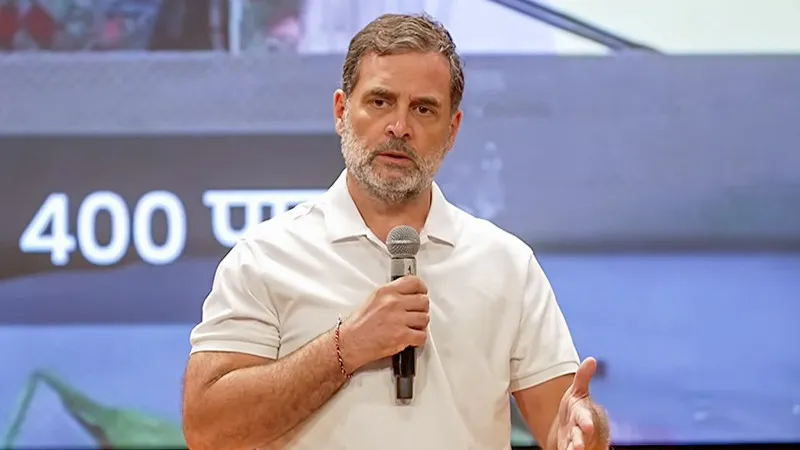
Addressing a plenary session of the Congress, Gandhi took a dig at Modi’s widely publicised interactions and embraces with international leaders, saying diplomacy could not be reduced to “hugging other leaders”. He argued that the Prime Minister’s responsibility was to protect and advance India’s interests rather than simply cultivate friendships with heads of foreign governments.
Gandhi also referred to the ongoing tensions involving Iran and claimed that India could have played a mediating role had the government acted at the right time. Instead, he alleged, Pakistan managed to step into the diplomatic space, leaving the Indian leadership wondering how the situation had developed.
The Congress leader further claimed that he was receiving information from within the Prime Minister’s Office, though he did not provide details or independently verifiable evidence for the assertion.
Turning his attention to China, Gandhi alleged that Indian forces were facing restrictions on patrolling in areas of Arunachal Pradesh. He accused the Modi government of making strong statements without matching them with effective action and claimed that the positions adopted by the Prime Minister, Defence Minister Rajnath Singh and Home Minister Amit Shah had been weakened.
Gandhi also alleged that the government had attempted to prevent sections of the media from reporting on developments relating to China. He claimed that newspapers and television channels had been contacted to discourage them from publishing or broadcasting stories concerning the issue.
Recalling the 2020 Galwan Valley clash between Indian and Chinese troops, Gandhi referred to the Prime Minister’s earlier statement that China had not occupied Indian territory. He contrasted that statement with claims made by the Indian Army regarding the loss of access to certain areas.
According to Gandhi, such public statements created difficulties during subsequent discussions with Chinese representatives. He alleged that Chinese officials had cited the Prime Minister’s own remarks while challenging India’s position during negotiations.
“These people have destroyed our foreign policy and weakened the country internally,” Gandhi alleged, accusing the government of failing to protect India’s strategic interests.
The Congress leader also criticised the government’s understanding of Indian history and traditions. He alleged that those in power frequently invoked events from thousands of years ago while failing to understand the realities of contemporary India.
Gandhi argued that India’s strength lay in allowing its people to express themselves freely. He alleged that the government was unwilling to provide adequate space for dissenting voices and criticism.
He also questioned why Prime Minister Modi does not hold regular press conferences. Recalling his own thoughts on the issue, Gandhi said he had initially believed there was a strategic reason behind the Prime Minister’s limited interaction with the press.
However, he claimed that his perspective changed after reflecting on the issue and suggested that many questions confronting the government could be addressed through direct interaction with journalists.
Gandhi also recounted an alleged conversation involving a police officer outside the Prime Minister’s residence and referred to remarks he claimed to have overheard from a BJP leader in Parliament.
According to Gandhi, he heard a BJP leader tell another that Rahul Gandhi “doesn’t fit into any mould”, while suggesting that others within the ruling party did.
The Congress leader used these examples to argue that the ruling establishment was increasingly conscious of the Congress’ political strength. His remarks come amid an intensifying political confrontation between the Congress and the BJP over foreign policy, national security, democratic institutions and the government’s approach to political dissent.
(The content of this article is sourced from a news agency and has not been edited by the Mavericknews30 team.)