
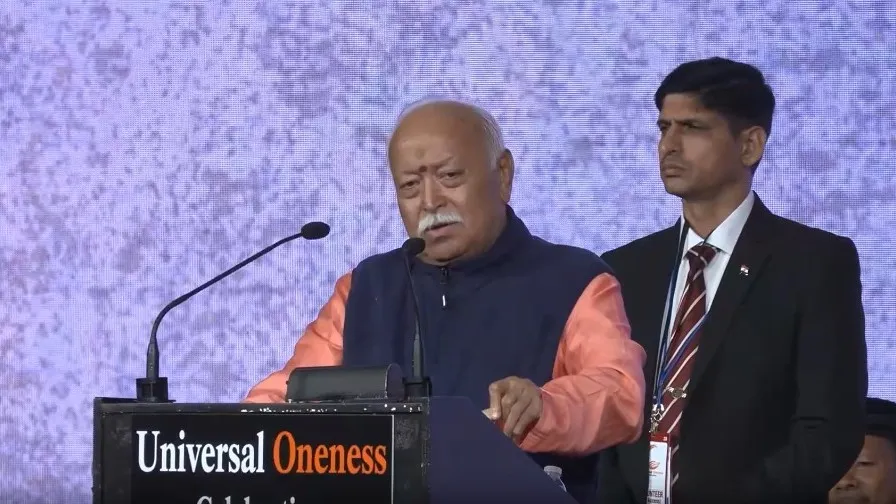
New York, August 2026 : Prominent religious leaders from different faiths have warned that hatred and intolerance are spreading rapidly across borders at a time when the world is already grappling with armed conflicts, displacement, discrimination and the disruptive impact of emerging technologies.
Addressing the ‘Universal Oneness’ gathering at Madison Square Garden in New York, Jewish, Christian and Muslim leaders called for greater dialogue, compassion and respect for differences. They stressed that humanity must recognise its shared identity while resisting forces that use religion, politics or technology to deepen divisions.
The gathering was attended by Rashtriya Swayamsevak Sangh (RSS) Chief Mohan Bhagwat along with religious representatives from several countries. Speakers used the platform to urge faith communities to take greater responsibility for preventing hatred and violence and to build relationships across religious and cultural boundaries.
Baba Jain, Founding Secretary-General of the World Council of Religious Leaders, presented a call to action prepared following consultations with more than 200 representatives of major faith traditions from 30 countries.
Jain acknowledged the powerful role religion can play in healing communities, resolving differences and inspiring people, but also warned that faith has sometimes been misused to promote exclusion, hatred and violence.
He called on religious leaders to begin by examining their own communities, including their language, teachings, institutions and practices. Faith leaders, he said, should clearly reject attempts to use religion to justify hatred, humiliation, dehumanisation or violence.
Jain also urged religious communities to develop relationships before conflicts or crises emerge rather than waiting until tensions have already escalated. He particularly emphasised the importance of bringing young people from different religious and cultural backgrounds together.
“The person we know is harder to hate,” he said, highlighting the importance of personal relationships in overcoming prejudice.
Imam Sharif said the real measure of the gathering would not be what was said inside the venue but what participants did after returning to their communities.
He asked what would be different the following day because people had gathered in New York. If participants left with stronger relationships, greater courage, a sense of shared responsibility and a determination to act, he said, the gathering could become the beginning of a much larger movement.
Sharif also stressed that unity should not mean uniformity. People, he said, do not need to abandon their individual religious identities or beliefs in order to live together peacefully.
“Unity does not require conformity. Conviction does not require contempt,” he said, making the case for coexistence without demanding that people become identical.
He further warned that rapid technological progress had not eliminated the prejudices and divisions that have historically troubled societies. Instead, technology has created new channels through which hatred can spread.
Hatred, he said, can now travel across national borders and through digital screens at unprecedented speed, even as humanity continues to struggle with prejudice, arrogance, tribalism, dehumanisation and the desire for domination.
Reverend Thorne said people were constantly being encouraged to identify individuals or communities they should fear, blame or exclude. The New York gathering, she said, sought to send an alternative message based on listening, understanding and human connection.
She said bringing people together instead of allowing them to retreat into separate communities could itself become a meaningful act.
“Before our titles, before our religions, before our politics, before the borders on a map, we are human beings, children of God,” Thorne said.
Rabbi Blumenthal similarly emphasised the inherent value of every individual. Drawing on Jewish teachings, he said every human being carries godliness and possesses infinite worth.
He argued that people should recognise that everyone deserves to be treated as equal, valued and loved. Religion, he said, should not only be understood as belief in God but also as recognition of the faith that God places in humanity.
Blumenthal also pointed to loneliness as one of the underlying problems affecting modern society. He urged people to rebuild meaningful relationships based on connection, love and mutual respect.
The gathering incorporated Raksha Bandhan and the traditional tying of a rakhi as symbols of care, protection and mutual responsibility. Participants were encouraged to extend the meaning of the bond beyond immediate families and apply it to relationships with neighbours, strangers and members of other religious communities.
The symbolism was intended to reinforce the idea that responsibility towards others should not be restricted by family, faith or nationality.
The discussions came against a backdrop of continuing conflicts, displacement and social tensions in several parts of the world. Speakers argued that religious institutions have an important role in addressing these challenges by encouraging dialogue and preventing differences from turning into hostility.
RSS Chief Mohan Bhagwat, who has led the organisation since 2009, was among the prominent attendees at the gathering. Founded in 1925, the RSS is marking its centenary and has used the milestone to emphasise its themes of social organisation, service and community engagement.
The New York event ultimately focused on a common message shared by speakers from different faith traditions: religious conviction and diversity can coexist with respect for others.
Participants stressed that building a more peaceful world requires more than statements of unity. It requires sustained relationships, service, dialogue and practical efforts to challenge hatred wherever it emerges.
As technology continues to accelerate the spread of information—and misinformation—the religious leaders argued that human connection, empathy and mutual respect must remain equally powerful forces capable of bringing communities together.