Chief Minister’s Rural Bus Scheme eases life in remote areas, connects 850 villages to regular bus services for the first time
107 buses operating on 106 routes across 13 districts in Bastar and Surguja divisions, improving access to education, healthcare, markets and administrative centres
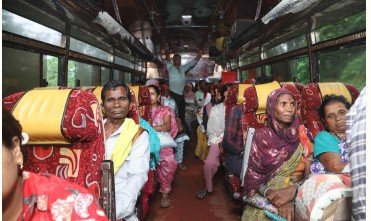
Raipur, Oct 2026: A bus arriving on a village road, its horn echoing in the distance, has become a symbol of new hope for residents of remote areas of Chhattisgarh. Children wave excitedly as the bus approaches, while smiles appear on the faces of villagers. For communities where the arrival of a bus was once considered a major event, regular bus services are now becoming part of everyday life.
The change is not merely about easier transportation. It is helping remote villages connect with schools, hospitals, markets, employment opportunities and administrative centres.
Launched on the initiative of Chief Minister Vishnu Deo Sai, the Chief Minister’s Rural Bus Scheme has achieved a significant milestone in its first year by expanding public transport to remote parts of the state. The first phase of the scheme, launched from Jagdalpur on October 4, 2025, covered the Bastar and Surguja divisions.
At present, 107 buses are operating on 106 selected routes across 13 districts, providing regular passenger bus services for the first time to 850 villages that previously lacked such connectivity.
24 Lakh Kilometres Covered, Rural Travel Made Easier
The 107 buses operating under the scheme have covered nearly 24 lakh kilometres in one year. Together, they travel around 17,500 kilometres every day.
Behind these figures are the changing lives of thousands of rural families who earlier had to walk or depend on private and other alternative modes of transport to reach weekly markets, hospitals, schools, tehsil offices, block headquarters and district headquarters.
With regular bus services now available, students are able to reach schools on time, while villagers can travel more easily to hospitals and markets. Access to block, tehsil and district headquarters for government-related work has also become easier.
Thus, the buses are not only reducing the physical distance between villages and towns but are also improving access to essential services and opportunities.
Change Reaches the Hills of Jashpur
The impact of the Chief Minister’s Rural Bus Scheme is also visible in the remote and hilly areas of Jashpur, the home district of Chief Minister Vishnu Deo Sai. Sixteen buses are currently operating on 16 selected routes in the district.
Several villages that previously faced significant difficulties in accessing transportation are now being connected through regular public bus services.
Sunita Nikunj, an Anganwadi worker from Sanna in Bagicha development block, has experienced the difference in her daily life. Earlier, she often had to seek a lift from someone to reach the Anganwadi centre in a nearby village. At times, she had to depend on private vehicles, and when no vehicle was available, she had to walk. The hilly terrain made the journey even more difficult.
With the start of the rural bus service, her commute has become easier. “This bus has become a very useful means of transport for me,” she said.
Her experience reflects how access to public transport can significantly improve the daily lives of working women in remote areas.
Villagers No Longer Have to Walk Long Distances
Dashrath Bhagat, a resident of Marangi village, is another beneficiary whose daily routine has become easier since the bus service began.
He said buses did not previously operate on the road and residents often had to walk when they needed to travel for essential work. With the new service, travelling to Bagicha has become much easier.
“Now, with the initiative of the Chief Minister, the bus service has started. We can easily travel to Bagicha and return on time,” Bhagat said.
Another passenger, Manglaram, said villagers earlier had to walk to markets such as Chhichhli and Champa. The availability of buses has considerably reduced the difficulties associated with such journeys.
“Now that the bus has started coming, it has become very convenient. We are all very happy,” he said.
These experiences underline that the importance of the scheme goes beyond transportation. It is saving people's time and providing them with a dependable option for meeting their daily needs.
Bus Services Reach Interior Areas of Sukma and Bijapur
A major feature of the scheme is its expansion into some of the state’s most remote and sensitive areas.
Rural buses are also operating in interior parts of Sukma and Bijapur and in villages covered under the Niyad Nellanar initiative.
In Sukma, areas including Golapalli, Bhejji, Kistaram, Minpa, Chintalnar, Burkapal, Chintagufa, Konta, Puvarti and Jagargunda have been brought under the public transport network. In Bijapur, areas such as Awapalli, Basaguda, Sarkeguda, Pamed, Bhairamgarh and Nelasanar are also being connected.
For residents of these areas, the arrival of buses provides a regular means of reaching weekly markets and essential services. In regions that have long had limited transportation facilities, regular buses are becoming an important link between villages and block and district headquarters.
Financial Support to Keep Buses Running on Remote Routes
To make regular bus operations viable on remote routes with relatively low passenger numbers, the state government is providing financial assistance to bus operators.
Under the scheme, assistance is provided at the rate of Rs 26 per kilometre in the first year, Rs 24 per kilometre in the second year and Rs 22 per kilometre in the third year. The support is available for three years. In addition, provision has been made for exemption from monthly motor vehicle tax for up to three years.
The objective is to ensure that bus services on remote rural routes do not become irregular because of low passenger numbers and that residents continue to receive reliable public transport.
Technology Used for Monitoring Bus Operations
The scheme has also been integrated with technology. A dedicated portal has been developed to provide information on live bus tracking, trips, routes and stoppages.
The buses are monitored through the Transport Department’s Control and Command Centre, while financial assistance to bus operators is being processed online on the basis of tracking and operational reports.
For passenger convenience, bus schedules are being made available through the ‘Bus Sangwari’ app. These measures are aimed at making rural transportation not only more extensive but also technology-driven and transparent.
Buses Carry a New Path of Development to Villages
The achievements of the Chief Minister’s Rural Bus Scheme in its first year cannot be measured only through the number of buses or kilometres covered.
Its real impact can be seen in the student who can now reach school on time, the woman who no longer has to wait for a lift to reach her workplace, and the villager who can visit a weekly market or complete an important task and return home on the same day.
The addition of 850 villages to regular bus services for the first time marks an important step towards strengthening rural connectivity. The buses reaching remote areas are reducing not only the geographical distance between villages and towns but also the gap in access to facilities and opportunities.
With the spirit of ‘Seva Mera Yogdan’, the Chief Minister’s Rural Bus Scheme is giving concrete shape to the service commitment by addressing the everyday needs of people in remote villages.
Every bus travelling along a rural road is bringing more than improved transportation. It is carrying easier access to education, healthcare, markets and administrative services — and a renewed hope for a better future — to villages across Chhattisgarh.