Raipur, August 2026 : As the nation celebrates its 80th Independence Day, the occasion is not only a celebration of freedom but also an opportunity to reflect on India’s continuous journey of development, which has given a new direction to the agricultural sector.
Under the leadership of Chief Minister Vishnu Deo Sai, the Chhattisgarh government has, over the past two-and-a-half years, undertaken a comprehensive effort to transform agriculture from a production-oriented activity into a modern, transparent, technology-driven and farmer-centric sector. Under the guidance of Agriculture Development and Farmers’ Welfare Minister Ramvichar Netam and the direction of Agriculture Production Commissioner Siddharth Komal Singh Pardeshi, the Agriculture Department has developed a system focused on providing quality agricultural inputs, continuous monitoring of fertilisers, transparent distribution and stringent quality control. The model is increasingly receiving attention at the national level. The state government remains committed to making Chhattisgarh’s farmers self-reliant and prosperous.
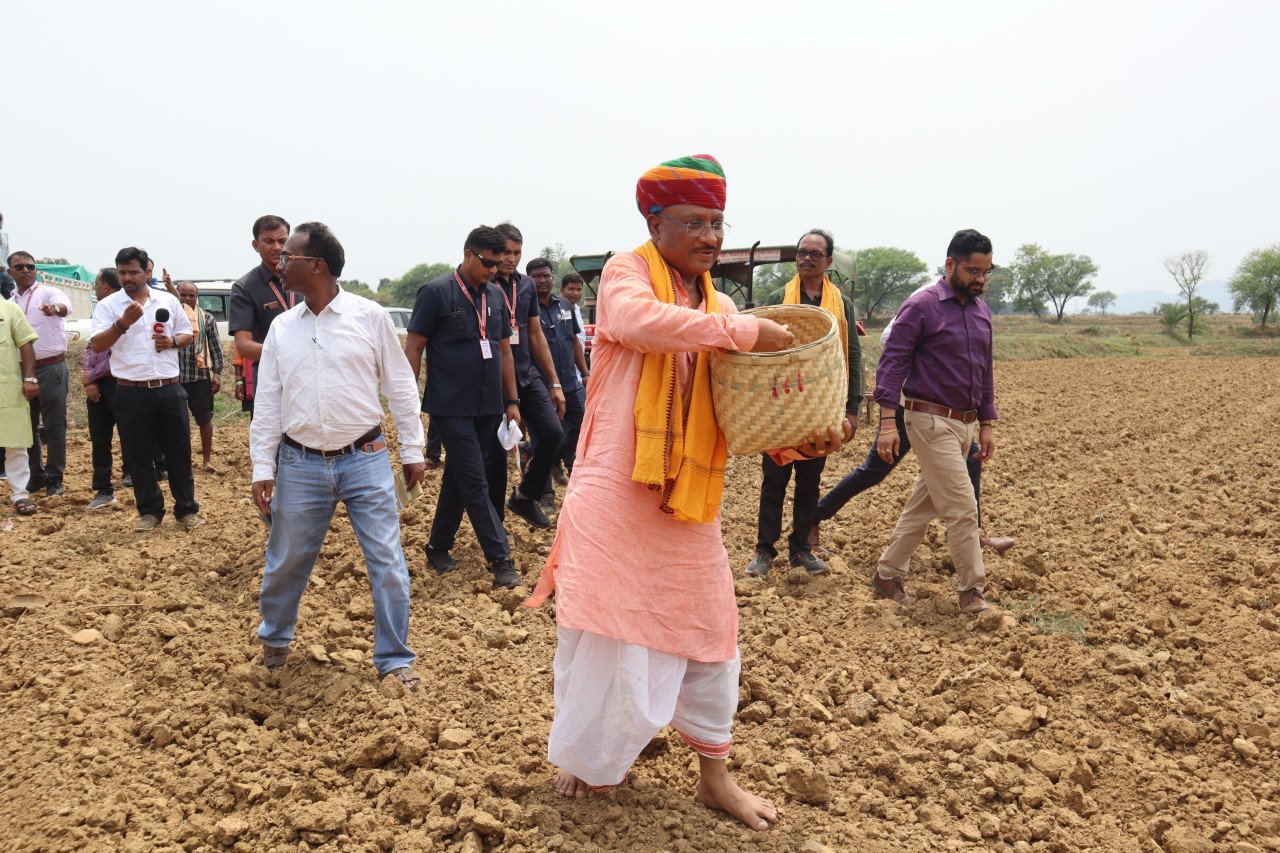
A key priority of the state government has been to ensure that farmers receive certified fertilisers and seeds on time and are protected from black marketing, hoarding and counterfeit agricultural inputs. As a result, during Kharif 2026, sowing had been completed across 45.62 lakh hectares, or nearly 94 per cent of the targeted 48.69 lakh hectares, as of August 11. Farmers have so far received 11.23 lakh metric tonnes of fertilisers and 4.55 lakh quintals of certified seeds.
Against the fertiliser storage target of 15.55 lakh metric tonnes, the state has stocked 15.83 lakh metric tonnes, ensuring that farmers do not face shortages. Chief Minister Vishnu Deo Sai has personally directed officials to ensure easy access to certified fertilisers and seeds according to farmers’ requirements and ordered strict action against negligence. The Agriculture Department is also promoting awareness about liquid nano-fertilisers as an alternative to conventional chemical fertilisers.
One of Chhattisgarh’s most notable achievements in agriculture has been its strengthened fertiliser quality-control mechanism. Under the leadership of Agriculture Production Commissioner Siddharth Komal Singh Pardeshi, the department launched an extensive campaign against counterfeit and substandard fertilisers.
Compared with 2025, enforcement action increased 11.20 times in 2026, rising from 44 cases to 493. Court cases increased from four to 65, seizure actions from two to 107, licence suspensions from three to 106, licence cancellations from two to 15, and sales restrictions from 33 to 189. For the first time, 11 FIRs were registered, reflecting the department’s zero-tolerance policy. These measures have strengthened farmers’ confidence and made the supply chain for agricultural inputs more transparent.
The government’s farmer-focused policies extend beyond fertilisers. Under the Krishak Unnati Yojana, approximately 25.52 lakh farmers received assistance of Rs 35,892.90 crore through Direct Benefit Transfer (DBT) between Kharif 2023 and Kharif 2025. Under the PM-KISAN Samman Nidhi, more than Rs 493 crore was provided to 24.63 lakh farmers as the 23rd instalment. Digital initiatives such as AgriStack and e-KYC have further enhanced transparency and accessibility.
The state is also focusing on agricultural mechanisation, micro-irrigation and natural farming. So far, 7,745 farmers have been provided modern agricultural machinery, while 568 Farm Machinery Banks have been established. Under the Pradhan Mantri Krishi Sinchayee Yojana, drip and sprinkler irrigation has been expanded across nearly 41,967 hectares. More than 57,000 farmers have also been brought into natural farming, promoting environmentally sustainable and low-cost agricultural practices.
Significant progress has also been recorded in horticulture, animal husbandry and fisheries. The area under horticultural crops has expanded to 8.91 lakh hectares. Oil palm and bamboo plantations have increased, while infrastructure such as high-tech nurseries, pack houses and cold-storage facilities is being rapidly developed.
In animal husbandry, milk production, dairy payment systems and mobile veterinary services have expanded. Fish production has increased by nearly 23 per cent to 9.59 lakh tonnes, placing Chhattisgarh among India’s leading fish-producing states.
Agricultural marketing and infrastructure have also received a major boost. As many as 21 markets in the state are now connected to the National Agriculture Market (e-NAM). Under the Agriculture Infrastructure Fund, against a target of Rs 1,900 crore, the state has achieved investments worth Rs 3,026 crore. The entire process of seed production and certification has been digitised. The government seed-testing laboratory in Raipur receiving NABL accreditation further reflects the state’s growing emphasis on scientific agriculture.
As India marks this historic Independence Day, Chhattisgarh’s agricultural transformation demonstrates how planned policies, effective administration, transparent systems and a farmer-centric approach can provide fresh momentum to the rural economy.
With improved availability of quality fertilisers, stringent quality control, expanded digital services, modern agricultural technologies and effective implementation of welfare schemes, Chhattisgarh is steadily building a stronger agricultural foundation.
Under the leadership of Chief Minister Vishnu Deo Sai, the guidance of Agriculture Minister Ramvichar Netam and the administrative leadership of Agriculture Production Commissioner Siddharth Komal Singh Pardeshi, Chhattisgarh is emerging as an example of a self-reliant, modern and prosperous agricultural ecosystem.