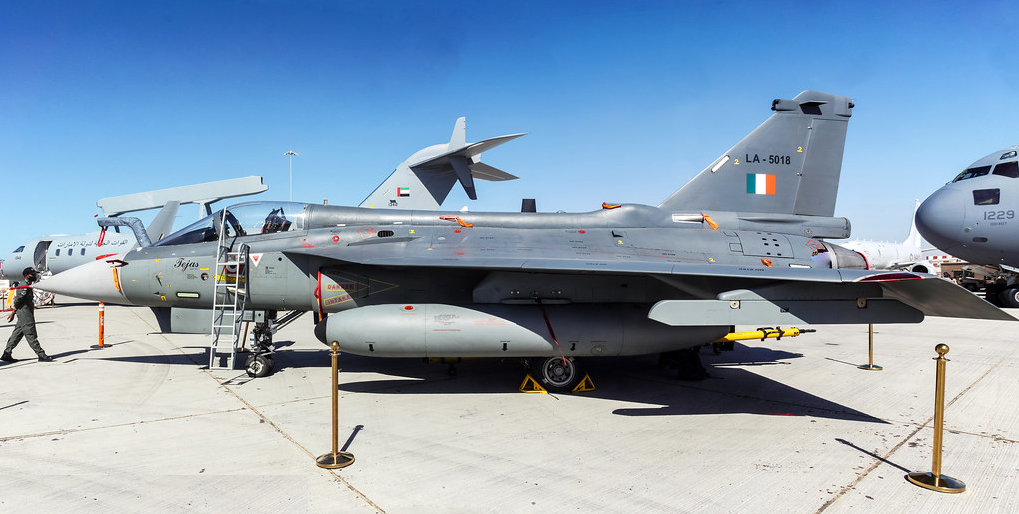
New Delhi, September 2026 : Hindustan Aeronautics Limited (HAL) has completed the original 40-aircraft order for India’s indigenous TEJAS Light Combat Aircraft, even as repeated delays in the supply of engines from US-based GE Aerospace continue to affect production of the upgraded TEJAS MK-1A variant.
HAL is completing the initial TEJAS MK-1 programme with the delivery of the final two twin-seat trainer aircraft. The completion marks an important milestone in India’s indigenous fighter aircraft development programme and comes as the company simultaneously works to accelerate production of the more advanced MK-1A.
The original Indian Air Force contract consisted of 16 Initial Operational Clearance single-seat aircraft, 16 Final Operational Clearance single-seat aircraft and eight twin-seat trainers. With the last two trainers being delivered, HAL has formally completed the 40-aircraft order.
The company’s immediate focus is now on the TEJAS MK-1A, which incorporates several operational and technological improvements over the earlier variant. However, production has been affected by delays in receiving F404-IN20 engines from GE Aerospace, which supplies engines for the aircraft.
The F404 and F414 engine families have played a central role in India’s Light Combat Aircraft programme, but supply bottlenecks have slowed aircraft production, testing and planned deliveries.
According to the information provided, GE has delivered 10 engines so far, while the MK-1A programme remains more than two years behind its original schedule. HAL has already assembled around 30 MK-1A airframes, of which about 20 have completed preliminary flight activity. Several aircraft, however, remain grounded while awaiting engines.
HAL has invoked contractual penalties against GE over delayed deliveries. GE has committed to increasing production to 24 engines during 2026-27 and subsequently to producing 30 engines annually, a move expected to help ease the bottleneck.
The Indian Air Force is seeking to induct its first MK-1A squadron by March 2027, with an initial target of 18-20 aircraft, including trainers. The requirement is particularly important as the IAF currently operates around 29 fighter squadrons, significantly below its authorised strength of about 42-42.5 squadrons. The retirement of MiG-21 aircraft has further increased the pressure on the fighter fleet.
Production Capacity Expands
HAL has also expanded its manufacturing infrastructure. Its new production line at Nashik, inaugurated in October 2025, has raised annual production capacity to 24 aircraft, with plans to increase this to 30 aircraft annually by financial year 2028.
The additional production line also expands the industrial footprint beyond Bengaluru and is intended to provide greater resilience by reducing dependence on a single manufacturing location.
Private industry has become an important part of the MK-1A supply chain. Companies including Larsen & Toubro, Lakshmi Machine Works and Dynamatic Technologies are involved in manufacturing complex components and aero-structures, including wings and fuselage sections.
The distributed manufacturing network includes centre-fuselage work in Hyderabad and wing production in Coimbatore. The broader ecosystem reflects India’s strategy of using private-sector capabilities to increase scale, efficiency and production resilience. The ecosystem has been estimated by analysts to represent a potential Rs 40,000-crore market opportunity.
Advanced Capabilities
The MK-1A introduces several significant upgrades over the original TEJAS MK-1. These include the EL/M-2052 Active Electronically Scanned Array radar, an indigenous electronic warfare suite, beyond-visual-range missile capability, software-defined communications and enhanced maintainability through advanced diagnostic systems.
Two aircraft have already been modified for system and weapons integration trials. These aircraft have successfully undergone trials involving the ASRAAM short-range missile and Astra beyond-visual-range missile.
The IAF has agreed to certain exemptions to facilitate early deliveries, but critical capabilities, including radar-to-electronic warfare integration and missile firing trials, remain essential before full induction.
HAL has stated that five MK-1A aircraft are fully ready for handover, incorporating the contracted capabilities. Another nine aircraft have been built and flown but are awaiting engines.
The company has also secured a follow-on contract for 113 additional engines, signed in November 2025, to support the second batch of 97 aircraft and provide continuity for the programme.
The completion of the original MK-1 order and the planned expansion of MK-1A production mark an important phase in India’s fighter fleet modernisation. Beyond replacing ageing aircraft, the TEJAS programme is helping establish a wider domestic aerospace manufacturing ecosystem.
However, meeting delivery schedules will remain critical for the IAF’s operational preparedness and for India’s broader ambition of developing the TEJAS into a globally competitive and potentially exportable combat aircraft.
Disclaimer: This article is sourced from a news agency and has not been independently edited by the MaverickNews30 team. The copy has been slightly edited with AI assistance for language and presentation, without altering the original facts.