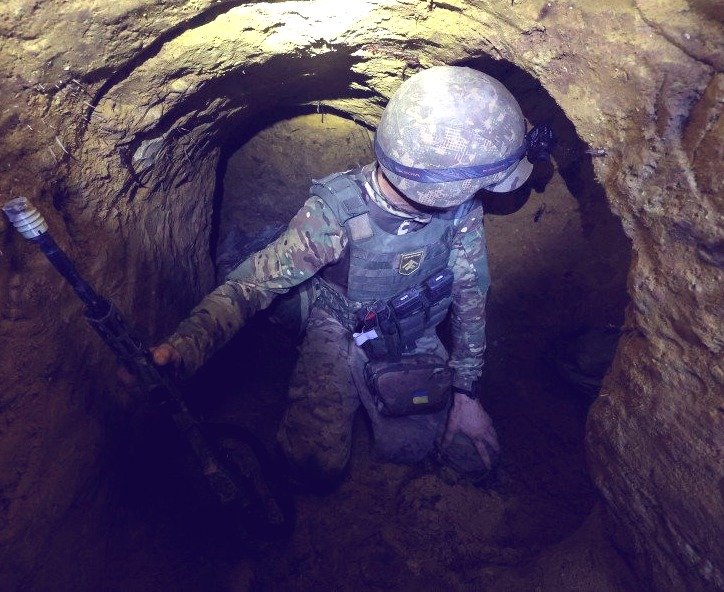
Kyiv; November 2026: Ukraine is developing specialised combat robots designed to operate inside underground gas pipelines and counter Russian troops in confined spaces, following a military operation in which Ukrainian forces advanced more than 15 kilometres through subterranean infrastructure behind Russian lines near Kupiansk.
According to Ukraine’s 2nd National Guard Corps Khartiia, specialists from its Lava Unmanned Systems Regiment are adapting unmanned ground vehicles (UGVs) to navigate narrow pipelines and conduct combat and reconnaissance missions underground. The project have emerged from lessons learned during Operation Veles, when Ukrainian soldiers used underground infrastructure to penetrate Russian rear positions in the Kupiansk sector.
The commander of Lava’s ground robotic systems battalion, known by the callsign Matematyk, said underground warfare requires an entirely different technological approach compared with conventional battlefield operations. “There is a very long list of tasks that need to be accomplished to fight underground and counter the enemy underground. This is a new class of technologies and challenges that we will have to confront”, the commander said.
Unlike conventional ground robots designed to operate across open terrain, the new systems must be compact enough to move through narrow gas pipelines while performing specialised military tasks. Existing civilian underground machinery is primarily designed for large-scale construction, tunnelling, and drilling, making it unsuitable for the confined spaces encountered during military operations inside pipelines.
Khartiia engineers are currently developing several robotic projects intended to address these limitations. The primary objective is to deploy machines in dangerous underground environments where soldiers would otherwise face significant risks during reconnaissance, combat, or operations to clear enemy positions.
“War is already underground, and it will expand. The question is how we adapt to this war”, Matematyk said.
The development follows Operation Veles, during which Ukrainian forces moved more than 15 kilometres through underground communications infrastructure to reach Russian positions from behind. The mission combined underground troop movements with coordinated attacks by Ukrainian units operating on the surface and drone strikes against Russian forces. According to Khartiia, more than 100 Russian soldiers were killed during the operation, while over 30 others were captured.
In 2025, on the Kupiansk front, Russian troops began using old gas pipelines to slip deep behind Ukrainian lines. Built from thick steel and buried mostly underground, these pipes once carried gas between Russia and Ukraine, and they’re extremely hard to destroy. Khartiia Corps was sent in to shut down the infiltration route, and soldiers quickly realised how much these pipes could offer in the age of drone warfare: logistics, evacuation, rotation. What began as a counter-infiltration mission grew into something much bigger. This is Operation Veles, where soldiers now live, move, and fight across kilometres of underground tunnels.
It is mention worthy that Ukrainian forces has carried out three major offensive operations in 2026, retaking hundreds of square kilometres of territory, disrupting Russian attack plans, and launching an extraordinary 15-kilometre underground assault behind enemy lines, President Volodymyr Zelenskyy said on October 27. The operations highlighted by Zelenskyy were the Air Assault Forces offensive on the Oleksandrivka axis, Operation Vivaldi by the 3rd Army Corps, and Operation VELES on the Kupiansk axis.
The largest territorial gains came on the Oleksandrivka axis, where Ukrainian Air Assault Forces and other units have now liberated more than 800 square kilometres of Ukrainian territory. President Volodymyr Zelensky had reiterated that: “This year, Ukraine’s positions on the front remain stronger than they have been in a long time during this war. If our partners’ support for Ukraine remained just as strong, particularly when it comes to Patriots and other air defence capabilities, Ukraine would be in a much better position diplomatically as well. Just now, in October alone, since October 14, there have already been several Russian ballistic missile attacks. Essentially, in two weeks, more than 100 ballistic missiles have been launched against Kyiv and the region. Unfortunately, there are significant restrictions on supplies, with air defence packages being delayed. I want to thank all our partners who provide their support on time”.
Ukraine’s 3rd Army Corps conducted the second major operation, Vivaldi, in the Donetsk region. Ukrainian forces reenforced more than 200 square kilometres in areas where Russian troops had repeatedly attempted to advance.
During Vivaldi, Ukrainian assault troops broke through Russia’s second and third defensive lines, disrupted logistics, and interfered with command and control. Earlier reports also indicated that 05 (five) settlements were liberated and more than 250 Russian troops were captured during the operation.
The third operation, VELES, was carried out on the Kupiansk axis by the 2nd Khartiia Corps of Ukraine’s National Guard together with other Defence Forces units. VELES has also disrupted Russian plans to use gas pipelines to infiltrate behind Ukrainian defensive positions around Kupiansk.
Earlier, the Institute for the Study of War (ISW) calculated that Russia’s offensive in Ukraine has effectively gone into reverse in recent weeks, with Moscow losing more territory than it has captured since the beginning of September while its personnel losses continue to climb. ISW has estimated that since 01st September 2026, Russian forces have lost a net 241 square kilometres of Ukrainian territory, meaning Ukrainian gains have exceeded Russian advances by that amount.
Team Maverick.