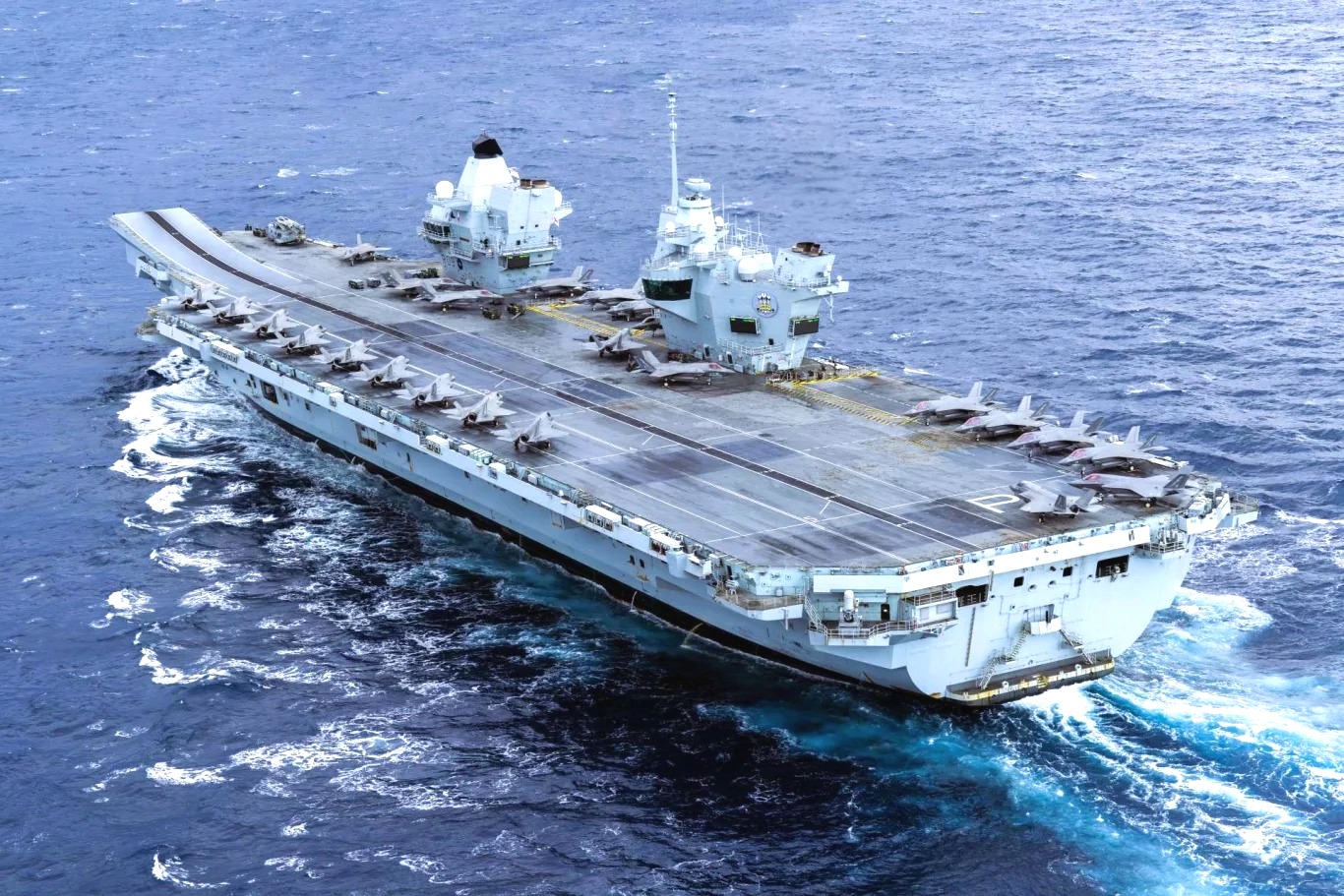
HMS Prince of Wales Carrier Strike Group Arrives in Norway to Reinforce NATO High North Maritime Security.

Stavanger, Norway; May 2026: United Kingdom’s HMS Prince of Wales has arrived in Stavanger, Norway, reinforcing NATO’s maritime posture on the Alliance’s northern flank as competition intensifies across the North Atlantic and Arctic approaches, according to a May 14, 2026 announcement from the carrier’s official X account. The deployment signals Britain’s ability to project sea-based airpower and sustain carrier strike operations in contested northern waters where submarine activity, critical undersea infrastructure, and transatlantic reinforcement routes are increasingly central to NATO deterrence.
Following Exercise Tamber Shield, the British carrier group demonstrated force-protection and littoral warfare capabilities in Norway’s confined fjord environment, operating alongside allied naval assets against fast-moving and asymmetric maritime threats. With F-35B integration, anti-submarine warfare helicopters, and replenishment support for extended operations, HMS Prince of Wales highlights NATO’s growing focus on survivability, interoperability, and sustained maritime control in the High North and North Atlantic.
The official X account of HMS Prince of Wales announced on May 14, 2026, that the UK flagship had arrived in Stavanger, Norway, after Exercise Tamber Shield. The move places one of Europe’s largest aircraft carriers on NATO’s northern flank at a time when the North Atlantic, Norwegian Sea, and High North are again central to allied maritime deterrence. The deployment follows an earlier Army Recognition report highlighting the carrier’s preparation for NATO operations in the High North and North Atlantic, where undersea infrastructure, submarine activity, and transatlantic reinforcement routes remain key security concerns.
HMS Prince of Wales’s arrival in Stavanger is more than a port call after a naval exercise. It confirms the continuation of a British carrier strike deployment designed to test the Royal Navy’s ability to operate in northern waters alongside NATO and Joint Expeditionary Force partners. According to the Royal Navy, the aircraft carrier sailed from Glen Mallan in Scotland after loading ammunition and supplies, accompanied by the Type 45 air defense destroyer HMS Duncan and the fleet tanker RFA Tidespring. This composition gives the UK task group air defense, command, aviation, and replenishment capabilities needed for sustained operations in the North Atlantic and High North.
Exercise Tamber Shield provided a demanding environment for carrier protection in restricted waters, particularly around the fjords near Bergen, where geography, weather, and short engagement distances can complicate naval operations. The Royal Navy stated that the exercise involved intensive drills against fast and manoeuvrable threats, with Wildcat helicopters from 815 Naval Air Squadron, P2000 patrol boats, and Norwegian missile craft contributing to force-protection training. For a 65,000-tonne aircraft carrier, this type of training is essential because modern naval threats increasingly combine drones, fast boats, submarines, coastal sensors, anti-ship missiles, and electronic warfare in complex littoral environments.
The Queen Elizabeth-class carrier displaces around 65,000 tonnes, measures 284 meters in length, can reach speeds above 25 knots, and has a range of about 10,000 nautical miles. Its flight deck can support a mixed air wing of F-35B Lightning II combat aircraft, Merlin helicopters, Wildcat helicopters, and unmanned systems depending on mission requirements. This makes the carrier not only a national flagship but also one of the few European naval platforms able to project airpower from the sea in support of NATO collective defense.
The F-35B factor remains central to the strategic value of HMS Prince of Wales, even when a specific deployment phase focuses mainly on helicopters and allied naval integration. Short takeoff and vertical landing aircraft give the UK and NATO an airpower option that does not depend on fixed runways, an important advantage in the High North, where long distances, severe weather, and limited infrastructure can restrict land-based operations. Merlin helicopters can support anti-submarine warfare and airborne surveillance, while Wildcat helicopters add maritime security, reconnaissance, and force-protection capabilities around the carrier group. Army Recognition also noted the role of Malloy drones in the carrier’s preparation cycle, reflecting the growing importance of unmanned systems for logistics, experimentation, and support tasks at sea.
Norway’s role gives this deployment additional strategic weight. Its coastline, fjords, and access to the Norwegian Sea place the country near maritime routes linking the Arctic, Barents Sea, North Atlantic, and Greenland-Iceland-UK gap. These waters are vital for monitoring submarine movements, protecting undersea cables and offshore energy infrastructure, and securing reinforcement routes between North America and Europe. By operating from and around Norway, HMS Prince of Wales contributes to a wider NATO posture aimed at maintaining sea control, improving allied interoperability, and demonstrating that the Alliance can move major naval forces into one of its most exposed northern regions.
The next phase of the deployment is expected to shift toward the High North and open waters, where NATO’s Dynamic Mongoose 26 anti-submarine warfare exercise is scheduled from May 18 to May 29 in the North Atlantic. This sequence gives the British carrier group a layered operational progression, moving from close-in force protection in Norwegian coastal waters to wider anti-submarine activity in the North Atlantic. For NATO, this is particularly relevant because northern waters remain a key area for detecting and tracking submarines, protecting strategic infrastructure, and ensuring that transatlantic sea lines of communication remain open during a crisis.
HMS Prince of Wales’s arrival in Stavanger confirms that the High North has become one of the main testing grounds for NATO maritime readiness. After Exercise Tamber Shield, the British carrier is demonstrating not only the Royal Navy’s ability to protect a high-value naval asset in demanding northern waters, but also the relevance of carrier strike in European collective defense. For the United Kingdom, the deployment validates its role as a leading maritime contributor to NATO; for the Alliance, it sends a clear message that the North Atlantic, the Norwegian Sea, and the Arctic approaches remain defended strategic corridors where sea control, airpower, anti-submarine warfare, and protection of critical infrastructure are now inseparable.
Team Maverick.








Eight Dead, 34 Missing After Mountain Collapse in Southwest China; Massive Rescue Operation Underway
Beijing, July 2026 : At least eight people have been confirmed dead and 34 others remain m…

Eight Dead, 34 Missing After Mountain Collapse in Southwest China; Massive Rescue Operation Underway
Beijing, July 2026 : At least eight people have been confirmed dead and 34 …