Siddaramaiah Resigns as Karnataka CM, Bringing Curtain Down on Historic Political Chapter

Bengaluru, May 2026 : Karnataka Chief Minister Siddaramaiah on Thursday formally submitted his resignation, ending one of the most influential and politically significant tenures in the state’s recent history. Widely regarded as the Congress party’s tallest mass leader in Karnataka, Siddaramaiah stepped down after serving as the state’s longest-serving Chief Minister, bringing to a close weeks of intense speculation over a possible leadership transition.
The resignation marks a major turning point in Karnataka politics and paves the way for Deputy Chief Minister D.K. Shivakumar to take over the leadership of the Congress government in the state.
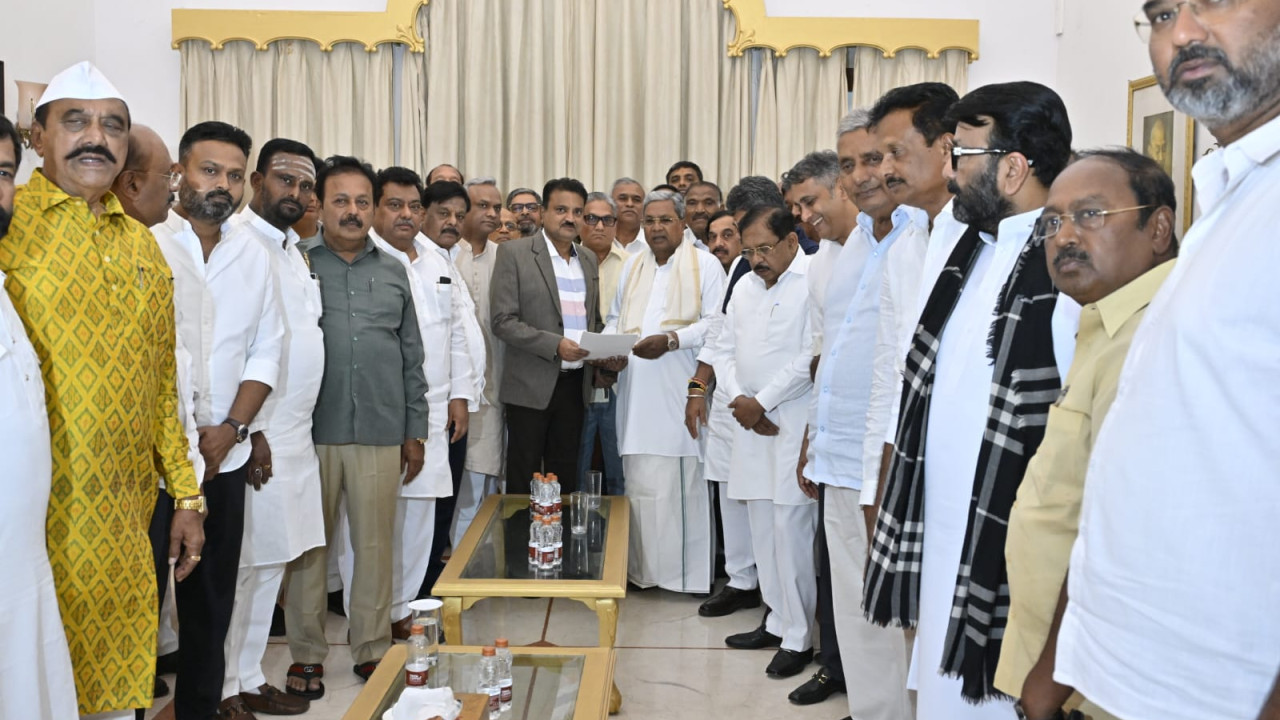
Siddaramaiah submitted his resignation at Lok Bhavan in Bengaluru to the Governor’s Secretary, as Governor Thaawar Chand Gehlot was away from the city. The event took place in the presence of Deputy Chief Minister D.K. Shivakumar, cabinet ministers and several senior Congress leaders.
Addressing a joint press conference alongside Shivakumar and Home Minister G. Parameshwara, Siddaramaiah confirmed his decision and said he had acted in accordance with the instructions of the Congress high command.
“I have submitted my resignation from the Chief Minister’s post to the Governor’s Secretary,” Siddaramaiah said. “The Governor was not in town, and officials informed me that he would return by tonight. Against this background, I have submitted my resignation letter to the Governor’s Secretary.”
He added that he had always maintained that he would step down whenever directed by the party leadership.
“I have always said, both inside and outside the Assembly, that whenever the high command directs me, I will tender my resignation. Two days ago, the high command asked me to step down and, keeping my word, I am submitting my resignation,” he stated.
At 78, Siddaramaiah now joins an elite list of Karnataka leaders who have occupied the Chief Minister’s office multiple times, including S. Nijalingappa, Veerendra Patil, D. Devaraj Urs, Ramakrishna Hegde, H.D. Kumaraswamy and B.S. Yediyurappa.
Born in August 1947 in Siddaramanahundi village of Mysuru district, Siddaramaiah’s rise from a modest rural background to the pinnacle of Karnataka politics has long been viewed as a remarkable political journey. As a child, he reportedly grazed cattle and began formal schooling directly from Class 4. He later earned a law degree before entering public life.
His father, Siddarame Gowda, had unsuccessfully contested Gram Panchayat elections and is said to have advised his son against trusting politics and politicians. Despite that warning, Siddaramaiah entered electoral politics and won a Taluk Board election, beginning a political career that would span nearly five decades.
Over the years, Siddaramaiah contested 12 Assembly elections and emerged victorious nine times. He also created a record by presenting 17 state budgets, underlining his long administrative and political experience.
Former Prime Minister and JD-S patriarch H.D. Deve Gowda is often credited as Siddaramaiah’s political mentor. Under Deve Gowda’s guidance, Siddaramaiah emerged as a prominent backward-class leader and mass mobiliser. However, ideological and political differences eventually led to a split between the two leaders, prompting Siddaramaiah to leave the Janata Dal fold and later join the Congress.
After joining the Congress in 2006 in the presence of Sonia Gandhi, Siddaramaiah steadily consolidated his position within the party. His political stature peaked in 2013 when he became Chief Minister for the first time after leading the Congress to victory in Karnataka.
Siddaramaiah was widely known for championing welfare politics and social justice initiatives. His supporters often described him as the architect of several progressive measures, including internal reservation policies, reservation in government contracts for oppressed communities and expanded representation for backward classes and marginalised groups in governance.
He also emerged as one of the Congress party’s most vocal critics of the BJP, RSS, Prime Minister Narendra Modi and Union Home Minister Amit Shah. At the same time, political opponents frequently accused him of engaging in appeasement politics and identity-based mobilisation.
His political journey saw several highs and lows. He first contested the Assembly election in 1978 from Chamundeshwari on a Lok Dal ticket but lost. In 1983, he won as an Independent candidate from the same constituency. He later served as Transport Minister in the S.R. Bommai government and subsequently became Finance Minister and Deputy Chief Minister in Janata Dal-led governments.
A major political turning point came in 2005 when Siddaramaiah launched the AHINDA movement aimed at consolidating minorities, backward classes and Dalits. The move eventually led to his expulsion from the JD-S but also helped establish him as a powerful independent political force.
In 2018, he won from Badami after losing from Chamundeshwari and later served as chairman of the Congress-JD-S coordination committee before becoming Leader of the Opposition in 2019.
With Siddaramaiah’s resignation, Karnataka politics now enters a new phase. Even as the Congress prepares for a leadership transition, Siddaramaiah’s supporters continue to describe his tenure as one of the most transformative periods in the state’s political history, marked by welfare-driven governance, social justice policies and strong political influence across Karnataka.

Indian Naval Ship Tarkash Concludes Port Call At Port Victoria, Seychelles
INS Tarkash, a stealth frigate of the Indian Navy, departed from Port Victoria, Seychelles…

Indian Naval Ship Tarkash Concludes Port Call At Port Victoria, Seychelles
INS Tarkash, a stealth frigate of the Indian Navy, departed from Port Victoria, Seychelles, …