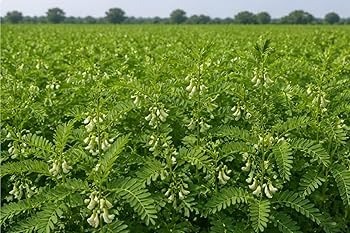
Farmers Encouraged to Use Dhaincha as Green Manure to Reduce Urea Consumption and Improve Soil Fertility

Nitrogen Fixation Enhances Soil Productivity; Agriculture Department Offering 50% Subsidy
Raipur, June 2026 : The Agriculture Department is encouraging farmers to adopt Dhaincha (Sesbania) as a green manure crop to improve soil fertility and reduce dependence on chemical fertilizers, particularly urea. Dhaincha, a leguminous crop, has the unique ability to fix atmospheric nitrogen into the soil, making it an effective and environmentally friendly option for sustainable farming.
Keeping in view the crop rotations commonly practiced in the district, such as paddy-wheat, paddy-chickpea, paddy-vegetable, and soybean-based systems, the department has advised farmers to integrate Dhaincha cultivation into their farming practices as a green manure crop.
According to agricultural experts, Dhaincha should be sown at the onset of the monsoon season using 25 to 30 kilograms of seed per hectare. About 35 to 40 days after sowing, when the plants reach a height of 1 to 1.5 metres and are in the early flowering stage, they should be incorporated into the soil using tractor-operated disc harrows, rotavators, or mouldboard ploughs.
After incorporation, maintaining adequate soil moisture is essential. Within 15 to 20 days, the Dhaincha biomass decomposes and releases nutrients into the soil, making them available for the subsequent crop.
The decomposition of Dhaincha significantly increases the levels of organic carbon, nitrogen, and other essential nutrients in the soil. It also improves soil structure, enhances water-holding capacity, and promotes the activity of beneficial microorganisms. These improvements positively influence the growth and productivity of future crops.
Agricultural scientists estimate that incorporating Dhaincha into the soil can provide approximately 40 to 60 kilograms of nitrogen per hectare. To obtain a similar amount of nitrogen through chemical fertilizers, farmers would typically need to apply 90 to 130 kilograms of urea. As a result, the use of Dhaincha can help save two to three bags of urea per hectare, significantly reducing input costs.
Dhaincha is considered a low-cost, eco-friendly, and soil-enriching alternative to chemical fertilizers. While excessive use of urea over long periods can adversely affect soil health and contribute to environmental pollution, regular use of green manure crops like Dhaincha improves soil quality and supports sustainable agriculture.
To promote the adoption of Dhaincha as green manure, the Agriculture Department is providing a 50 percent subsidy on the total cost of cultivation. Interested farmers can obtain Dhaincha seeds from the Seed Processing Centre and Seed Corporation Office at Kaurinbhatha, Rajnandgaon.
The department has appealed to farmers to adopt balanced nutrient management practices and make greater use of green manures such as Dhaincha. This will help reduce dependence on chemical fertilizers while making agricultural production more profitable, sustainable, and environmentally friendly.
The department further advised farmers to sow Dhaincha immediately after the onset of the monsoon, incorporate it into the soil before flowering at around 35 to 40 days of growth, and sow or transplant the main crop 15 to 20 days later. Following this practice can significantly improve soil fertility and contribute to higher crop yields.
By integrating Dhaincha into existing cropping systems, farmers can ensure the availability of 40–60 kilograms of nitrogen per hectare, save on fertilizer costs, and move toward a more sustainable and productive agricultural future.





Shivakumar Says Congress United, Assures Women Will Get Cabinet Berth
Bengaluru, Aug 2026 : Karnataka Chief Minister D.K. Shivakumar on Monday sought to dismiss…

Shivakumar Says Congress United, Assures Women Will Get Cabinet Berth
Bengaluru, Aug 2026 : Karnataka Chief Minister D.K. Shivakumar on Monday sought to dismiss …