Establishment of High Energy Medical Cyclotron Project in Nagpur

Boost to Cancer Treatment and Research
Approval was granted in today’s State Cabinet meeting for the establishment of a High Energy Medical Cyclotron Project (HEMCP) in Nagpur. The meeting was chaired by Chief Minister Devendra Fadnavis. A provision of Rs 300 crore will be made for the project.
The project will be implemented through Mahacare, and a separate subsidiary company will be established for its management.
The project will provide impetus to cancer diagnosis, treatment and research. Patients from several cities in Central India will benefit from it. Nagpur will develop into a radiopharmaceutical innovation hub, while medical treatment will become more precise. This is the only ambitious project of its kind in Central India and will provide major relief to needy citizens. The system can also be used for diagnosing various diseases and disorders, including cancer.
As the number of cancer patients in the country is increasing, the primary objective of this project is to ensure local availability of radioisotopes required for PET-CT and nuclear medicine services.
Approval has been granted to allot 30 hectares of land at Bhansoli (Kinhi) in Hingna taluka for the project. The estimated project cost is Rs 300 crore, of which Rs 150 crore will be provided through the Medical Education Department. After the final project report, funds for land, construction, machinery, human resources and other requirements will be determined.
Approval has also been granted for a 50:50 cost-sharing arrangement between the Medical Education Department and the Industries Department.
Due to Nagpur’s central geographical location, patients within a radius of approximately 500 kilometres from Maharashtra, Madhya Pradesh, Chhattisgarh, Telangana and Andhra Pradesh will benefit from the project.
Nagpur is an ideal centre for the project because it houses institutions such as All India Institute of Medical Sciences Nagpur, the National Cancer Institute and Government Medical College.
The project will reduce dependence on Mumbai and Hyderabad for advanced cancer services. It will strengthen cancer diagnosis and treatment facilities in Central India, expand PET-CT and nuclear medicine facilities, reduce delays in treatment and transportation costs, and enhance research, training and academic capabilities.
Approval was also granted to establish a Special Purpose Vehicle (SPV) under the Companies Act, 2013, for implementation of the project.
The Commissioner of Medical Education will serve as Chairperson of the SPV, while the Development Commissioner of the Industries Department will serve as Co-Chairperson. The Chief Executive Officer of the SPV will act as Member Secretary.
Other directors will include representatives from Health Services, Food and Drug Administration, Nagpur Municipal Corporation, the Nagpur District Collector, Government Medical College Nagpur, AIIMS Nagpur, National Cancer Institute, Tata Memorial Centre, IIT Bombay, IIM Nagpur, and experts from the field of nuclear science, radiation safety and radiopharmaceutical operations.
Until the SPV is established, the project will be overseen by a steering committee headed by Dr. Shrikar Pardeshi, Principal Secretary to the Chief Minister. Dr. Vipin Itankar, Commissioner of Nagpur Municipal Corporation, will serve as Member Secretary.
Maharashtra Rural Drinking Water Policy 2026 Announced
Comprehensive Framework for Maintenance of Jal Jeevan Mission 2.0
Effective and Permanent Measures for Drinking Water Supply
The State Cabinet approved the Maharashtra Rural Drinking Water Policy 2026, aimed at implementing effective and permanent measures for drinking water supply in rural areas. The meeting was chaired by Chief Minister Devendra Fadnavis.
Under this policy, a comprehensive framework will be prepared for the maintenance and repair of schemes implemented under Jal Jeevan Mission 2.0.
The policy will integrate various rural water supply schemes to ensure citizens receive clean, disinfected and quality drinking water. Existing and new schemes will be reviewed, and long-term planning will be undertaken to ensure sustainable implementation.
The Maharashtra Rural Drinking Water Policy 2026 aligns with the objectives of Viksit Maharashtra 2047 and Viksit Bharat. Through this policy, sustainable, clean and permanent solutions will be provided to rural households by 2047.
Short-term, medium-term and long-term planning will be undertaken. The policy aims to ensure 100 per cent equitable access to safe drinking water for citizens.
The policy also focuses on:
- Achieving water self-sufficiency in villages.
- Reviving water sources and ensuring their sustainability.
- Promoting rainwater harvesting.
- Reusing and recycling wastewater.
- Meeting 100 per cent maintenance and repair costs.
- Preventing water theft.
- Transferring all schemes to Village Health, Nutrition, Water Supply and Sanitation Committees or social organisations.
- Providing water and sanitation facilities to socially disadvantaged and vulnerable sections.
- Strengthening Gram Panchayats for sustainable water and sanitation management.
- Implementing SCADA systems for multi-village water supply schemes.
- Expanding digital platforms for real-time monitoring of water and sanitation assets.
- Introducing GIS and dashboard-based real-time tracking of services and grievances.
Under the policy, maintenance and repair funds, along with a corpus fund, will be created at the Gram Panchayat, Maharashtra Jeevan Pradhikaran and Zilla Parishad levels for both individual and regional water supply schemes.
These funds may be used by Gram Panchayats, local self-government institutions and implementing agencies for capital expenditure and maintenance work.
A three-tier grievance redressal mechanism will be established under the policy, utilising the Nal Jal Service Application and Nal Jal Mitra initiatives.
A central water management system will also be established under the State Water and Sanitation Mission to efficiently manage and monitor water supply schemes operated by rural local bodies.
In addition, a comprehensive computerized command system will be developed.
Maharashtra Autonomous Systems Policy 2026 Announced
Boost for Drone, Robotics and Autonomous Vehicle Industries
Approval was granted in the Cabinet meeting for the formulation of the Maharashtra Autonomous Systems Policy 2026 to facilitate research and development, innovation, manufacturing, deployment, maintenance, repair and overhaul in the field of autonomous systems. The meeting was chaired by Chief Minister Devendra Fadnavis.
The policy is expected to promote industries involved in the manufacturing of drones, robots and autonomous vehicles, along with training, engineering and research and development projects related to these technologies. It will encourage investment in this sector.
The policy is expected to attract investments of approximately Rs 25,000 crore and create more than one lakh direct and indirect employment opportunities.
The policy will remain in force for at least five years or until a new policy is formulated.
Autonomous systems are used in air, land and water domains, as well as in infrastructure and industrial inspection, agriculture and environmental management, public safety and disaster response, logistics and urban management.
Infrastructure and Industrial Inspection
- Safety inspection of bridge pillars.
- Marine mapping and surveys.
- Monitoring of expressways.
- Land surveys.
- Aerial inspection for power transmission infrastructure.
Agriculture and Environmental Management
- Soil sample collection.
- Mechanical weed control.
- Fisheries and water quality monitoring.
- Crop spraying.
- Forest monitoring.
Public Safety and Disaster Response
- Search and inspection in industrial leak zones.
- Monitoring rivers and coastal areas.
- Control of illegal fishing.
- Deep-sea marine operations.
- Drone ambulances.
- Delivery of medical supplies.
- Disaster mapping.
- Firefighting support.
- Crowd management.
Logistics and Urban Management
- Warehouse automation and inventory management.
- Port security and surveillance.
- Medicine delivery.
- Maintenance work in inaccessible locations.
The policy will enable the use of unmanned systems for various air, land and maritime operations.
To support this ecosystem, three dedicated Centres of Excellence will be established in the state. The government will also focus on developing skilled manpower, including training approximately 5,000 remote pilots.
Special emphasis will be given to the effective implementation of the Namo Drone Didi Scheme, under which more than 1,000 women from self-help groups will be trained as certified drone pilots for agricultural applications.
A detailed Government Resolution (GR) will be issued specifying conditions, eligibility criteria, procedures and fund disbursement related to:
- Fixed capital investment incentives.
- Electricity subsidies.
- GST reimbursement.
- Stamp duty exemptions.
- Patent registration reimbursement.
- Other incentives under the policy.
Mahanet Digital Infrastructure Limited to be Established for BharatNet
Approval was granted in the Cabinet meeting to establish Mahanet Digital Infrastructure Limited (MDIL) as a Special Purpose Vehicle (SPV) for the effective implementation of the upgraded BharatNet programme in Maharashtra.
The meeting was chaired by Chief Minister Devendra Fadnavis.
The objective is to create a robust and high-quality broadband backbone across the state through optical fibre connectivity up to the Gram Panchayat level.
BharatNet Phase I was implemented by the Central Government through BBNL and BSNL.
The upgraded BharatNet Phase II is being implemented to provide high-speed broadband connectivity to all Gram Panchayats and rural households across the country.
As per Central Government guidelines, the SPV will have equal representation from the Centre and the State Government.
The existing network created under BharatNet Phases I and II will be transferred to this SPV in its current condition. However, any disputes, litigations or financial liabilities arising prior to the transfer will not be borne by the SPV.
So far, digital connectivity has been established in approximately 853 Gram Panchayats in Maharashtra under BharatNet Phase II, enabling the delivery of e-governance services.
The programme has also expanded:
- Fiber-to-the-Home (FTTH) connections.
- 4G mobile network coverage.
The Administrator of the Digital Bharat Fund will serve as Chairperson of the SPV.
Members will include Additional Chief Secretaries or Principal Secretaries from:
- Rural Development Department.
- Finance Department.
- Information Technology and Artificial Intelligence Department.
- Revenue and Forest Department.
The State Government will appoint a Member Secretary, while the Central Government will nominate four senior officers as members.
The establishment of MDIL is expected to accelerate rural digital infrastructure, improve internet access and strengthen e-governance delivery across Maharashtra.
Effective Implementation of Viksit Bharat–G Ram G Scheme
Approval for Amendments to the Maharashtra Employment Guarantee Act, 1977
The Cabinet meeting approved amendments to the Maharashtra Employment Guarantee Act, 1977, to facilitate the effective implementation of the centrally sponsored Viksit Bharat–G Ram G (VBGRAMG) Scheme in the state. The meeting was chaired by Chief Minister Devendra Fadnavis.
This decision is expected to boost employment generation in rural areas, expand sustainable livelihood opportunities and strengthen the rural economy, thereby reinforcing the vision of Viksit Bharat.
The state will now be able to effectively implement the Central Government’s Viksit Bharat Employment and Livelihood Guarantee Mission (Rural), known as “Viksit Bharat–G Ram G.”
Accordingly, amendments will be made to the Maharashtra Employment Guarantee Act, 1977, in line with Section 30 of the Viksit Bharat Employment and Livelihood Guarantee Mission (Rural) Act, 2025.
The Cabinet also approved making necessary budgetary provisions under Section 3-A(1) of the Maharashtra Employment Guarantee Act, 1977, for implementation of the scheme in the state and for expenditure accordingly.
Approval was also granted to seek the Governor’s assent for the necessary amendments and to promulgate an ordinance in this regard.
Extension of Time for Submission of Caste Validity Certificates by Elected Representatives in Local Bodies
Representatives elected from reserved seats for Scheduled Castes, Scheduled Tribes and Other Backward Classes in local self-government institutions will receive a final extension of six months for submitting caste validity certificates.
The Cabinet meeting approved amendments to the relevant Acts in this regard. The meeting was chaired by Chief Minister Devendra Fadnavis.
Due to inadequate manpower in caste scrutiny committees and the deployment of government and aided school teachers for census work, delays are occurring in completing school and home inquiries required for caste verification.
As a result, candidates elected from reserved seats have faced difficulties in obtaining caste validity certificates within the prescribed time.
Considering this situation, candidates elected in local body elections held during 2025–26 will be granted an additional final extension of six months.
For this purpose, necessary amendments will be made to the relevant provisions of:
- The Mumbai Municipal Corporation Act,
- The Maharashtra Municipal Corporation Act, and
- The Maharashtra Municipal Councils, Nagar Panchayats and Industrial Townships Act.
The Cabinet also approved promulgation of an ordinance with the Governor’s approval.
Division of General Administration Department
Information & Public Relations and Protocol to Become Separate Departments
The Cabinet approved the creation of two new independent departments—Information and Public Relations and Protocol—by bifurcating the General Administration Department (GAD). The meeting was chaired by Chief Minister Devendra Fadnavis.
This decision was taken while confirming the minutes of the previous Cabinet meeting.
With this move, following the reorganisation and merger of administrative departments, the number of independent departments in the state will increase from 45 to 46.
Currently, the Directorate General of Information and Public Relations functions under the General Administration Department.
This Directorate is responsible for government publicity, media relations and public outreach. It operates:
- Seven divisional offices,
- A Director’s office in Nagpur,
- Maharashtra Information Centres in New Delhi and Panaji (Goa), and
- District Information Offices across all districts of Maharashtra.
Through these offices, awareness and publicity activities are conducted regarding government schemes, development works and public welfare initiatives.
The Directorate also serves as an important communication channel between the government, media and citizens during emergencies, festivals and urgent situations.
The creation of a separate department is expected to accelerate decision-making and improve administrative efficiency.
Earlier, the Cabinet had approved a proposal for restructuring departments in Mantralaya to improve coordination and streamline administration.
Under the revised decision, the following departments will be created through division and reorganisation:
New Departments Created
- Agriculture and Horticulture Department split into:
- Agriculture Department
- Horticulture Department
- Cooperation, Marketing and Textiles Department split into:
- Cooperation Department
- Marketing Department
- Textiles Department
- General Administration Department split into:
- Protocol Department
- Information and Public Relations Department
- Home Department to have a separate:
- Transport Department
- Industries, Energy, Labour and Mining Department split into:
- Industries and Mining Department
- Energy Department
- Labour Department
- Revenue and Forest Department split into:
- Revenue Department
- Relief and Rehabilitation Department
- Forest Department
- School Education and Sports Department split into:
- School Education Department
- Sports Department
- Tourism and Cultural Affairs Department split into:
- Tourism Department
- Cultural Affairs Department
- Medical Education and Drugs Department split to create:
- Food and Drug Administration Department
Additionally, the Employment Guarantee Scheme Department will be removed from the Planning Department and merged with the Soil and Water Conservation Department.
The reorganisation is expected to bring greater efficiency, improve coordination and accelerate the government’s decision-making processes.

Sri Lanka Deploys Troops to Quell Deadly Riot at Overcrowded Prison
Colombo, Aug 2026 : Sri Lanka deployed hundreds of military personnel and elite commandos …
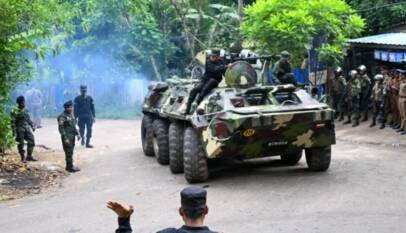
Sri Lanka Deploys Troops to Quell Deadly Riot at Overcrowded Prison
Colombo, Aug 2026 : Sri Lanka deployed hundreds of military personnel and elite commandos …