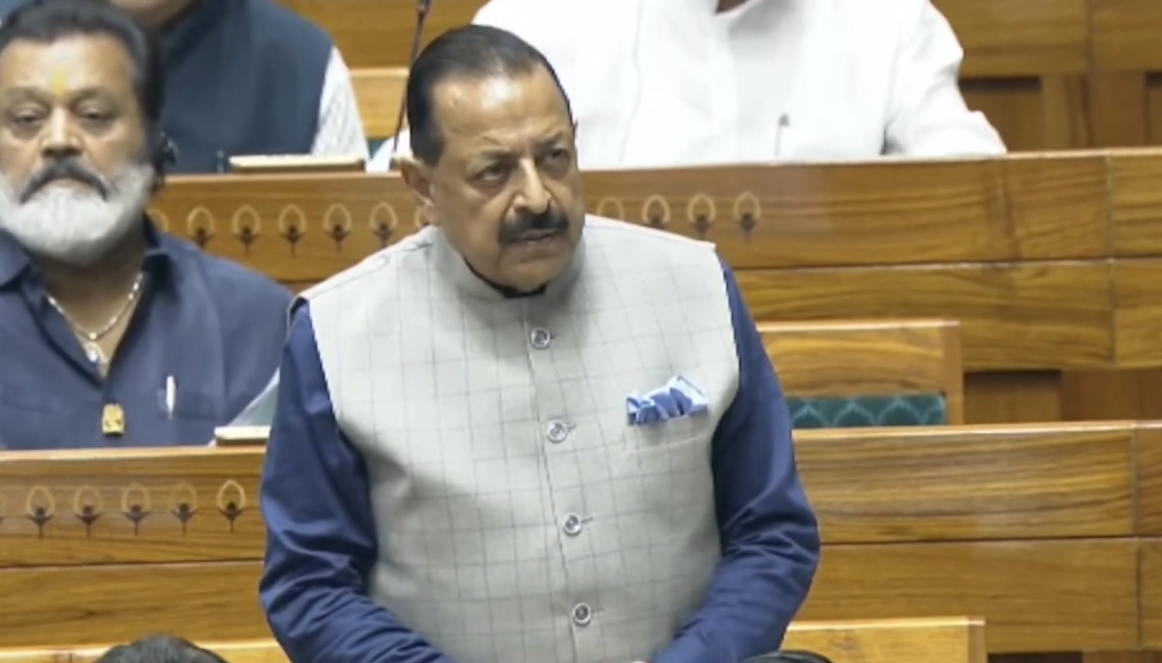
Dr. Jitendra Singh Introduces the Public Examinations (Prevention of Unfair Means) Amendment Bill, 2026 in Lok Sabha

Public Examinations Amendment Bill Seeks Fast-Tracked Investigation, Special Fast Track Courts and Stricter Penal Provisions
Seeks Faster Justice and Stronger Deterrence Against Examination Malpractices
Union Minister of State (Independent Charge) for Science & Technology; Earth Sciences and Minister of State in the Prime Minister’s Office, Personnel, Public Grievances and Pensions, Atomic Energy and Space, Dr. Jitendra Singh, today introduced the Public Examinations (Prevention of Unfair Means) Amendment Bill, 2026 in the Lok Sabha.
The Amendment Bill seeks to further strengthen the provisions of the Public Examinations (Prevention of Unfair Means) Act, 2024 by providing for fast-tracked investigation, speedy trial through Special Fast Track Courts, appointment of Special Public Prosecutors, time-bound disposal of appeals and more stringent penal provisions to effectively deter unfair means and organised malpractices in public examinations.
The proposed amendments have been brought in to reinforce the existing legal framework in view of incidents of question paper leakages and organised examination-related malpractices reported in recent years. They are aimed at ensuring greater accountability, strengthening deterrence against such offences and safeguarding the integrity of public examinations.
The Bill proposes to enhance the punishment for persons resorting to unfair means by increasing the term of imprisonment to not less than five years, extendable up to ten years, as against the existing provision of imprisonment for a term of not less than three years, extendable up to five years. The maximum fine is also proposed to be enhanced from ₹10 lakh to ₹50 lakh.
For service providers found involved in offences under the Act, the Bill proposes to increase the maximum fine from ₹1 crore to ₹5 crore and extend the period of debarment from conducting any public examination from four years to eight years.
The Bill also proposes enhanced punishment for managerial personnel of service providers by providing for imprisonment for a term of not less than five years, extendable up to ten years, along with enhancement of the maximum fine from ₹1 crore to ₹5 crore.
To deal more effectively with organised examination-related crimes, the Amendment Bill proposes to increase the minimum term of imprisonment from five years to seven years, extendable up to ten years, while enhancing the maximum fine from ₹1 crore to ₹10 crore.
The Bill further empowers the Central Government to refer the investigation of offences under the Act to a Special Task Force constituted for this purpose.
To ensure expeditious investigation and trial, the Bill proposes insertion of a new Section 12A providing for completion of investigation within two months, designation of Courts of Session as Special Fast Track Courts for day-to-day trial of offences under the Act, completion of trial within three months from the date of filing of the charge sheet, and appointment of Special Public Prosecutors for every Special Fast Track Court.
The Bill also proposes insertion of a new Section 12B providing that appeals against any judgment, order or sentence of a Special Fast Track Court may be preferred before the High Court within a period of thirty days and, as far as possible, shall be disposed of within a period of three months.
The Public Examinations (Prevention of Unfair Means) Act, 2024, enacted on 12 February 2024 and brought into force with effect from 21 June 2024, provides a comprehensive national legal framework to prevent unfair means in public examinations. The Act applies to examinations conducted by the Union Public Service Commission (UPSC), Staff Selection Commission (SSC), Railway Recruitment Boards (RRBs), Institute of Banking Personnel Selection (IBPS), National Testing Agency (NTA), Ministries and Departments of the Central Government and their attached and subordinate offices for recruitment, as well as such other authorities as may be notified by the Central Government. All offences under the Act are cognizable, non-bailable and non-compoundable, with stringent provisions relating to imprisonment, fine and attachment of property.
The proposed amendments are expected to further strengthen the legal framework for preventing examination-related malpractices, including question paper leakages, impersonation and organised cheating, while ensuring swift investigation, speedy trial and timely disposal of appeals. By strengthening deterrence against such offences and ensuring prompt delivery of justice, the Amendment Bill seeks to uphold the integrity, fairness and transparency of public examinations, protect the interests of deserving and meritorious candidates, and reinforce public confidence in the integrity, fairness and transparency of the country’s public examination system.

Telangana to Launch Digital Family Register, Family Register Certificates to Be Available Through MeeSeva
Hyderabad, July 2026 : The Telangana government has decided to establish a statewide Telan…
Telangana to Launch Digital Family Register, Family Register Certificates to Be Available Through MeeSeva
Hyderabad, July 2026 : The Telangana government has decided to establish a statewide Telangana …