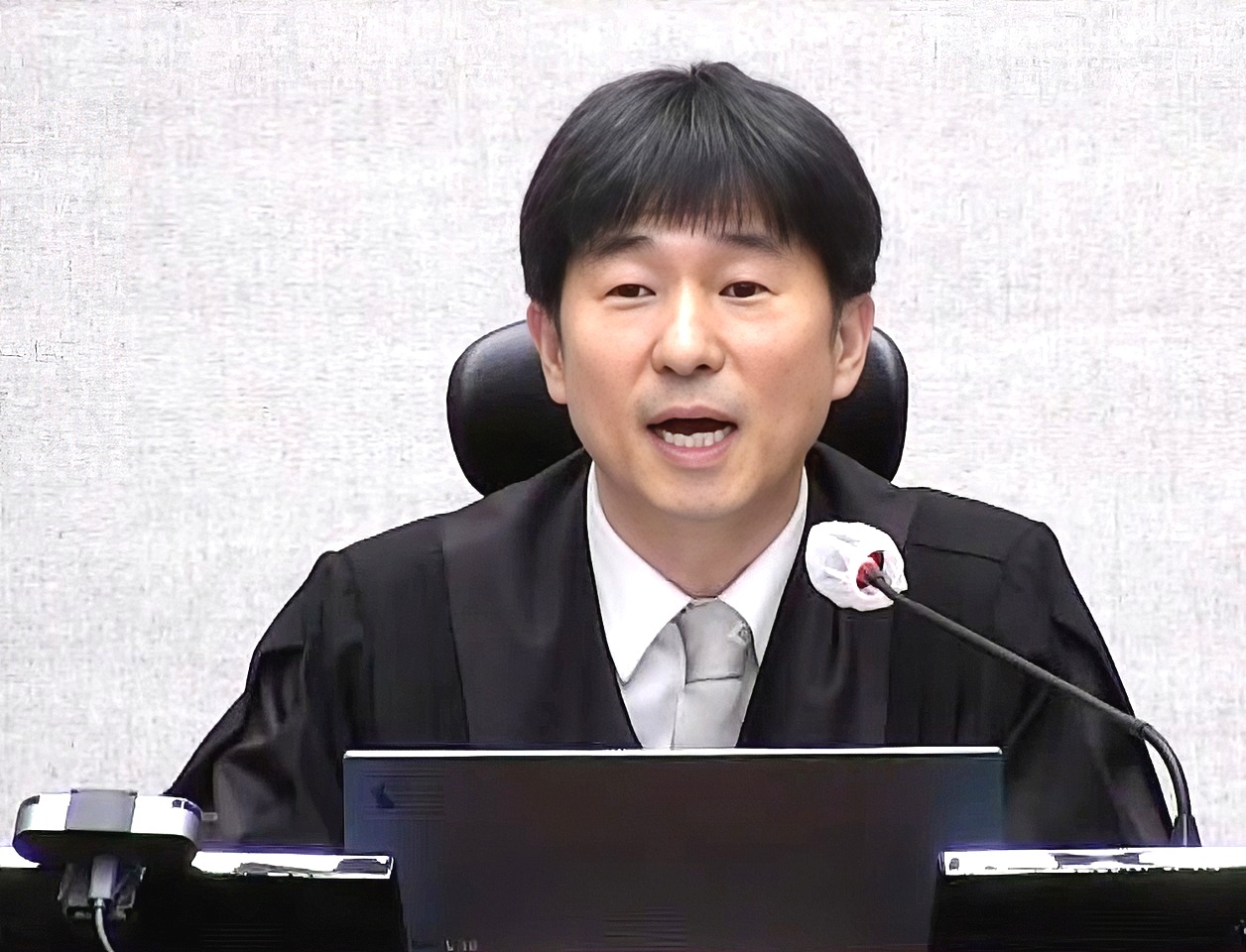
Former South Korean President Sentenced To Life Imprisonment.

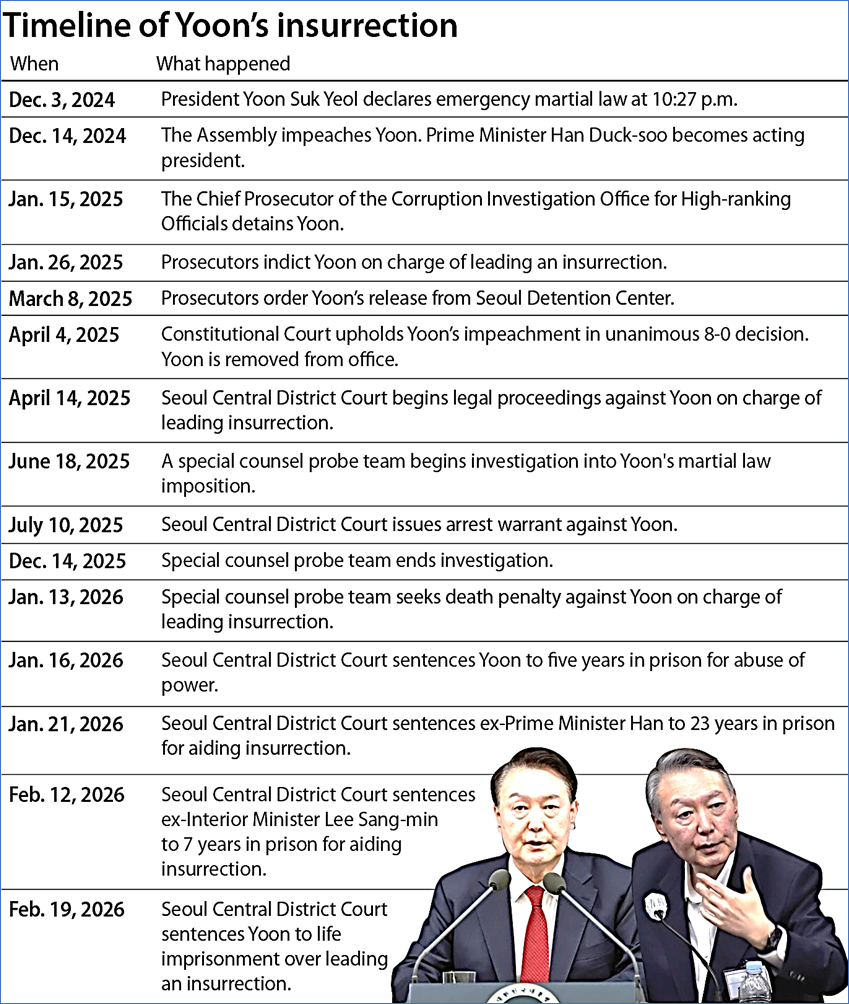
Seoul; February 2026: Former President Yoon Suk Yeol was found guilty of leading an insurrection as an incumbent president, the first such ruling in Korean history, and sentenced to life in prison on Thursday. The sentence came 443 days after Yoon declared martial law on December 03rd 2024, an act that the court recognised as an insurrection, however unsuccessful it may have been.
In a lengthy ruling read by Judge Ji Gwi-yeon, which cited the Bible and medieval European history, the court determined that actions such as blocking the entrance to the National Assembly constituted the crime of insurrection.
“A president can commit the crime of insurrection with the purpose of subverting the Constitution”, said Judge Ji, “Paralysing constitutional institutions amounts to the subversion of the Constitution. The most telling example is a president mobilising the military to occupy the legislature”. While reading the verdict, the judge twice emphasised that the essence of the case “lies in the fact that troops were sent to the National Assembly”.
For Yoon’s crimes, the Seoul Central District Court’s Criminal Division 25, presided over by Ji sentenced him to life imprisonment. The sentence matches the final life term handed down to former President Chun Doo Hwan, who was convicted of insurrection and insurrection-motivated murder in leading a military coup on December 12th 1979, and brutally suppressing pro-democracy protests in the southwestern city of Gwangju that began on May 18th 1980. The sentence is lower than the death penalty sought by the special counsel team, the maximum statutory penalty for insurrection.
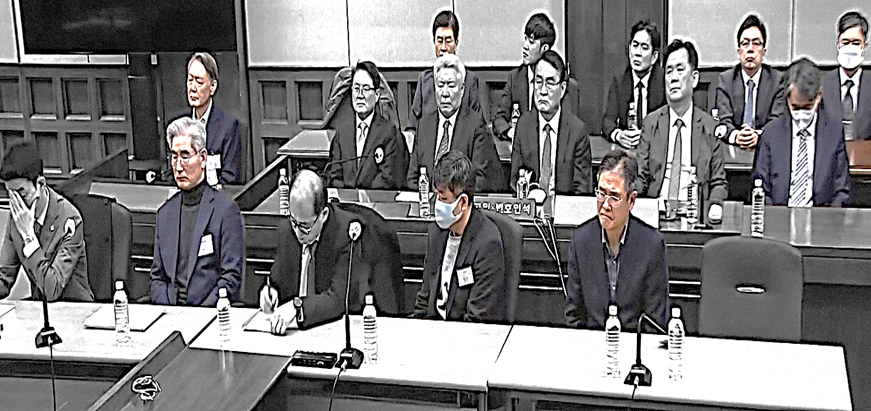
“While the Criminal Act generally prescribes severe punishment only when crimes such as murder result in actual harm, insurrection is uniquely punishable by a severe sentence for the act of creating danger itself”, said the court. “This is because the law reflects the extremely high level of risk inherent in the crime”.
“An act of insurrection disregards lawful procedures and uses violent means to prevent the National Assembly from exercising its authority, thereby damaging the core values of democracy, making it highly blameworthy”, continued the ruling. “What is most regrettable is that military and police activities undermined political neutrality, lowered international credibility and aggravated political polarisation into an extreme state of division of society, causing immeasurable social costs”.
The court first recognised that the Corruption Investigation Office for High-ranking Officials (CIO) had the authority to investigate insurrection, a prerequisite for establishing the insurrection charge. Yoon’s legal team argued that it was illegal for the CIO to investigate a sitting president, and that the evidence was therefore illegitimate.
“Under the exception clause in the CIO Act, the direct relevance between abuse of authority and insurrection is acknowledged, and from a normative perspective, the significance of efficient investigation cannot be denied”, said the court. It also ruled that the presidential immunity from prosecution during tenure, as argued by Yoon’s attorneys, does not extend to investigation, and it rejected claims that evidence had been illegally obtained.
The court found that the declaration of emergency martial law satisfied the elements of insurrection: creating violence for the purpose of subverting the Constitution.
“There is sufficient reason to conclude that sending troops to the National Assembly was intended to obstruct and paralyze its activities, rendering it unable to properly perform its functions for a considerable amount of time”, said the court.
The court concluded that the intent of obstructing and paralyzing National Assembly activities is “in itself clear” based on Yoon’s use of vocabulary such as “anti-state forces of the National Assembly” and “eradication” in the martial law proclamation, as well as the explicit ban on National Assembly activities in Martial Law Decree No. 1.
In the ruling, the court defined violence as “the broadest form of violence or agitation”.
“Blocking the entrance to the National Assembly and occupying the National Election Commission constitute acts of violence in themselves, a force sufficient to disturb the peace across the country, including in Seoul and the metropolitan area where the National Assembly and the National Election Commission are located”, said the court. “Most actions, including troops being deployed to the National Assembly by helicopter or by climbing over walls, fall within the scope of such violence”.
“Even for parts in which the defendant Yoon did not individually participate, he bears full responsibility for the crime of insurrection”, added the court.
During his final statement last month, Yoon had argued that his declaration was a “warning” and more of an “appeal” to the people, which the court rejected.
“Yoon did not set a plan for when to withdraw the troops”, said the court. “As the withdrawal of troops and the resumption of National Assembly operations depended on Yoon’s decision, it is sufficient to conclude that a prolonged paralysis of the Assembly was anticipated”.
The court also found Yoon guilty of approving a so-called “politician arrest squad” to detain 14 prominent figures including then opposition leader Lee Jae Myung, National Assembly Speaker Woo Won-shik and Han Dong-hoon, as ordered by former Defense Minister Kim Yong-hyun with Yoon’s approval. The court found that they constituted co-perpetrators of insurrection as a collective offense. Deploying military and police forces to occupy the National Election Commission under Kim was likewise recognised by the court as an act of insurrection.
The court also rejected the claim by Yoon’s attorneys that martial law is a highly political act by the president and therefore not subject to judicial review. “If the declaration of emergency martial law is exercised for the purpose of paralysing constitutional institutions, a power that cannot be exercised even under martial law, then even if it is a constitutional authority, the crime of insurrection with the purpose of subverting the Constitution may be established”, said the court.
Another claim frequently made by Yoon, that the whole reason he declared martial law was because of the opposition party was also shot down with a biblical metaphor. “This argument seems to confuse motive or justification with the purpose”, said the court. “A desire to correct a national crisis is merely a motive or reason. One cannot steal a candle simply because one is reading the Bible“.
However, the court took into account that Yoon did not devise “an extremely elaborate plan”, that there were circumstances indicating restraint in the use of physical force and that it was difficult to find clear cases of direct violence. “Most acts related to the emergency martial law ultimately failed, the defendant had no prior criminal record and he served as a public official for a long period”, the court said, adding that Yoon is 65 years old, which is “relatively old in age”.
Team Maverick.



Young Changemaker Jia Chandra Inspires Community with Message of Neurodiversity and Inclusion
Secunderabad, June 2026 : An evening of inspiration, empathy and awareness unfolded at Oms…

Young Changemaker Jia Chandra Inspires Community with Message of Neurodiversity and Inclusion
Secunderabad, June 2026 : An evening of inspiration, empathy and awareness unfolded at Omsree …